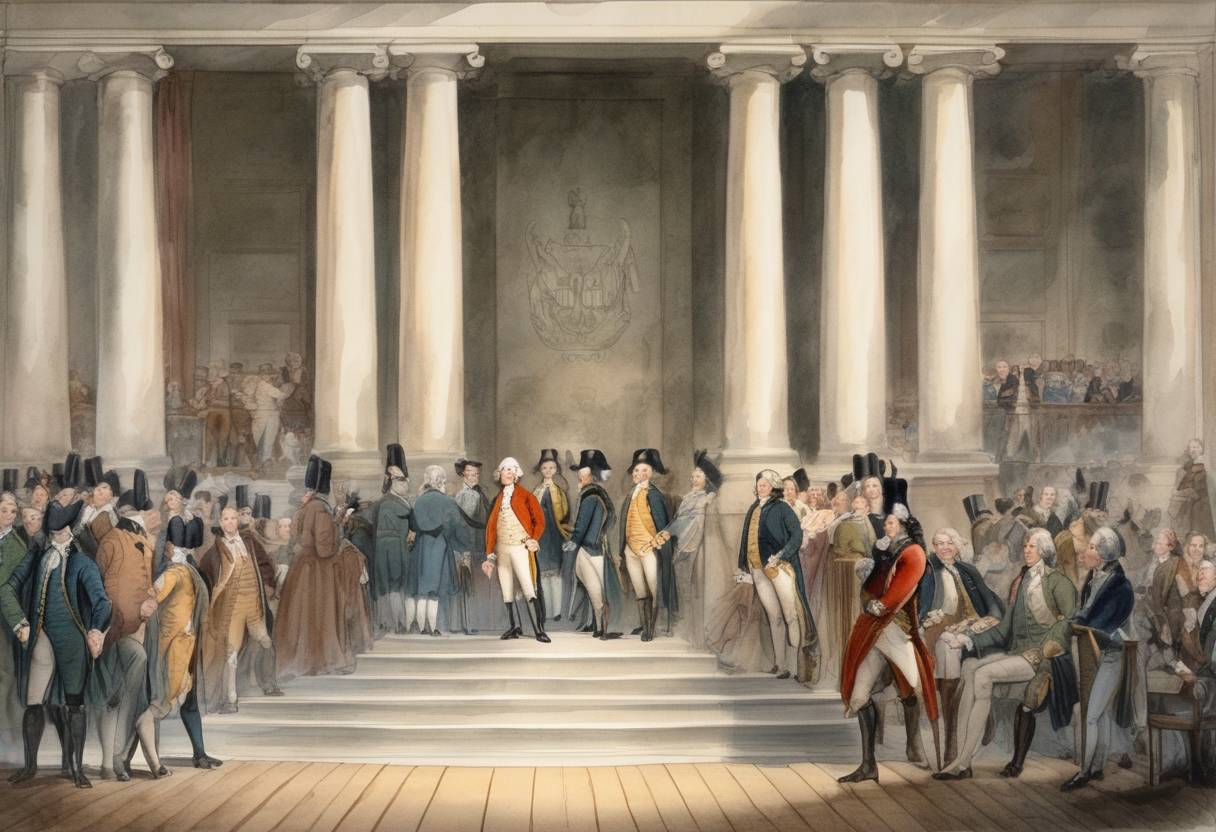
George Washington’s Inauguration: April 30, 1789
On April 30, 1789, George Washington was inaugurated as the first President of the United States, marking a pivotal moment in American history. This event took place on the balcony of Federal Hall in New York City, which was then the temporary capital of the United States.
Context Leading Up to the Inauguration
Constitutional Convention: The inauguration followed the ratification of the United States Constitution, which was drafted during the Constitutional Convention of 1787. This new framework of government replaced the Articles of Confederation, aiming to create a stronger federal government.
Election of 1788-1789: Washington was unanimously elected by the Electoral College, a testament to his leadership during the American Revolutionary War and his role in the Constitutional Convention. His election was seen as a unifying choice for the fledgling nation.
The Inauguration Ceremony
Location: Federal Hall, located on Wall Street in New York City, served as the first capitol building of the United States. The site was chosen for its central location among the original thirteen states.
The Oath of Office: Washington took the presidential oath of office administered by Robert R. Livingston, the Chancellor of New York. The oath was taken on a Bible borrowed from the nearby St. John’s Masonic Lodge, as no official Bible was available.
Washington’s Attire: He wore a dark brown suit made of American cloth, symbolizing his support for domestic manufacturing, and white silk stockings, along with a sword, reflecting his status as a military leader.
Washington’s Inaugural Address
Themes: In his inaugural address, Washington emphasized the importance of the Constitution, the need for unity, and the responsibilities of the new government. He expressed humility and a sense of duty, acknowledging the challenges ahead.
Delivery: The address was delivered to a joint session of Congress in the Senate Chamber of Federal Hall. Washington’s speech set a precedent for future inaugurations, highlighting the peaceful transfer of power and the role of the presidency.
Aftermath and Historical Significance
Setting Precedents: Washington’s presidency established many protocols and traditions still followed today, including the formation of a Cabinet and the two-term limit, which later became law with the 22nd Amendment.
National Unity: His leadership helped solidify the new government and foster a sense of national identity. Washington’s presidency laid the foundation for the United States’ future growth and stability.
Legacy: As the first President, Washington’s actions and decisions were closely watched and often set lasting precedents. His commitment to republican ideals and his voluntary relinquishment of power after two terms reinforced the principles of democracy.
George Washington’s inauguration as the first President of the United States was not just a ceremonial event but a foundational moment that shaped the trajectory of the nation. His leadership and vision were instrumental in guiding the United States through its formative years.