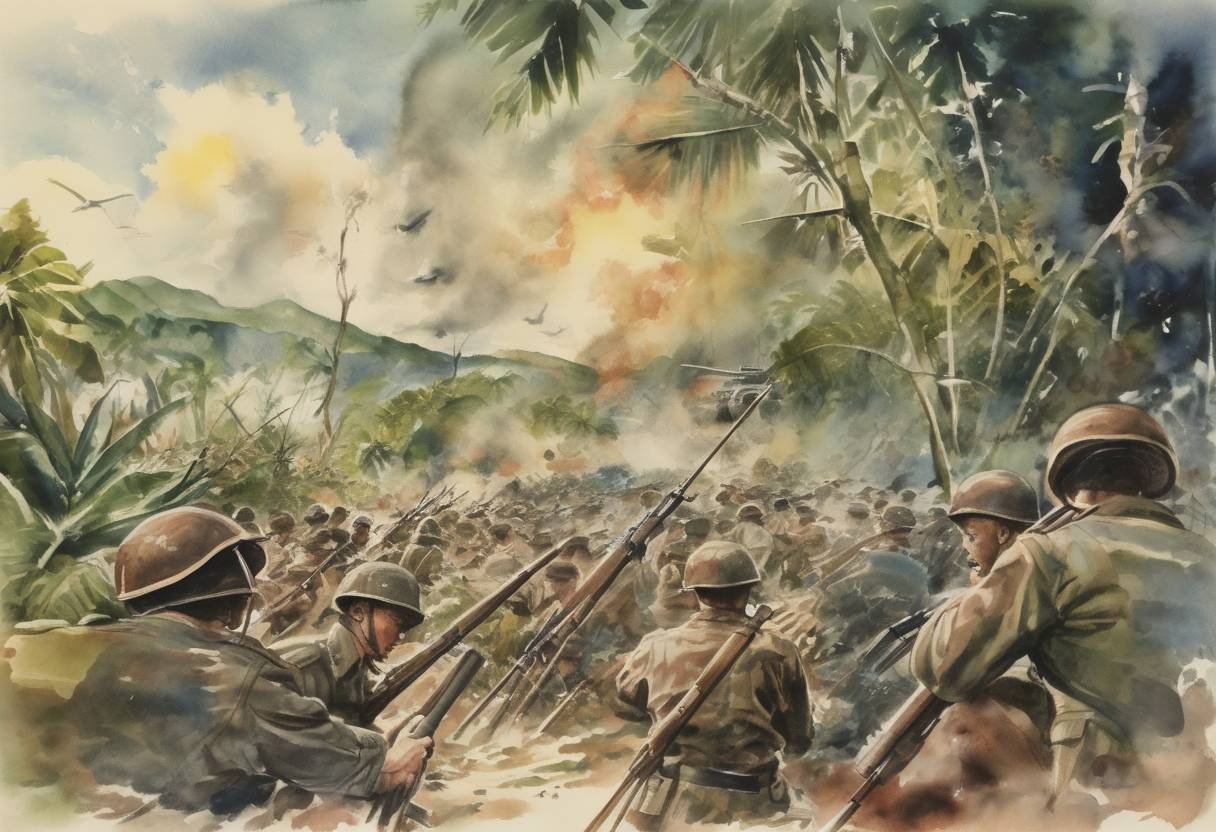
The Battle of Saipan: A Decisive Victory for the United States
Overview
The Battle of Saipan, which concluded on July 9, 1944, marked a pivotal victory for the United States in the Pacific Theater of World War II. This battle was part of the larger Mariana and Palau Islands campaign, aimed at securing strategic positions for the Allied forces.
Context and Prelude
- Strategic Importance: Saipan, part of the Mariana Islands, was crucial due to its location. Capturing Saipan would allow the United States to establish airfields within striking distance of the Japanese home islands, facilitating future bombing campaigns.
- Operation Forager: The assault on Saipan was part of Operation Forager, a larger plan to capture the Mariana Islands. The operation was designed to cut off Japan from its southern resources and establish bases for further operations in the Pacific.
Key Events
- Invasion Begins: The battle commenced on June 15, 1944, with a massive amphibious assault. Over 71,000 U.S. Marines and Army troops landed on the island, facing fierce resistance from approximately 31,000 Japanese defenders.
- Tough Terrain and Resistance: The U.S. forces encountered difficult terrain and well-fortified Japanese positions. The Japanese defenders, commanded by Lieutenant General Yoshitsugu Saito, employed a strategy of entrenched defense and counterattacks.
- Naval and Air Support: The U.S. Navy provided crucial support with bombardments from battleships and aircraft carriers, which helped suppress Japanese defenses and supply lines.
Conclusion and Aftermath
- End of the Battle: By July 9, 1944, after nearly a month of intense fighting, U.S. forces declared Saipan secure. The battle resulted in heavy casualties on both sides, with over 3,400 U.S. troops killed and more than 10,000 wounded. Japanese casualties were significantly higher, with nearly the entire garrison killed, including many civilians.
- Strategic Consequences: The capture of Saipan had significant strategic implications. It provided the U.S. with a base for launching B-29 Superfortress bombers, which would later conduct devastating raids on the Japanese mainland, including the atomic bombings of Hiroshima and Nagasaki.
- Psychological Impact: The loss of Saipan was a severe blow to Japanese morale and military strategy. It led to political repercussions in Japan, including the resignation of Prime Minister Hideki Tojo.
Historical Significance
The Battle of Saipan was a turning point in the Pacific War, demonstrating the effectiveness of American amphibious warfare and air power. It set the stage for further Allied advances in the Pacific and contributed significantly to the eventual defeat of Japan in World War II.