The End of the Siege of Paris: A Decisive Victory for Prussia
1871 · Paris, France
The Siege of Paris ends, marking a decisive victory for Prussia in the Franco-Prussian War.
July 19, 1870
France declared war on Prussia, initiating the Franco-Prussian War.
Paris, France | French Government
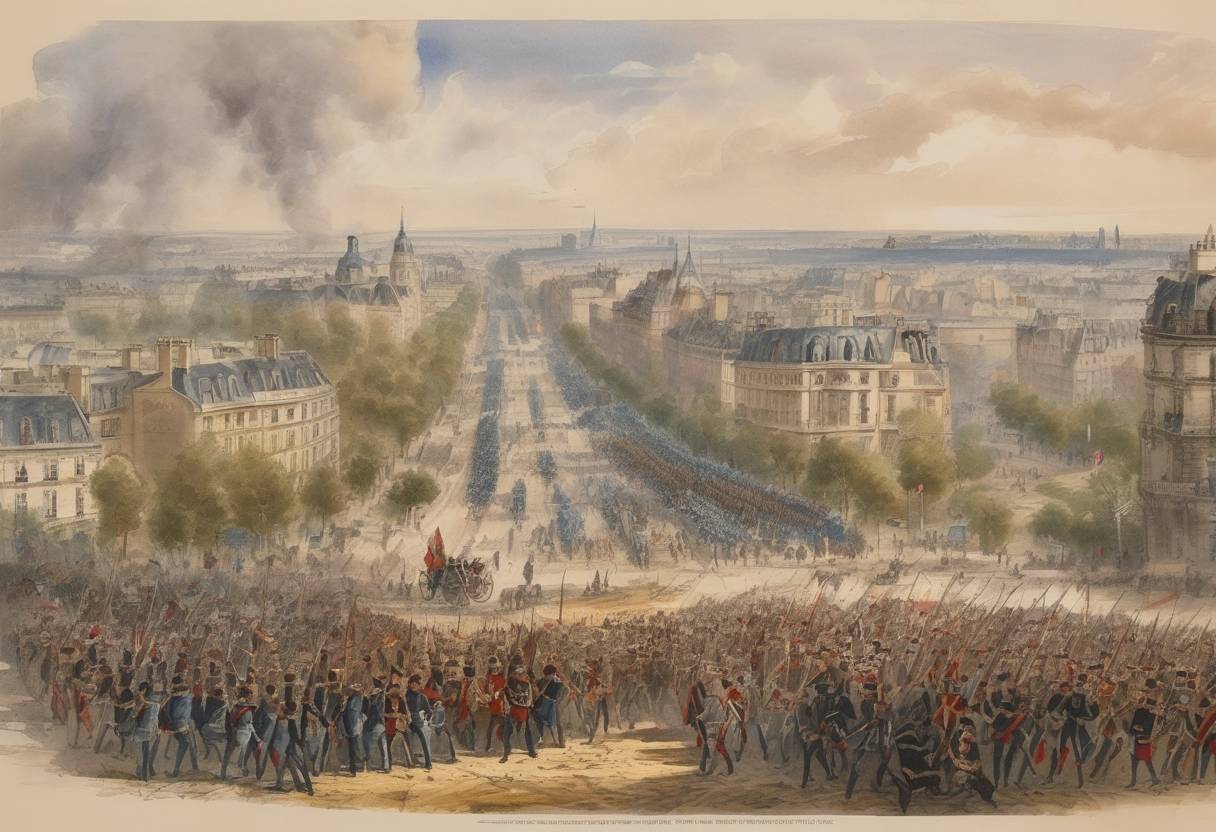
On July 19, 1870, France declared war on Prussia, marking the beginning of the Franco-Prussian War. This conflict was a pivotal moment in European history, leading to significant shifts in power and the eventual unification of Germany.
The roots of the Franco-Prussian War can be traced back to the growing tensions between the French Second Empire, led by Emperor Napoleon III, and the rising power of Prussia, under the leadership of Chancellor Otto von Bismarck. Several factors contributed to these tensions:
German Unification Efforts: Bismarck was determined to unify the numerous independent German states under Prussian leadership. This ambition was perceived as a threat by France, which feared the emergence of a powerful German state on its eastern border.
The Ems Dispatch: The immediate catalyst for the war was the Ems Dispatch, a diplomatic communication that Bismarck edited to provoke French outrage. The dispatch concerned the candidacy of a Hohenzollern prince for the Spanish throne, which France opposed. Bismarck’s manipulation of the dispatch made it appear as though the French ambassador had been insulted by the Prussian king, inflaming public opinion in France.
Nationalism and Public Pressure: Both countries were experiencing strong nationalist sentiments. In France, there was public pressure on Napoleon III to assert French dominance and prestige, while in Prussia, there was a desire to consolidate German unity.
On July 19, 1870, in response to the perceived insult from the Ems Dispatch and the broader geopolitical tensions, France officially declared war on Prussia. The declaration was met with enthusiasm in both countries, as nationalistic fervor gripped the populations.
The war itself was relatively short, lasting from July 1870 to May 1871. Key events included:
Early Battles: The French initially mobilized their forces, but the Prussian military, with its superior organization and leadership, quickly gained the upper hand. The Battle of Sedan, fought on September 1, 1870, was a decisive Prussian victory that resulted in the capture of Napoleon III.
Siege of Paris: Following the defeat at Sedan, Prussian forces laid siege to Paris. The city endured a harsh winter and severe shortages before capitulating in January 1871.
The Franco-Prussian War had profound consequences for Europe:
German Unification: The victory solidified Prussian dominance and led to the proclamation of the German Empire on January 18, 1871, in the Hall of Mirrors at the Palace of Versailles. King Wilhelm I of Prussia was crowned as the German Emperor, marking the unification of Germany.
The Treaty of Frankfurt: The war officially ended with the Treaty of Frankfurt on May 10, 1871. France was forced to cede the territories of Alsace and Lorraine to Germany and pay a significant indemnity.
The Fall of the French Empire: The defeat led to the collapse of the Second French Empire and the establishment of the Third Republic.
The Franco-Prussian War not only reshaped the political landscape of Europe but also set the stage for future conflicts, including World War I, due to the deep-seated animosities and territorial disputes it engendered.
Source: en.wikipedia.org