The Death of King Louis XIV: The Sun King's Final Day
1715 · Versailles, France
King Louis XIV of France, known as the Sun King, dies after a reign of 72 years, the longest of any major European monarch.
June 7, 1654
Louis XIV was crowned King of France in Reims Cathedral, marking the beginning of his reign, which would last for 72 years.
Reims, France | Kingdom of France
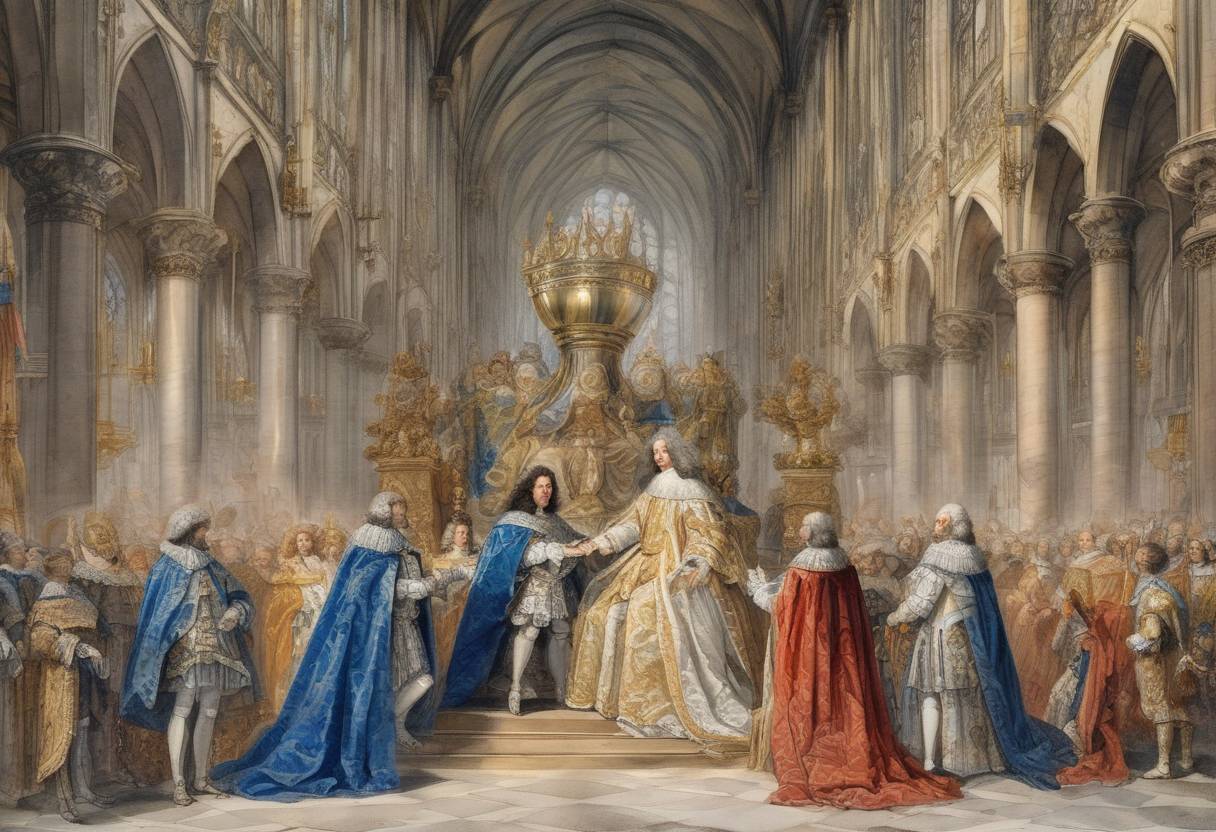
On June 7, 1654, Louis XIV was crowned King of France in the historic Reims Cathedral, marking the official commencement of one of the longest reigns in European history. His reign, which lasted 72 years, profoundly shaped the course of French and European history.
Early Life: Louis XIV was born on September 5, 1638, to King Louis XIII and Anne of Austria. He became king at the tender age of four upon his father’s death in 1643. However, due to his youth, the kingdom was initially governed by his mother, Anne, as regent, with Cardinal Mazarin serving as the chief minister.
The Fronde: The period leading up to Louis XIV’s coronation was marked by the Fronde, a series of civil wars in France between 1648 and 1653. These conflicts arose from the nobility’s opposition to royal authority and Mazarin’s policies. The resolution of the Fronde solidified the young king’s power and reinforced the monarchy’s authority.
Location: The coronation took place in Reims Cathedral, a traditional site for the coronation of French kings. The cathedral’s significance dates back to the baptism of Clovis I, the first King of the Franks, in 496 AD.
Ceremony: The coronation was a grand and symbolic affair, emphasizing the divine right of kings. Louis XIV was anointed with holy oil from the Sainte Ampoule, a sacred vial believed to have been used since the time of Clovis. This act underscored the belief that the king’s authority was sanctioned by God.
Absolute Monarchy: Louis XIV is often cited as the quintessential example of an absolute monarch. His reign is characterized by the centralization of power and the famous declaration, “L’État, c’est moi” (“I am the state”).
Cultural Patronage: Under Louis XIV, France became a cultural powerhouse. He was a patron of the arts, supporting figures like Molière, Racine, and Lully, and he commissioned the construction of the Palace of Versailles, a symbol of royal grandeur.
Military and Political Influence: Louis XIV’s reign saw numerous military conflicts, including the Franco-Dutch War and the War of the Spanish Succession. His foreign policy aimed at expanding French influence and securing its borders.
Economic Policies: The king’s finance minister, Jean-Baptiste Colbert, implemented mercantilist policies to strengthen the French economy, although these were often offset by the costs of Louis’s wars.
Louis XIV’s reign left a lasting impact on France and Europe. His efforts to centralize power and his patronage of the arts helped shape the modern French state and culture. However, his aggressive foreign policy and the financial strain of his wars also set the stage for future economic difficulties, contributing to the conditions that eventually led to the French Revolution.
In summary, the coronation of Louis XIV on June 7, 1654, was not just a ceremonial event but the beginning of a transformative era in French history, characterized by both grandeur and challenges.
Source: en.wikipedia.org