Theodosius I Proclaimed Co-Emperor of the Eastern Roman Empire
379 · Sirmium, Roman Empire
Theodosius I is proclaimed co-emperor of the Eastern Roman Empire by Emperor Gratian.
March 10, 0241
The Roman Emperor Gordian I was proclaimed emperor along with his son Gordian II, marking the beginning of the Gordian revolt against Emperor Maximinus Thrax.
Thysdrus, Roman Empire (modern-day Tunisia) | Roman Empire
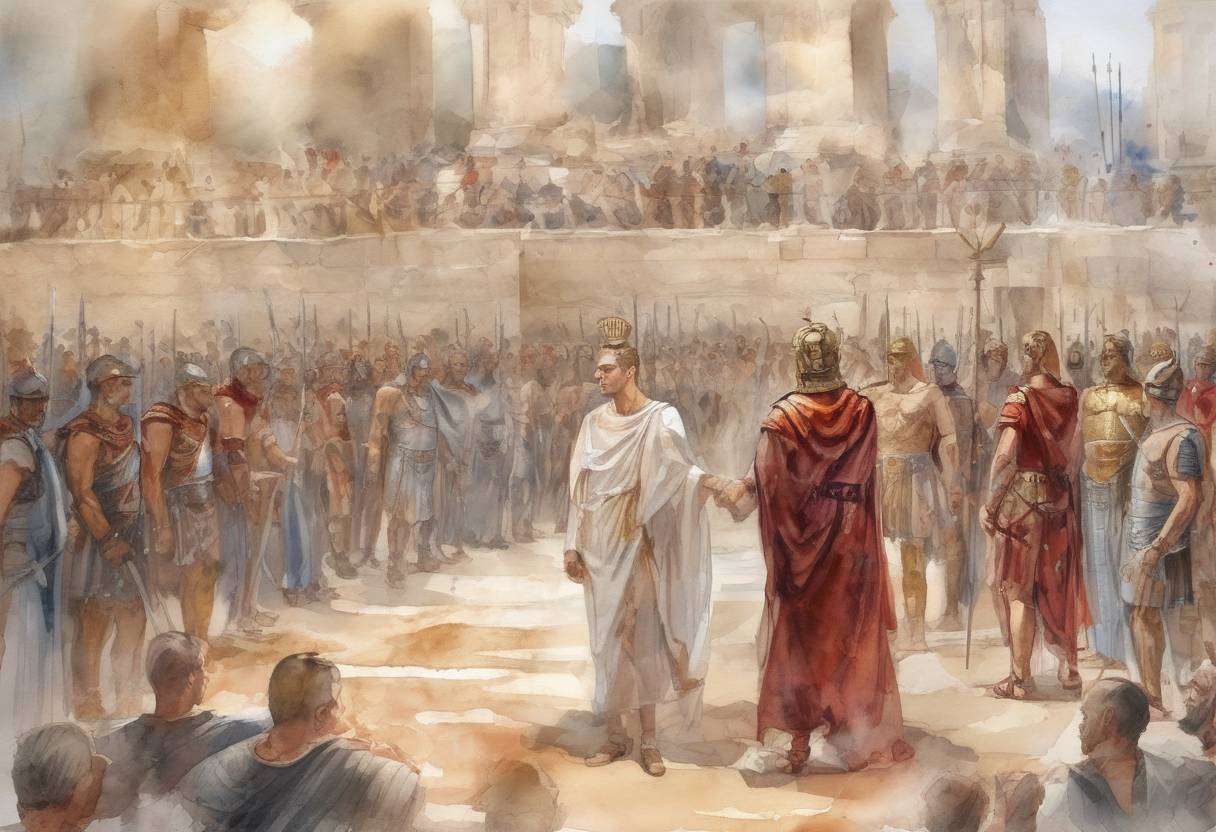
On March 10, 241 CE, a significant event unfolded in the Roman Empire: the proclamation of Gordian I and his son Gordian II as co-emperors. This marked the beginning of the Gordian revolt against the reigning Emperor Maximinus Thrax, a pivotal moment in the Year of the Six Emperors.
The Roman Empire in the early 3rd century was characterized by political instability and frequent changes in leadership. Maximinus Thrax, a former soldier of humble origins, had seized power in 235 CE after the assassination of Emperor Alexander Severus. His rule was marked by military focus and heavy taxation, which led to widespread discontent among the Roman aristocracy and provincial elites.
The revolt began in the province of Africa Proconsularis, where Gordian I, a respected senator and landowner, served as the proconsul. The local aristocracy, frustrated with Maximinus’s oppressive policies, saw an opportunity to challenge his authority. They proclaimed Gordian I as emperor, and he, in turn, appointed his son, Gordian II, as co-emperor.
The proclamation was a direct challenge to Maximinus Thrax’s rule and was quickly supported by the Roman Senate, which had grown increasingly hostile to Maximinus’s regime. The Senate’s endorsement was crucial, as it lent legitimacy to the Gordians’ claim to the throne.
The Gordian revolt was a brief but significant episode in Roman history. Despite initial support, the Gordians faced challenges from loyalist forces. In a swift military confrontation, Capelianus, the governor of Numidia and a supporter of Maximinus, defeated Gordian II in battle, leading to his death. Gordian I, upon hearing of his son’s demise, took his own life.
The revolt set off a chain of events that led to further instability. Following the Gordians’ deaths, the Senate appointed Pupienus and Balbinus as co-emperors, but they too faced challenges, eventually leading to the rise of Gordian III, the grandson of Gordian I.
The Gordian revolt highlighted the volatility of the Roman imperial system during this period. It underscored the power struggles between the military and the Senate, as well as the influence of provincial leaders. The events of 241 CE were part of a broader pattern of political upheaval that characterized the Crisis of the Third Century, a period marked by frequent changes in leadership and internal conflict.
In summary, the proclamation of Gordian I and Gordian II as emperors was a bold but ultimately unsuccessful attempt to overthrow Maximinus Thrax, reflecting the deep-seated tensions within the Roman Empire during this tumultuous era.
Source: en.wikipedia.org