Death of Carloman I and Its Historical Significance
771 · , Frankish Kingdom
Carloman I, King of the Franks and co-ruler with his brother Charlemagne, dies, leaving Charlemagne as the sole ruler of the Frankish Kingdom.
April 2, 0742
Charlemagne, also known as Charles the Great, was born. He would later become King of the Franks and Lombards and Emperor of the Carolingian Empire, playing a crucial role in the Carolingian Renaissance and the unification of much of Western Europe.
Herstal, Frankish Kingdom | Carolingian Empire
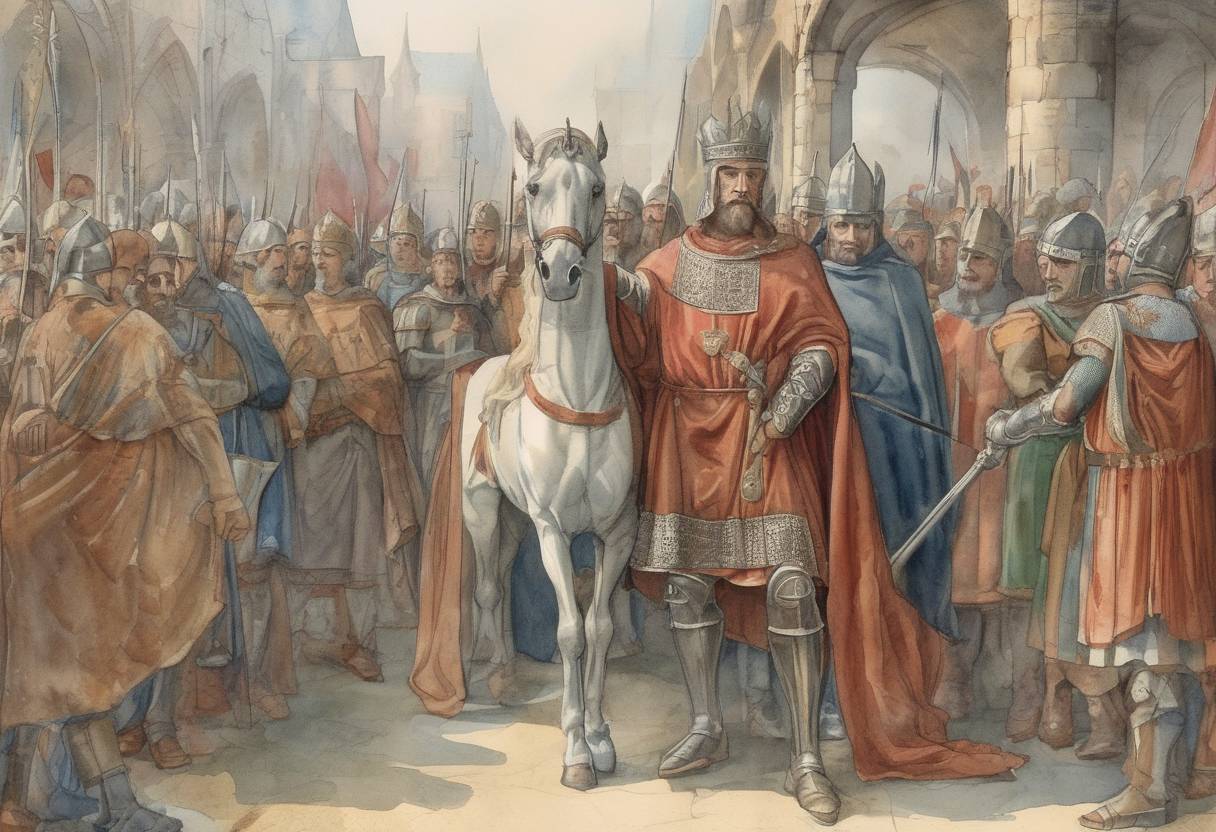
Charlemagne, also known as Charles the Great, was born on April 2, 742. His birth marked the beginning of a life that would significantly shape the course of European history. Charlemagne was the eldest son of Pepin the Short, the first Carolingian King of the Franks, and Bertrada of Laon. His birthplace is traditionally believed to be in the region of modern-day Belgium or Germany, though exact details remain uncertain.
Charlemagne grew up in a period of transition and consolidation for the Frankish kingdom. His father, Pepin the Short, had established the Carolingian dynasty by deposing the last Merovingian king, Childeric III, with the support of the Pope. This alliance between the Frankish monarchy and the Papacy would later play a crucial role in Charlemagne’s reign.
Upon Pepin’s death in 768, the Frankish kingdom was divided between Charlemagne and his younger brother, Carloman. The division was short-lived, as Carloman’s sudden death in 771 left Charlemagne as the sole ruler. This consolidation of power allowed Charlemagne to embark on a series of military campaigns that would expand his influence across much of Western Europe.
Charlemagne’s reign was marked by significant military conquests, including the annexation of the Lombard kingdom in Italy and the expansion into Saxony and other regions. His efforts to unify and Christianize these territories laid the groundwork for the Carolingian Empire.
One of Charlemagne’s most enduring legacies was the Carolingian Renaissance, a revival of art, culture, and learning based on classical models. He established a network of schools and promoted the use of the Latin language, which helped preserve many classical texts and laid the foundation for the intellectual revival of the Middle Ages.
In 800, Charlemagne was crowned “Emperor of the Romans” by Pope Leo III, a title that symbolized the fusion of Roman, Christian, and Germanic elements that characterized his empire. This coronation marked the beginning of what would later be known as the Holy Roman Empire.
Charlemagne’s efforts to unify and govern a diverse empire set the stage for the development of modern European states. His legacy is reflected in the political and cultural landscape of Europe, influencing the continent’s history long after his death in 814.
Source: en.wikipedia.org