The End of the Battle of Iwo Jima: March 16, 1945
1945 · Iwo Jima, Japan
The Battle of Iwo Jima ended as the island was declared secure by the United States military.
February 23, 1945
During the Battle of Iwo Jima, a group of United States Marines and a Navy corpsman raise the American flag atop Mount Suribachi, an event captured in the iconic photograph by Joe Rosenthal.
Iwo Jima, Japan | United States Marine Corps
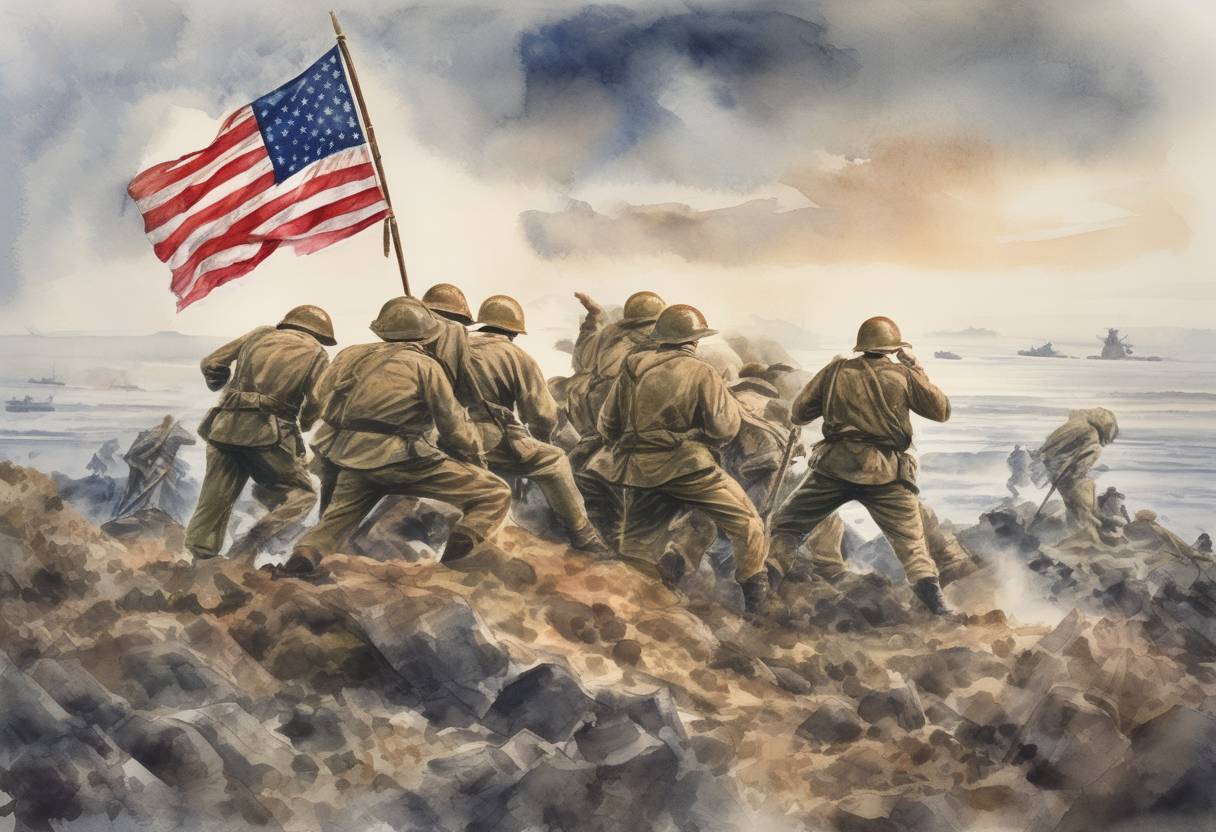
On February 23, 1945, during the Battle of Iwo Jima in World War II, a group of United States Marines and a Navy corpsman raised the American flag atop Mount Suribachi. This moment was immortalized in an iconic photograph taken by Associated Press photographer Joe Rosenthal.
The Battle of Iwo Jima: This battle was a major military campaign fought between the United States and the Empire of Japan. It began on February 19, 1945, and was part of the Pacific Campaign. The objective was to capture the island of Iwo Jima, which held strategic importance due to its airfields that could be used for launching attacks on the Japanese mainland.
Mount Suribachi: This dormant volcanic cone is the highest point on the island, providing a strategic vantage point. Capturing it was crucial for the U.S. forces to secure the island.
The Event: On the morning of February 23, 1945, after four days of intense fighting, a 40-man patrol from the 2nd Battalion, 28th Marines, led by First Lieutenant Harold Schrier, was ordered to climb Mount Suribachi and raise the American flag to signal the capture of the summit.
The Photograph: Joe Rosenthal captured the moment when five Marines—Sergeant Michael Strank, Corporal Harlon Block, Private First Class Franklin Sousley, Private First Class Ira Hayes, and Private First Class Rene Gagnon—and Navy corpsman John Bradley raised the second, larger flag. The photograph quickly became a symbol of hope and perseverance for the American public.
Symbolism: The image of the flag raising became one of the most enduring symbols of American resolve and unity during World War II. It was widely reproduced and used to boost morale and support for the war effort.
Pulitzer Prize: Joe Rosenthal’s photograph won the Pulitzer Prize for Photography in 1945, and it remains one of the most famous war photographs in history.
Legacy: The image inspired the Marine Corps War Memorial in Arlington, Virginia, which was dedicated in 1954. It serves as a tribute to all Marines who have given their lives in defense of the United States.
The flag raising on Iwo Jima is remembered not only as a pivotal moment in the battle but also as a powerful representation of courage and sacrifice during World War II.
Source: en.wikipedia.org