The Landing of the Mayflower Pilgrims at Plymouth Rock
1620 · Plymouth, United States
The Mayflower Pilgrims landed at Plymouth Rock in present-day Massachusetts, marking a significant event in the early colonization of North America.
March 16, 1621
Samoset, an Abenaki Native American, makes contact with the Pilgrims of Plymouth Colony, becoming the first Native American to do so.
Plymouth, United States
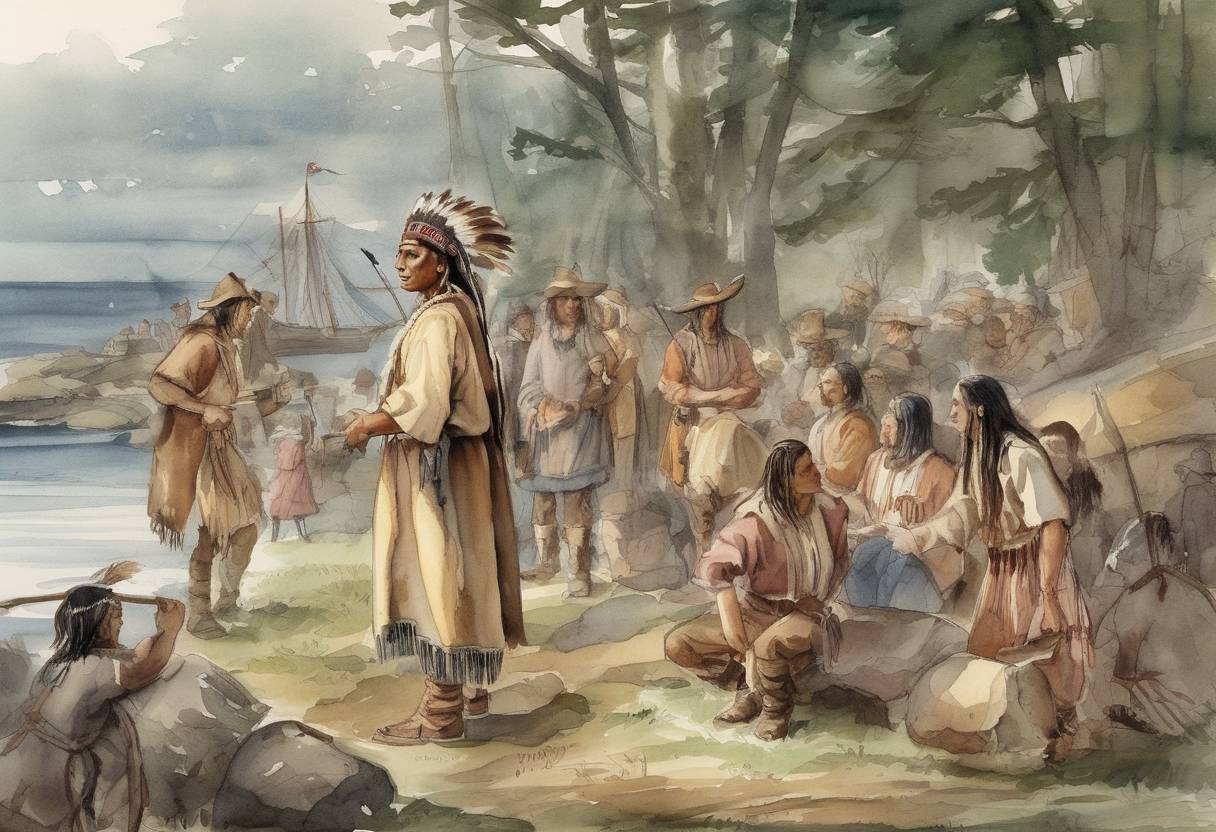
On March 16, 1621, a significant event in early American history occurred when Samoset, an Abenaki Native American, made contact with the Pilgrims of Plymouth Colony. This encounter marked the first time a Native American initiated communication with the settlers, paving the way for future interactions and alliances.
The Pilgrims, a group of English Separatists seeking religious freedom, had arrived at Plymouth in December 1620 aboard the Mayflower. They faced a harsh winter, during which nearly half of the original settlers perished due to disease and malnutrition. By March 1621, the surviving Pilgrims were struggling to establish their new settlement.
Samoset, a sagamore (chief) of the Eastern Abenaki tribe from what is now Maine, had learned some English from fishermen and traders along the coast. On March 16, he boldly walked into the Plymouth settlement, greeting the astonished Pilgrims with the words, “Welcome, Englishmen.” His ability to communicate in English was crucial in establishing an initial rapport with the settlers.
Samoset’s visit was significant for several reasons:
Cultural Exchange: Samoset provided the Pilgrims with valuable information about the local geography, the surrounding tribes, and the political landscape. He informed them about the Wampanoag people, who inhabited the region, and their leader, Massasoit.
Diplomatic Relations: Samoset’s introduction laid the groundwork for future diplomatic relations between the Pilgrims and the Native American tribes. He returned a few days later with Squanto (Tisquantum), a member of the Patuxet tribe, who played a crucial role in helping the Pilgrims survive by teaching them agricultural techniques and acting as an interpreter.
Foundation for Peace: The initial contact eventually led to the signing of a peace treaty between the Pilgrims and the Wampanoag Confederacy, led by Massasoit. This treaty ensured mutual protection and cooperation, which lasted for several decades.
Samoset’s interaction with the Pilgrims was a pivotal moment in early American history. It demonstrated the potential for peaceful coexistence and mutual benefit between Native Americans and European settlers, albeit temporarily. The alliance with the Wampanoag was crucial for the Pilgrims’ survival and the eventual success of the Plymouth Colony.
While the initial peace did not last indefinitely, and future relations between Native Americans and European settlers were often fraught with conflict, Samoset’s encounter remains a symbol of the possibilities for understanding and cooperation across cultures.
Source: en.wikipedia.org