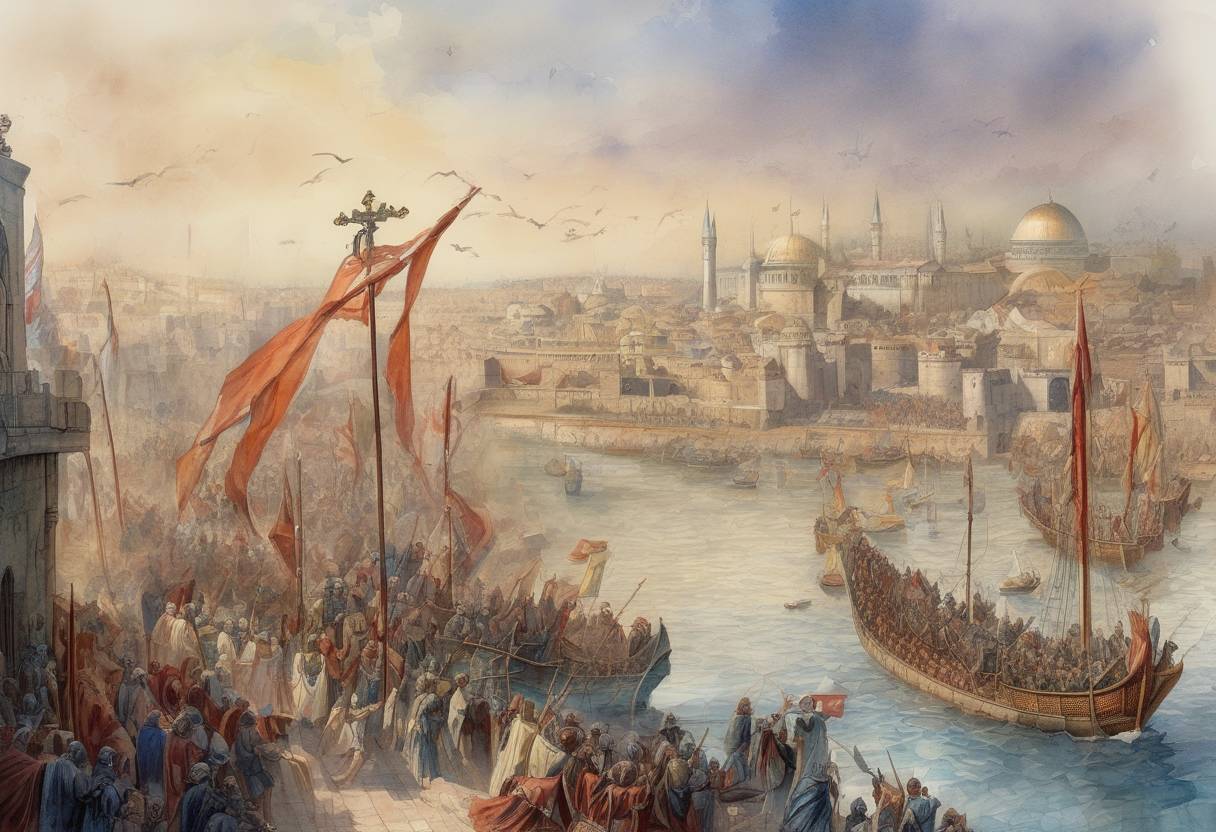
The Capture of Constantinople: The Fourth Crusade on April 13, 1204
On April 13, 1204, a pivotal and unexpected event unfolded during the Fourth Crusade: the capture of Constantinople by the Crusaders. This marked a significant turning point in the history of the Crusades and had profound implications for the Byzantine Empire and the broader medieval world.
Background
The Fourth Crusade was initially launched with the intention of reclaiming Jerusalem from Muslim control. However, a series of complex political and financial challenges diverted the Crusaders from their original goal. The Crusade was called by Pope Innocent III in 1198, aiming to strengthen Christian control in the Holy Land. However, the Crusaders faced significant logistical and financial difficulties, leading to a controversial agreement with the Republic of Venice.
The Venetian Influence
Venice played a crucial role in the Fourth Crusade. The Crusaders had contracted the Venetians to provide a fleet for their journey to the Holy Land. However, when the Crusaders failed to pay the full amount owed, the Venetians proposed an alternative plan: to capture the Christian city of Zara (now Zadar, Croatia) as compensation. This diversion set a precedent for the Crusade’s deviation from its religious goals.
The Road to Constantinople
The Crusaders’ journey took another unexpected turn when they became embroiled in the internal politics of the Byzantine Empire. Alexios IV Angelos, a Byzantine prince, promised the Crusaders substantial financial and military support if they helped him reclaim the throne from his uncle, Alexios III. The Crusaders agreed, and in 1203, they successfully installed Alexios IV as co-emperor alongside his father, Isaac II.
The Capture of Constantinople
Despite initial success, tensions between the Crusaders and the Byzantines grew. Alexios IV struggled to fulfill his promises, leading to unrest in Constantinople. In January 1204, Alexios IV was overthrown and killed, leaving the Crusaders without their promised support.
Faced with dwindling resources and no clear path forward, the Crusaders decided to take Constantinople by force. On April 12, 1204, they launched a full-scale assault on the city. By April 13, they had breached the city’s formidable defenses, leading to the sack of Constantinople.
The Aftermath
The capture and subsequent sack of Constantinople were marked by widespread looting and destruction. Many of the city’s treasures and relics were taken to Western Europe, and the event left a lasting scar on Byzantine-Western relations.
In the wake of the conquest, the Crusaders established the Latin Empire, with Baldwin of Flanders crowned as its first emperor. The Latin Empire lasted until 1261, when the Byzantines, under the leadership of Michael VIII Palaiologos, recaptured the city.
Historical Significance
The Fourth Crusade’s diversion to Constantinople had several significant consequences:
- Weakening of the Byzantine Empire: The sack of Constantinople severely weakened the Byzantine Empire, contributing to its eventual decline and fall to the Ottoman Turks in 1453.
- Cultural and Religious Impact: The event deepened the schism between the Eastern Orthodox and Roman Catholic Churches, a division that persists to this day.
- Shift in Crusader Objectives: The Fourth Crusade highlighted the shifting priorities of the Crusader movement, from religious to political and economic goals.
The capture of Constantinople remains a controversial and debated episode in the history of the Crusades, illustrating the complex interplay of religious fervor, political ambition, and economic necessity that characterized the medieval period.