The Siege of Vienna Ends - October 3, 1529
1529 · Vienna, Austria
The Siege of Vienna ended, with the Ottoman Empire failing to capture the city from the Habsburgs, thus marking a key turning point in the Ottoman-Habsburg wars.
October 25, 1529
The Siege of Vienna was lifted, marking the end of the first attempt by the Ottoman Empire, led by Suleiman the Magnificent, to capture the city.
Vienna, Austria | Ottoman Empire
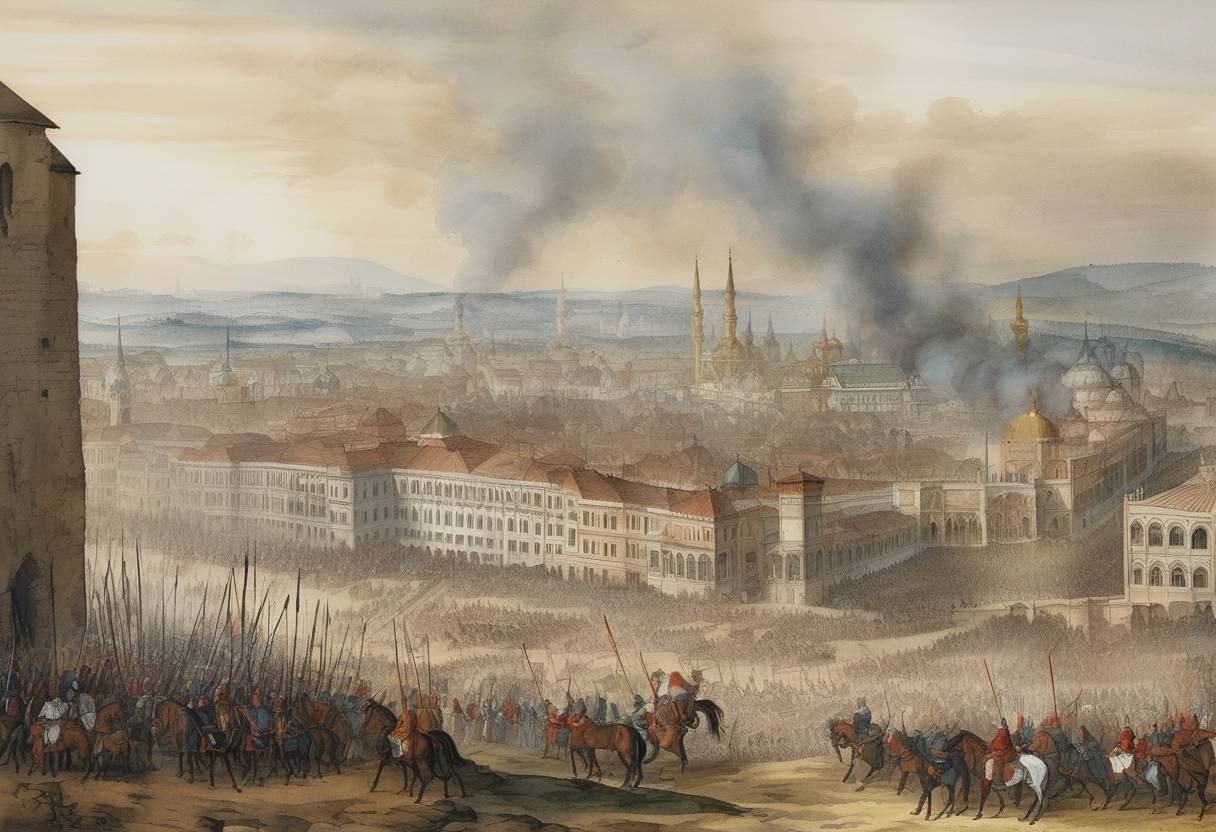
On October 25, 1529, the Siege of Vienna was officially lifted, marking a significant turning point in European history. This event concluded the first attempt by the Ottoman Empire, under the leadership of Suleiman the Magnificent, to capture Vienna. The siege represented a pivotal moment in the ongoing power struggle between the Ottoman Empire and the Habsburg Monarchy.
The Ottoman Empire, at the height of its power during Suleiman the Magnificent’s reign, sought to expand its influence into Europe. The strategic location of Vienna made it a crucial target, serving as a gateway to Western Europe. Suleiman, buoyed by victories in Eastern Europe and buoyed by the recent conquest of Buda in the Kingdom of Hungary in 1526, directed his forces toward Vienna.
Suleiman’s forces, composed of a large army estimated between 100,000 and 120,000 men, began the siege in late September 1529. The city, defended by a garrison of approximately 17,000 men under the command of Count Nicholas of Salm and Wilhelm von Roggendorf, prepared for an intense confrontation. Despite being heavily outnumbered, the defenders took advantage of the city’s fortifications.
The Ottomans launched a series of assaults, employing artillery barrages and undermining techniques to breach the city’s walls. However, they faced stiff resistance and numerous challenges, including inclement weather and logistical difficulties. The defenders’ resolve, coupled with these external factors, prevented the Ottomans from making significant headway.
On October 25, 1529, faced with deteriorating conditions and the onset of winter, Suleiman ordered the withdrawal of his forces. The lifting of the siege marked a failed attempt to capture Vienna and a rare setback in Suleiman’s otherwise successful reign. This event is often cited as a crucial moment in halting Ottoman expansion into Central Europe, maintaining the balance of power between the Christian kingdoms and the Muslim Ottoman Empire.
The defense of Vienna fortified European alliances and emphasized the need for unity against the Ottoman threat. It also launched Vienna’s reputation as a formidable fortress and a symbol of resistance against outside invaders, shaping Vienna’s role in European politics for centuries to come.
Although the siege was unsuccessful, the conflict between the Ottoman Empire and European powers continued, culminating in further attempts to capture Vienna. Notably, the second siege in 1683, also unsuccessful, dramatically changed power dynamics in Europe. The long-term significance of these events reinforced the Habsburgs’ authority in Europe and marked the beginning of the gradual decline of Ottoman influence in the region.
Source: en.wikipedia.org