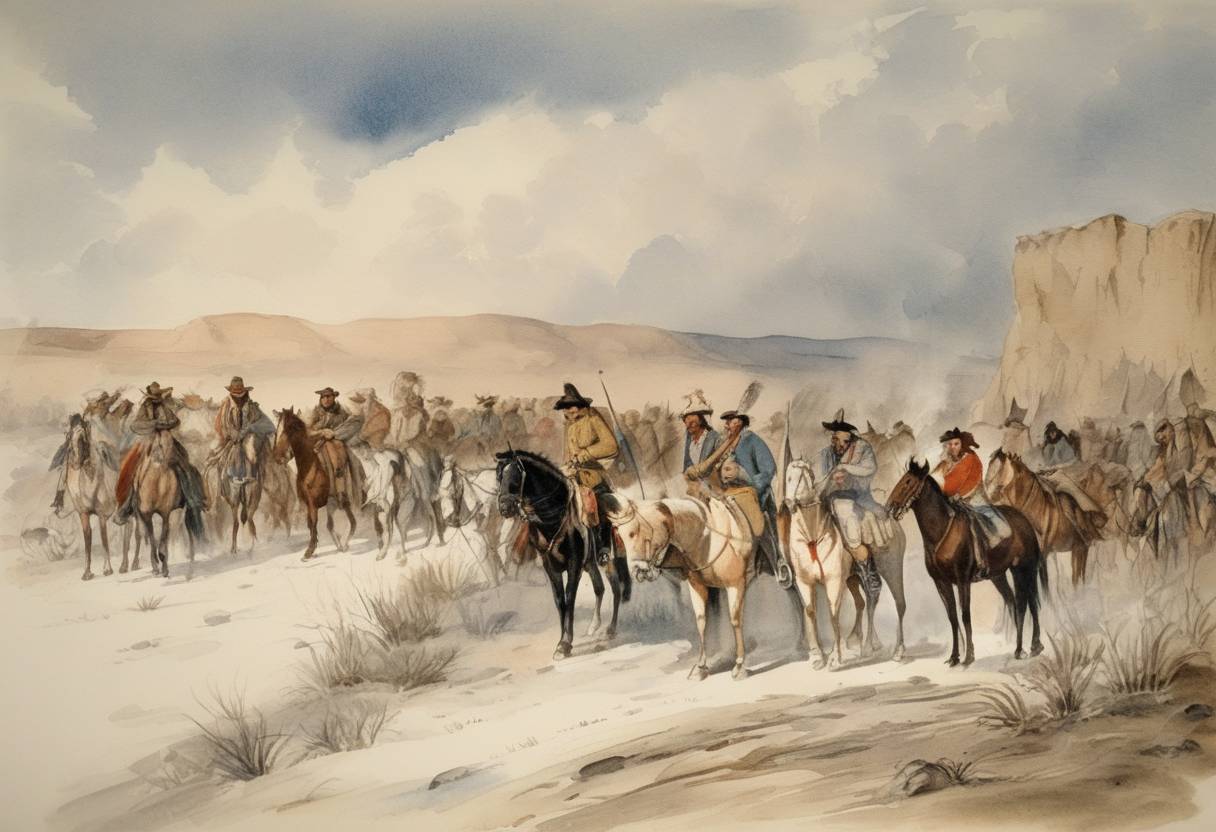
Pike Expedition Reaches Otero County, Colorado - November 15, 1806
The Pike Expedition, led by U.S. Army officer Lieutenant Zebulon Pike, was dispatched by President Thomas Jefferson following the 1803 Louisiana Purchase. Its purpose was to explore the southwestern portion of the newly acquired territory and assert U.S. claims in the region. The journey that would later lead Pike to Colorado began in 1806.
Context
- Louisiana Purchase: The acquisition of approximately 828,000 square miles of territory from France in 1803, effectively doubling the size of the United States and sparking a series of exploration missions.
- Zebulon Pike’s Mission: Pike was tasked with mapping the southern reaches of the Louisiana Purchase, determining the borders with Spanish-held territories, and gathering information on the natural resources and native populations.
Pike’s Journey to Colorado
As Pike and his team traveled westward, they aimed to follow the Arkansas River’s course, which was believed to lead into Spanish territory. This expedition was vital in exploring the southwestern frontier of the U.S.
November 15, 1806
- Arrival at Present-Day Otero County, Colorado: On this date, the Pike Expedition reached what is now Otero County, marking an important milestone in their journey through the Colorado landscape.
- Site of Present-Day Pueblo, Colorado: This specific area, later known for the city of Pueblo, served as a gateway to exploring the mountains and valleys that characterize this region of Colorado.
Significance
- Geographical Discoveries: The expedition provided valuable geographical data and insights into the topography and resources of the southwestern Louisiana Purchase.
- Relations with Native Tribes: Pike’s interactions with local Indigenous populations provided critical ethnographic and cultural information, although they also reflected the complex and oftentimes contentious relations between U.S. explorers and Native tribes.
- Influence on American Expansion: The mission reinforced U.S. expansionist interests and territorial claims, setting the stage for future exploration and settlement efforts in the West.
Aftermath
The expedition’s exploration helped pave the way for further American expansion into the Southwest. Although Pike and his team were ultimately detained by Spanish authorities later in their journey—leading to Pike’s capture in what is now northern Mexico—their journey had lasting impacts on the mapping and understanding of the region.
Pike’s detailed accounts, recorded in his journals, became important documents for future explorers and settlers, highlighting the challenges and opportunities of these new territories. The expedition contributed significantly to the United States’ westward expansion narrative, emphasizing themes of discovery, competition, and the complex dynamics of early 19th-century American frontier life.