The End of the Cassini Mission: September 15, 2017
2017 · Saturn, N/A
The Cassini spacecraft, a collaboration between NASA, ESA, and the Italian Space Agency, ended its mission by plunging into Saturn's atmosphere after 13 years of exploration.
July 1, 2004
The Cassini-Huygens spacecraft, built by NASA, ESA, and ASI, successfully entered orbit around Saturn, beginning an extensive mission to study the planet and its moons.
Pasadena, United States | NASA
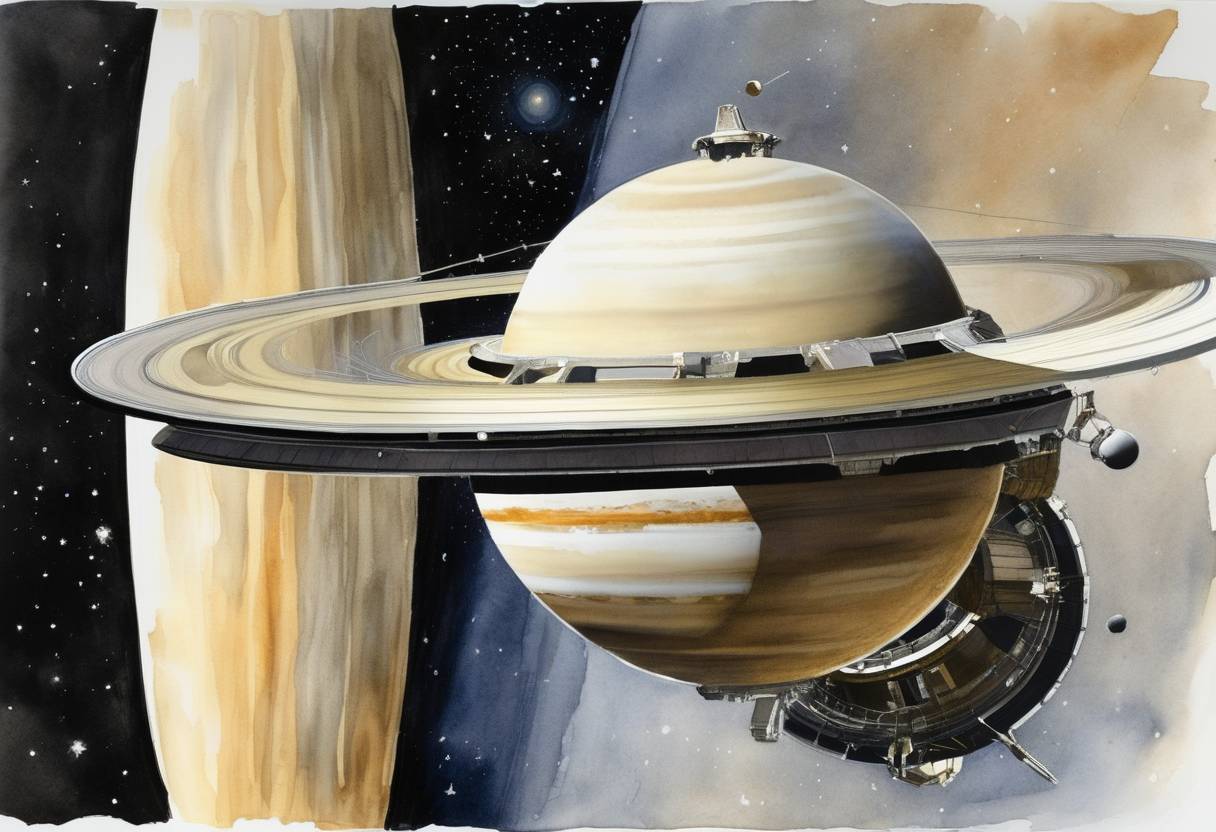
On July 1, 2004, the Cassini-Huygens spacecraft successfully entered orbit around Saturn, marking a significant milestone in the study of the outer planets. This joint mission by NASA (National Aeronautics and Space Administration), ESA (European Space Agency), and ASI (Italian Space Agency) was designed to explore the Saturnian system in unprecedented detail.
The mission began with the launch of the spacecraft on October 15, 1997, from Cape Canaveral, Florida. The mission’s namesake honored two historical figures: Giovanni Cassini, an Italian astronomer who discovered several of Saturn’s moons, and Christiaan Huygens, a Dutch scientist and discoverer of Saturn’s largest moon, Titan.
After nearly seven years of travel through space, Cassini-Huygens executed a strategic orbital insertion maneuver on July 1, 2004. This process involved a critical 96-minute engine burn that slowed the spacecraft enough to be captured by Saturn’s gravity, enabling it to begin its mission of exploration.
The Cassini-Huygens mission was tasked with a comprehensive study of Saturn, its rings, its magnetosphere, and its moons. Key objectives included:
The Cassini-Huygens mission greatly enhanced our understanding of the Saturnian system and its potential for habitability. Originally intended to last four years, the mission continued until September 15, 2017, due to its remarkable scientific success. The spacecraft was intentionally plunged into Saturn’s atmosphere to avoid contamination of its moons, concluding an era of profound discovery in planetary science. The data gathered continues to spark scientific inquiry and discovery today.
Source: saturn.jpl.nasa.gov