Itō Hirobumi Begins His Third Term as Prime Minister of Japan - January 12, 1898
1898 · Tokyo, Japan
Itō Hirobumi begins his third term as Prime Minister of Japan.
August 4, 1854
The Hinomaru, a red circle on a white field, was first chosen as the national flag of Japan for merchant ships under a decree from the Tokugawa shogunate.
Yokohama, Japan | Tokugawa shogunate
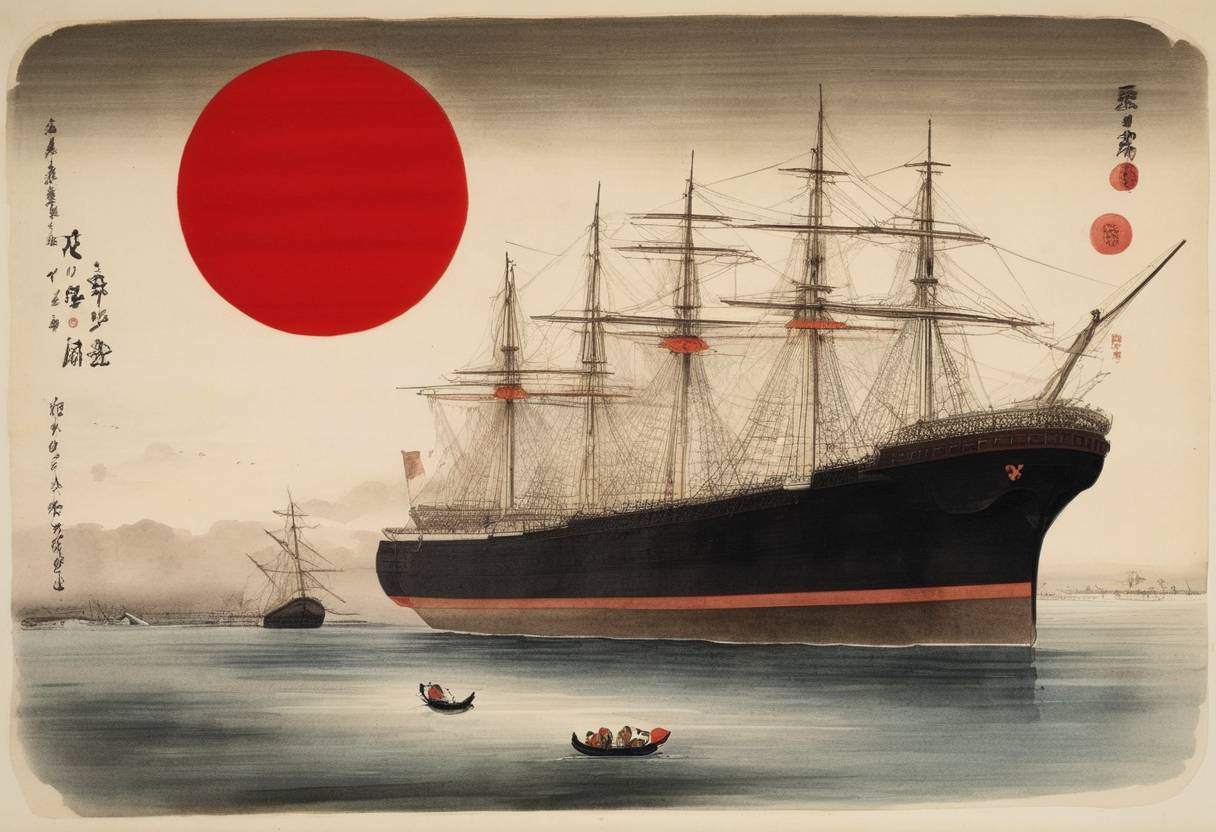
On August 4, 1854, during the late Edo period, the Tokugawa shogunate officially decreed the use of the Hinomaru, a red circle on a white field, as the national flag specifically for Japanese merchant ships. This decision was part of Japan’s efforts to establish a distinct national identity in the face of increasing foreign interactions and pressures.
In the mid-19th century, Japan was under the rule of the Tokugawa shogunate, a feudal regime that had enforced a policy of national seclusion, known as “sakoku,” for over two centuries. However, external pressures, particularly the arrival of Commodore Matthew Perry from the United States in 1853, prompted the opening of Japan to international trade and influence. This period marked the beginning of Japan’s transition from a seclusionist policy to greater engagement with the global community.
The decree on August 4, 1854, to use the Hinomaru as the flag for merchant ships was part of wider reforms to standardize symbols of national identity. The decision was, in part, practical: Japan needed to ensure that its vessels were recognized internationally as representative of a unified and sovereign state, especially as it began to engage in international commerce.
The Hinomaru, meaning “circle of the sun,” has deep cultural roots in Japan. The sun has long been a significant symbol in Japanese culture, embodying notions of purity, brightness, and sincerity. By adopting the red circle on a white background, the Hinomaru also reflected the mythological and religious significance of the sun in Shinto belief, the indigenous spirituality of Japan.
After its initial designation for merchant ships, the Hinomaru began to gain wider recognition and eventually was adopted as the de facto national flag of Japan. Although the design was made official for all Japanese vessels and citizens became more familiar with its use, it was not until 1870 that it formally became the national flag of Japan during the Meiji Restoration, a time when Japan further embraced modernization and internationalization.
This historical choice reflects the early stages of Japan’s transformation into a modern state and its efforts to assert itself on the international stage amidst geopolitical challenges. The Hinomaru remains a potent national symbol, embodying Japan’s cultural identity and historical journey.
Source: en.wikipedia.org