Opening of the Manchester Ship Canal
1894 · Manchester, United Kingdom
The Manchester Ship Canal was officially opened by Queen Victoria after eight years of construction, linking Manchester to the Irish Sea.
August 13, 1913
Harry Brearley of Sheffield, England, cast the first stainless steel, revolutionizing the steel industry.
Sheffield, United Kingdom | Brown-Firth Research Laboratories
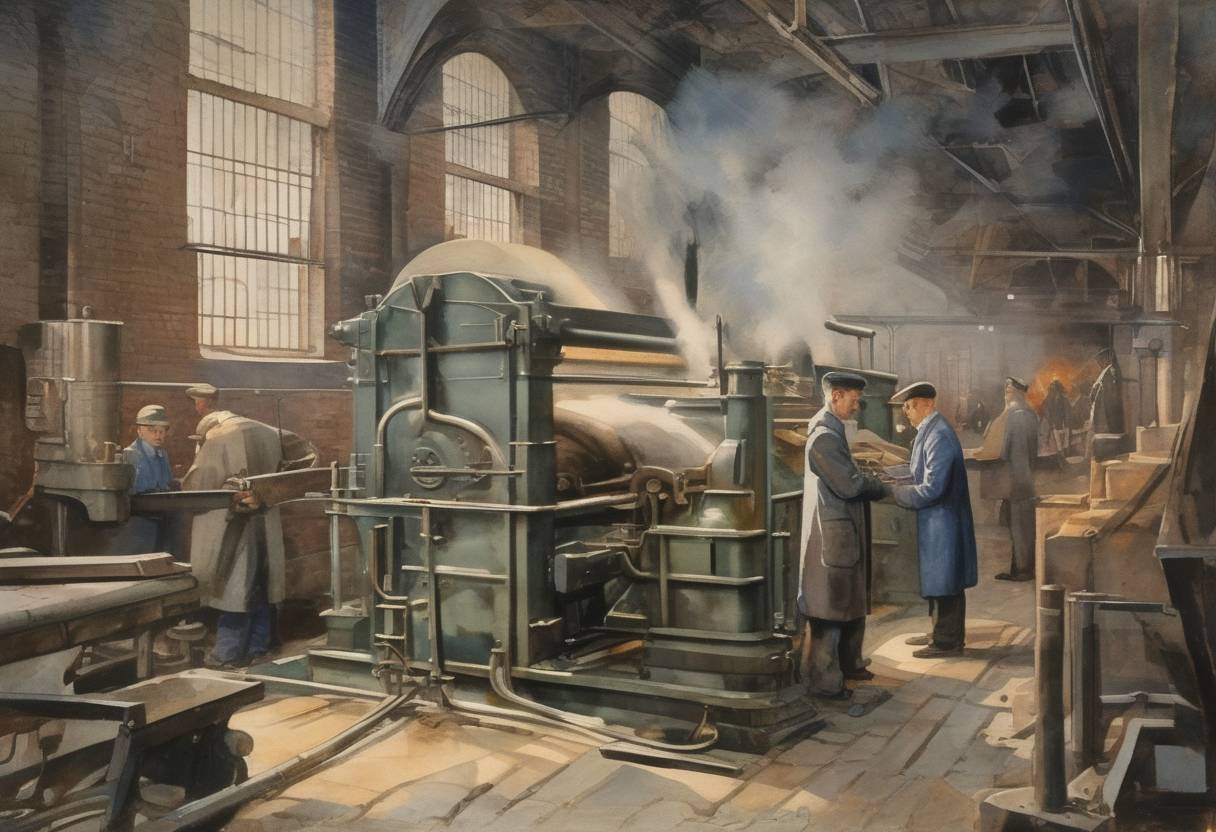
On August 13, 1913, Harry Brearley, a metallurgist from Sheffield, England, cast the first stainless steel, marking a pivotal moment in the history of metallurgy and the steel industry. This innovation would go on to revolutionize various industries due to its remarkable resistance to corrosion and staining.
Sheffield’s Steel Industry: By the early 20th century, Sheffield was already renowned for its high-quality steel production, particularly in cutlery and tools. The city was a hub of innovation and expertise in metallurgy.
Harry Brearley: Born in 1871, Brearley was the son of a steelworker and began his career in the steel industry at a young age. He worked his way up through various roles, eventually becoming a key figure in metallurgical research.
Research Objective: Brearley was initially tasked with developing a steel alloy that could withstand the high temperatures and erosion associated with gun barrels. This was part of a broader effort to improve the durability of military equipment.
Experimentation: During his experiments, Brearley explored the effects of adding different elements to steel. On August 13, 1913, he successfully created an alloy containing about 12.8% chromium and 0.24% carbon, which exhibited remarkable resistance to rust and corrosion.
Naming: The new alloy was initially referred to as “rustless steel.” It was later dubbed “stainless steel” due to its ability to resist staining and maintain a clean appearance.
Industrial Applications: Stainless steel quickly found applications in a wide range of industries, including cutlery, medical instruments, and construction. Its durability and resistance to corrosion made it an ideal material for environments exposed to moisture and chemicals.
Global Influence: The invention of stainless steel had a profound impact on global manufacturing and engineering. It enabled the development of new technologies and products that were previously impractical due to corrosion issues.
Legacy: Harry Brearley’s discovery is celebrated as a landmark achievement in materials science. It not only bolstered Sheffield’s reputation as a center of metallurgical innovation but also set the stage for further advancements in alloy development.
The casting of the first stainless steel by Harry Brearley on August 13, 1913, represents a transformative moment in industrial history. This breakthrough not only enhanced the performance and longevity of countless products but also underscored the importance of scientific research and experimentation in driving technological progress. Brearley’s work laid the foundation for the modern steel industry and continues to influence material science today.
Source: www.britannica.com