The Opening of the Trans-Canada Highway
1962 · , Canada
The Trans-Canada Highway, the world's second-longest national highway, is officially opened.
April 25, 1959
The St. Lawrence Seaway, which allows ships to travel from the Atlantic Ocean to the Great Lakes, is officially opened to shipping.
Montreal, Canada | St. Lawrence Seaway Authority
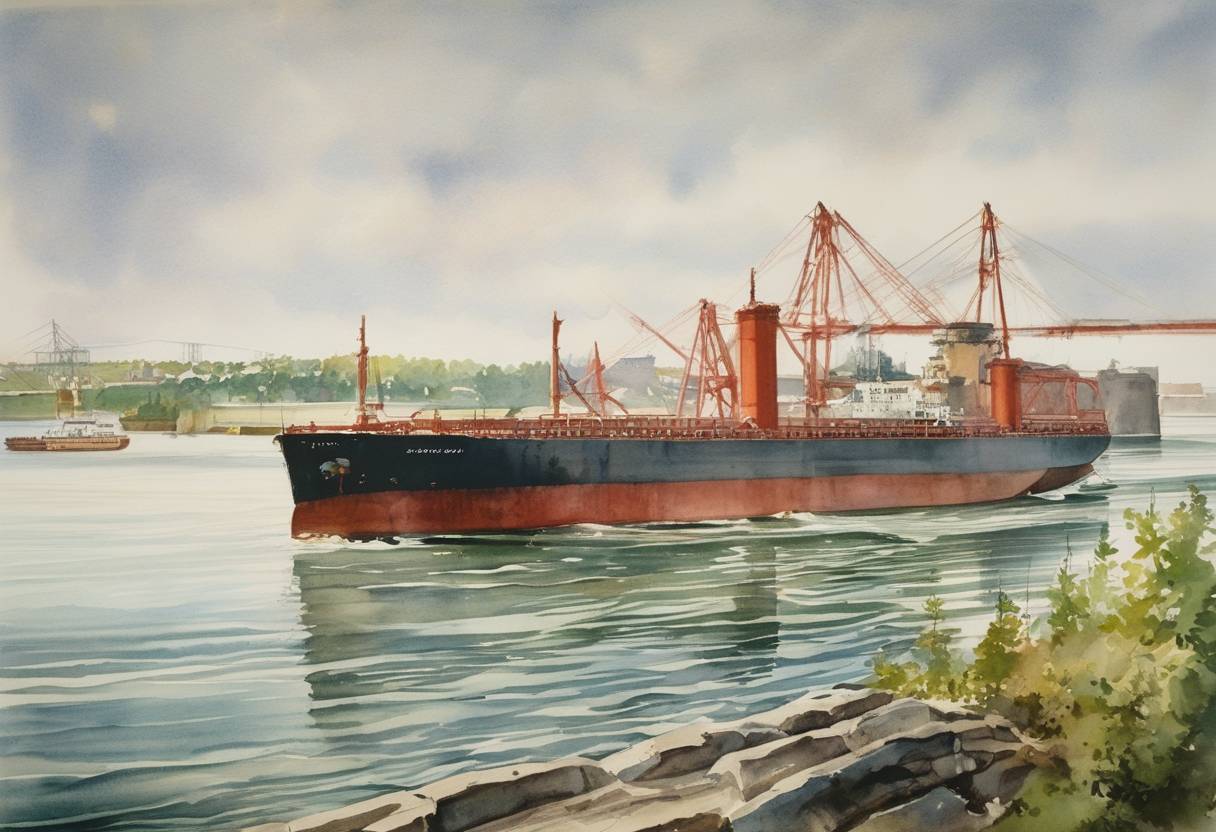
On April 25, 1959, the St. Lawrence Seaway was officially opened to commercial shipping, marking a significant milestone in North American transportation and trade. This extensive maritime route enables ships to travel from the Atlantic Ocean all the way to the Great Lakes, thereby facilitating more efficient trade routes and economic interactions between several states and provinces of the United States and Canada.
The concept of creating a navigable waterway connecting the Great Lakes to the Atlantic Ocean dates back to the 19th century. Initial authorization for such a project was passed by the U.S. Congress in the 1930s, but it wasn’t until the mid-20th century that cooperative efforts between the United States and Canada led to practical construction. The agreement between the two countries, finalized in 1954, outlined the commitment to share both the costs and responsibilities associated with constructing the Seaway.
The construction involved an immense engineering undertaking, which included dredging riverbeds, constructing canals, and building a series of locks to manage the elevation change between Lake Ontario and the Atlantic. The project, undertaken primarily between 1954 and 1959, required the relocation of towns and infrastructure, as well as collaboration between various engineering teams and labor forces from both countries.
The Seaway consists of a series of locks, canals, and channels that stretch for about 2,342 miles (3,768 kilometers), from the Atlantic Ocean to the westernmost reaches of Lake Superior. The waterway includes 15 locks, with seven located in the U.S. sections of the Seaway and eight in Canadian sections, overcoming a total elevation difference of 600 feet (approximately 183 meters).
The opening of the St. Lawrence Seaway had transformative impacts on trade and economic patterns in North America. It provided a more direct shipping route for goods such as iron ore, coal, and grain, critical commodities for both manufacturing and agriculture. This transportation corridor enabled industries in the interior plains of North America to access international markets more efficiently and reduced shipping costs significantly compared to land-based transportation modes.
Moreover, the Seaway strengthened bilateral relations between the United States and Canada, showcasing successful cooperation in managing shared natural resources and trade.
Since its opening, the St. Lawrence Seaway has been a critical component of North America’s transportation infrastructure. It has facilitated billions of dollars in trade annually, becoming an indispensable route for maritime commerce. While environmental concerns and the emergence of alternative trade routes present ongoing challenges, the importance of the Seaway remains undisputed.
Its construction and operation have demonstrated the potential of international collaboration in infrastructure development and continue to serve as an influential model for subsequent projects around the globe.
Source: www.history.com