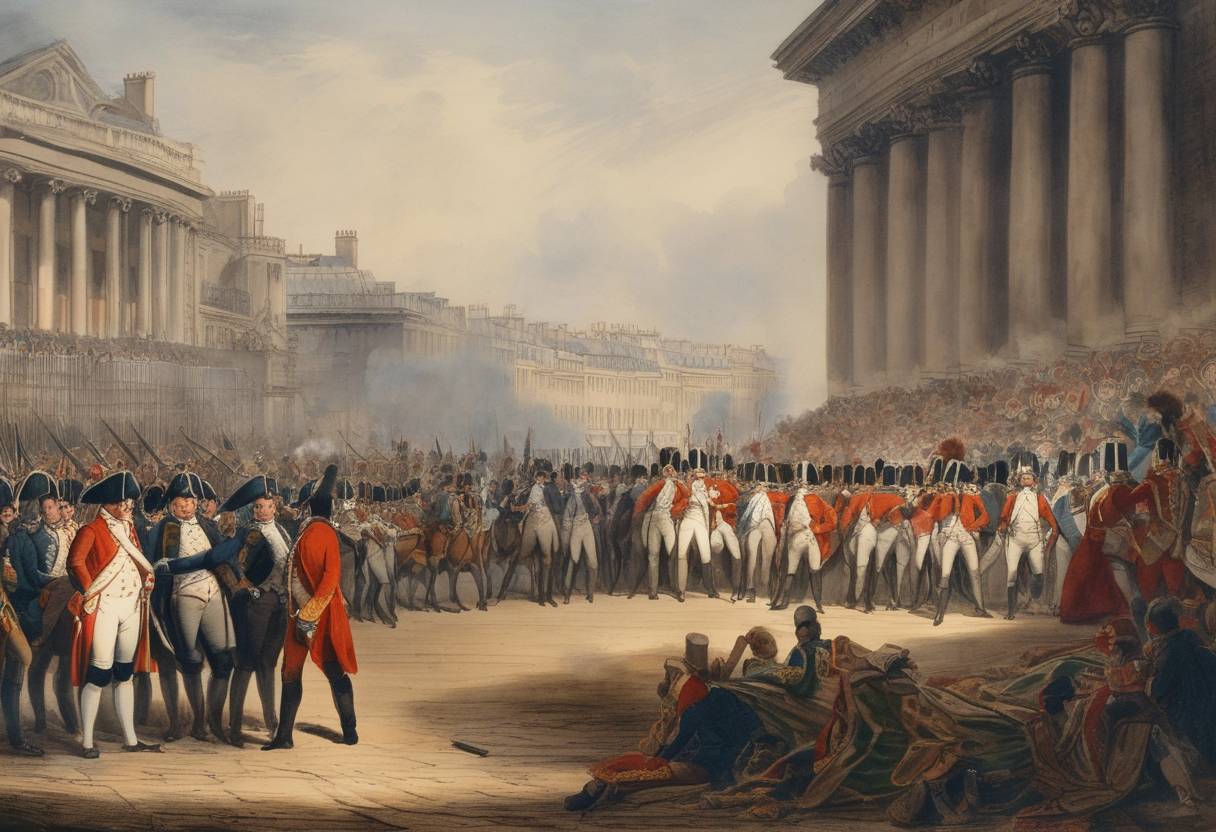
The Coup of 18 Brumaire: Rise of Napoleon Bonaparte
On November 9, 1799 (18 Brumaire, Year VIII in the French Revolutionary Calendar), a pivotal event in French history took place: Napoleon Bonaparte staged a coup d’état that effectively ended the French Revolution and began the age of Napoleonic France. The event is known as the Coup of 18 Brumaire.
Background
France, at the close of the 18th century, was in a state of political and social upheaval. The French Revolution, which began in 1789, had overthrown the monarchy and led to the establishment of the First French Republic. However, the revolutionary government, known as the Directory, was increasingly seen as ineffective and corrupt, struggling with economic difficulties and political instability.
Napoleon Bonaparte, a successful and ambitious general, had gained fame with his military campaigns in Italy and Egypt. Upon returning to France, he found an environment ripe for change, with the populace disillusioned by the Directory’s governance.
The Coup
On the 18 Brumaire, Napoleon, with the assistance of key political figures including Emmanuel-Joseph Sieyès and Roger Ducos, orchestrated a plan to overthrow the Directory. They falsely proclaimed a Jacobin conspiracy necessitating military protection for the government, which allowed Napoleon to move troops into Paris.
The plan unfolded with precision, where the Council of Ancients and the Council of Five Hundred, the legislative bodies, were moved to the suburban area of Saint-Cloud — away from potential rioting in Paris. Napoleon’s brother, Lucien Bonaparte, was the president of the Council of Five Hundred and played a crucial role in controlling the proceedings.
When the councilors of the Five Hundred began to resist, Napoleon, supported by military force, dispersed them. Under pressure and intimidation, the legislators there were persuaded to establish a provisional government, bypassing the usual legislative procedures.
Establishment of the Consulate
With the dissolution of the Directory, a new consular government was formed. Initially composed of three Consuls—Napoleon, Sieyès, and Ducos—it was clear that Napoleon was the dominant figure, taking charge as the First Consul. This new constitutional arrangement effectively centralized power in Napoleon’s hands.
Aftermath and Significance
The Coup of 18 Brumaire marked the end of the French Revolution’s radical and chaotic period, setting France on a trajectory towards stable but autocratic rule under Napoleon. It eliminated the democratic experiment of the Directorate and paved the way for Napoleon’s eventual crowning as Emperor of the French in 1804.
This event not only altered the political landscape of France but also laid the groundwork for major military and social reforms that characterized Napoleon’s rule. It served as a critical juncture that shifted Europe from revolutionary chaos to the Napoleonic Wars, influencing the continent’s socio-political dynamics in the years to come.