1501 · Ludlow, England
The first marriage by proxy of Katherine of Aragon and Prince Arthur of England took place. This was an essential step in securing the political alliance between England and Spain.
October 18, 1469
Ferdinand II of Aragon married Isabella I of Castile, leading to the unification of Spain.
Valladolid, Spain | Kingdom of Aragon and Kingdom of Castile
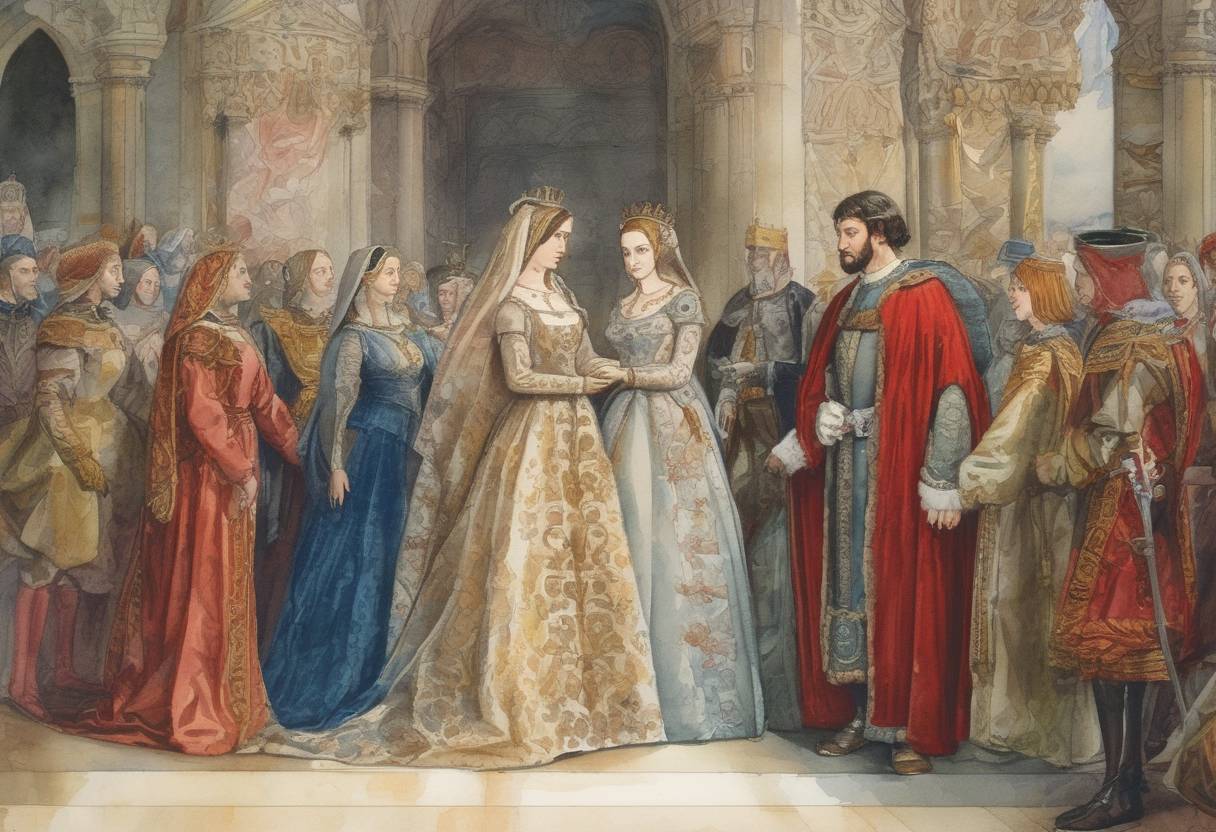
On October 18, 1469, a significant event took place in the town of Valladolid, Spain, that would alter the course of Spanish history: the marriage of Ferdinand II of Aragon and Isabella I of Castile. This union laid the foundation for the unification of Spain and the emergence of a powerful nation-state.
During the 15th century, the Iberian Peninsula was a patchwork of kingdoms, including Castile, Aragon, Navarre, and the Muslim-ruled Emirate of Granada. Castile and Aragon were the two largest Christian kingdoms, each with its own distinct culture, language, and political structure. The marriage between Ferdinand and Isabella was not merely a personal union but a strategic alliance aimed at consolidating power and territory.
The marriage was orchestrated to strengthen both kingdoms against internal and external threats. At the time, Castile was embroiled in a civil war over succession, while Aragon faced challenges from France and internal strife. The union was seen as a way to stabilize the region and create a formidable alliance against common adversaries, including the Muslim forces in Granada.
Ferdinand and Isabella were married in a modest ceremony in the Palacio de los Vivero in Valladolid. Despite the simplicity of the event, the marriage was of immense political significance. It was conducted in secret initially, as Isabella’s half-brother, King Henry IV of Castile, opposed the union. However, the marriage was later ratified and recognized.
Following their marriage, Ferdinand and Isabella became known as the “Catholic Monarchs” (Los Reyes Católicos). Their reign marked the beginning of a new era in Spanish history, characterized by religious unity and territorial expansion.
The marriage set the stage for the eventual unification of Spain. Although Castile and Aragon remained separate entities with their own laws and institutions, the personal union of their crowns under Ferdinand and Isabella paved the way for a more centralized Spanish state. This unification was further solidified with the conquest of Granada in 1492, which ended Muslim rule in Spain.
The Catholic Monarchs also played a crucial role in the Age of Exploration. In 1492, they sponsored Christopher Columbus’s voyage, leading to the discovery of the New World and the expansion of Spanish influence across the globe.
Ferdinand and Isabella were instrumental in the establishment of the Spanish Inquisition in 1478, aimed at maintaining Catholic orthodoxy. Their reign also saw the expulsion of Jews from Spain in 1492, a decision with profound cultural and demographic consequences.
The marriage of Ferdinand II of Aragon and Isabella I of Castile on October 18, 1469, was a turning point in Spanish history. It not only united two powerful kingdoms but also set the stage for the emergence of Spain as a dominant European power. Their legacy is marked by both the unification of Spain and the significant, albeit controversial, religious and cultural transformations that followed.
Source: en.wikipedia.org