The Pawning of Orkney and Shetland: February 20, 1472
1472 · Kirkwall, Scotland
Orkney and Shetland are pawned by Norway to Scotland in lieu of a dowry for Margaret of Denmark.
January 23, 1570
The assassination of James Stewart, 1st Earl of Moray, the Regent of Scotland, occurs, marking the first recorded assassination by firearm.
Linlithgow, Scotland | Kingdom of Scotland
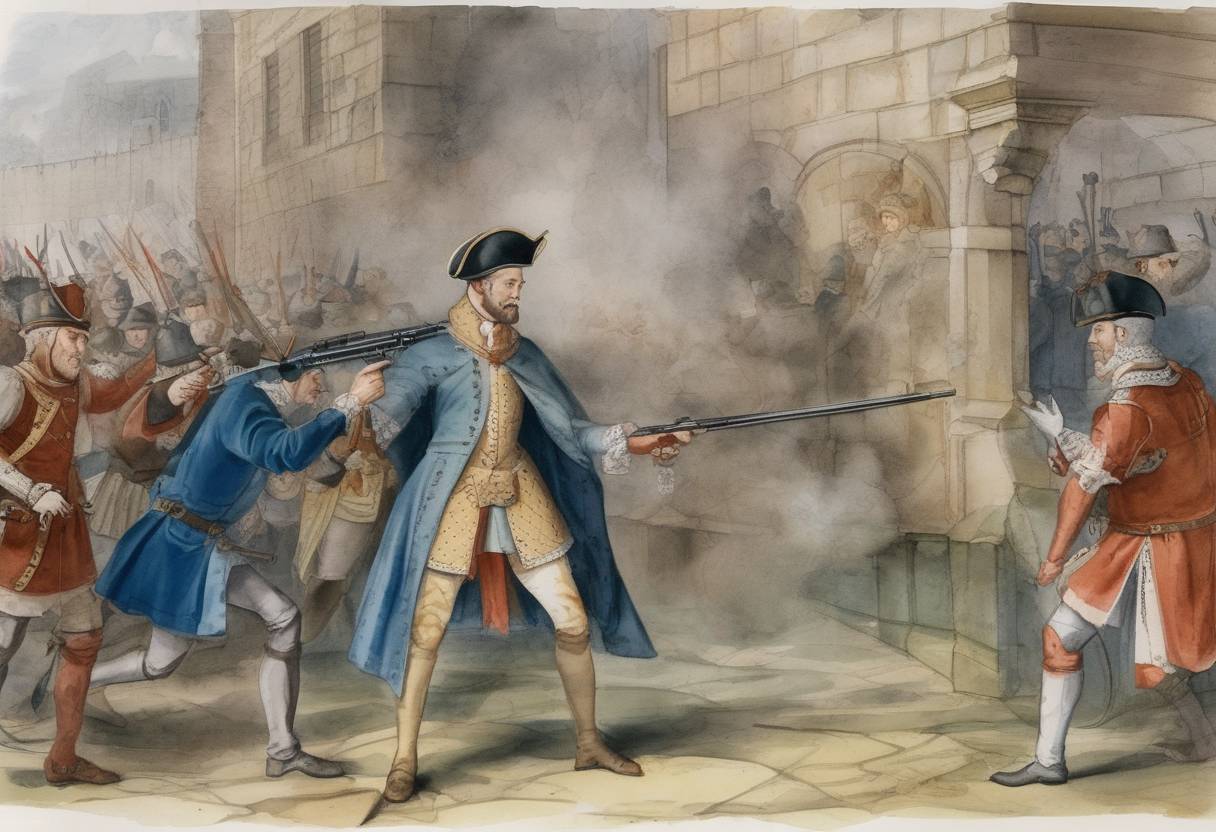
On January 23, 1570, James Stewart, 1st Earl of Moray and the Regent of Scotland, was assassinated in Linlithgow, marking a significant moment in history as the first recorded assassination by firearm. This event had profound implications for Scottish politics and the broader European context of the time.
James Stewart, born around 1531, was the illegitimate son of King James V of Scotland and Lady Margaret Erskine. Despite his illegitimacy, Stewart rose to prominence due to his political acumen and military prowess. He became a staunch supporter of the Protestant Reformation in Scotland and played a crucial role in the political landscape during the reign of his half-sister, Mary, Queen of Scots.
In 1567, following the forced abdication of Mary, Queen of Scots, Stewart was appointed as the Regent for her infant son, King James VI. As Regent, he was tasked with governing Scotland during a tumultuous period marked by religious conflict and political instability.
The assassination took place in Linlithgow, a town in West Lothian, Scotland. Stewart was shot by James Hamilton of Bothwellhaugh, a supporter of Mary, Queen of Scots. Hamilton used a firearm, specifically an arquebus, to carry out the assassination. The use of a firearm in this manner was unprecedented at the time and marked a new era in the methods of political assassination.
Hamilton’s motivations were deeply personal and political. He was a fervent supporter of the deposed Queen Mary and sought revenge against Stewart, whom he blamed for the confiscation of his lands and the imprisonment of his wife.
The assassination of the Earl of Moray had immediate and long-lasting effects on Scotland. It plunged the country into further chaos and exacerbated the ongoing civil war between the supporters of Mary, Queen of Scots, and those loyal to her son, King James VI. The event underscored the deep divisions within Scotland and highlighted the volatile nature of its politics during the 16th century.
Furthermore, the assassination by firearm set a precedent for future political killings, demonstrating the lethal potential of firearms in altering political landscapes. It foreshadowed the increasing use of such weapons in assassinations and warfare in the centuries to come.
In the broader European context, the assassination of a prominent Protestant leader like Stewart had implications for the religious conflicts that were sweeping across the continent, particularly during the Reformation and Counter-Reformation periods.
The assassination of James Stewart, 1st Earl of Moray, remains a pivotal moment in Scottish history. It not only marked the first recorded assassination by firearm but also highlighted the intense political and religious strife of the era. Stewart’s death left a power vacuum and contributed to the ongoing instability in Scotland, influencing the nation’s trajectory in the years that followed.
Source: en.wikipedia.org