Assassination of Umar ibn al-Khattab
644 · Medina, present-day Saudi Arabia
Umar ibn al-Khattab, the second caliph of the Rashidun Caliphate, is assassinated by the Persian slave Abu Lu'lu'a Firuz.
August 31, 0651
The Rashidun Caliphate's third caliph, Uthman ibn Affan, is assassinated in Medina, leading to the First Fitna, a major civil war within the Islamic community.
Medina, present-day Saudi Arabia | Rashidun Caliphate
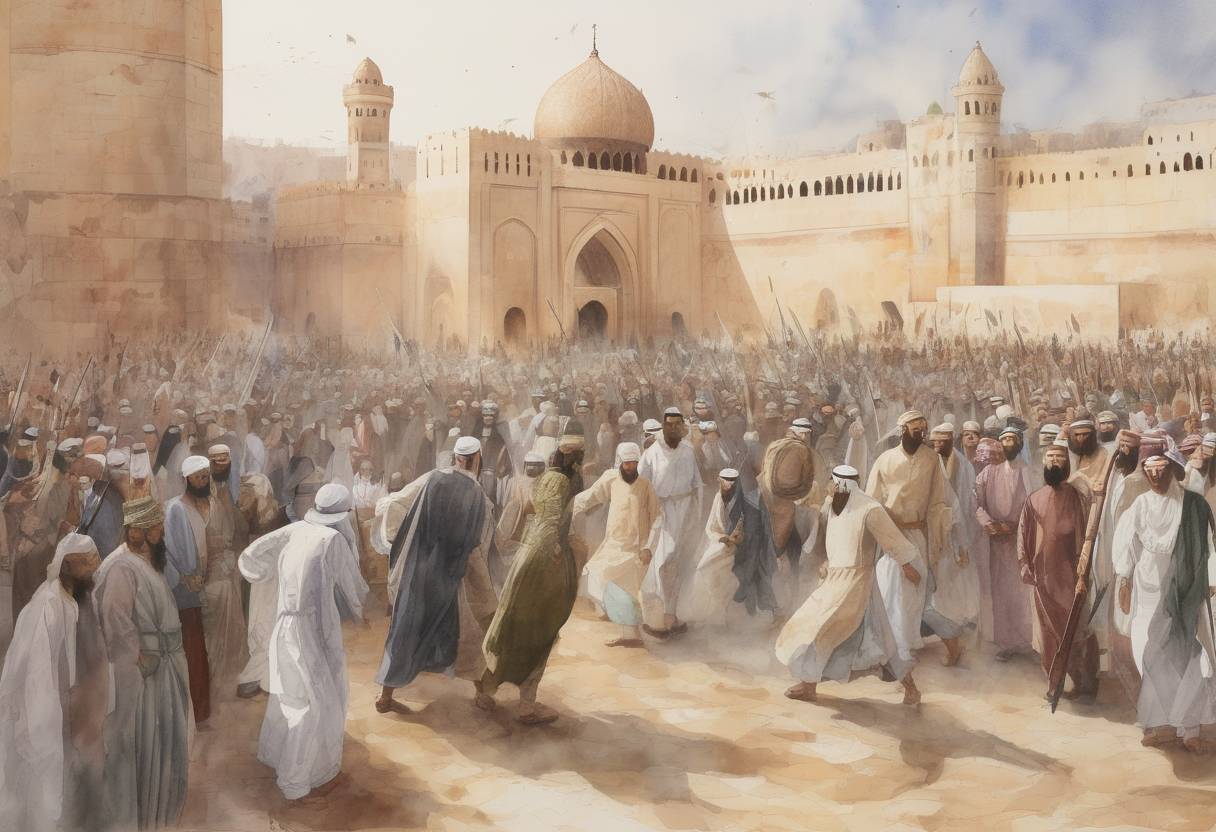
On August 31, 651, Uthman ibn Affan, the third caliph of the Rashidun Caliphate, was assassinated in Medina, an event that precipitated the First Fitna, a significant civil war within the early Islamic community.
Uthman ibn Affan was elected as the third caliph in 644 CE, succeeding Umar ibn al-Khattab. His reign was marked by significant territorial expansion and administrative consolidation. Uthman is notably credited with commissioning the compilation of the Quran into a single, standardized text, which helped preserve the Islamic scripture’s integrity.
However, his rule was also characterized by growing discontent and accusations of nepotism. Uthman appointed many of his Umayyad relatives to key positions, which led to widespread dissatisfaction among various factions within the Islamic community. This discontent was exacerbated by economic grievances and perceived injustices in the distribution of wealth and resources.
The tensions culminated in 651 CE when a group of rebels from Egypt, Iraq, and other regions besieged Uthman’s residence in Medina. Despite attempts at negotiation and intervention by prominent companions of the Prophet Muhammad, the siege continued. On August 31, 651, the rebels broke into Uthman’s house and assassinated him while he was reading the Quran.
The assassination of Uthman led to the First Fitna, the first major civil war within the Islamic community. The conflict was primarily between the supporters of Uthman’s successor, Ali ibn Abi Talib, and those who sought justice for Uthman’s murder, including the powerful Umayyad family.
Battle of the Camel (656 CE): This battle was fought between forces loyal to Ali and those led by Aisha, the widow of Muhammad, along with companions Talha and Zubair, who sought to avenge Uthman’s death. Ali emerged victorious, but the battle deepened divisions.
Battle of Siffin (657 CE): A protracted conflict between Ali’s forces and those of Muawiya ibn Abi Sufyan, the governor of Syria and a relative of Uthman, who refused to recognize Ali’s caliphate until Uthman’s murderers were punished.
Arbitration and Fragmentation: The arbitration process following the Battle of Siffin failed to resolve the conflict, leading to further fragmentation and the emergence of the Kharijites, a radical group that opposed both Ali and Muawiya.
The First Fitna ended with the assassination of Ali in 661 CE, paving the way for Muawiya to establish the Umayyad Caliphate. This marked a significant shift in Islamic governance from the elective caliphate of the Rashidun to a hereditary monarchy under the Umayyads.
The assassination of Uthman and the ensuing First Fitna had profound implications for the Islamic world. It highlighted the challenges of leadership and governance in a rapidly expanding empire and set a precedent for future conflicts over succession and legitimacy. The events also contributed to the eventual Sunni-Shia split, as different groups interpreted the events and their implications for Islamic leadership in varying ways.
The legacy of these events continues to influence Islamic thought and politics to this day, underscoring the enduring impact of this pivotal moment in history.
Source: en.wikipedia.org