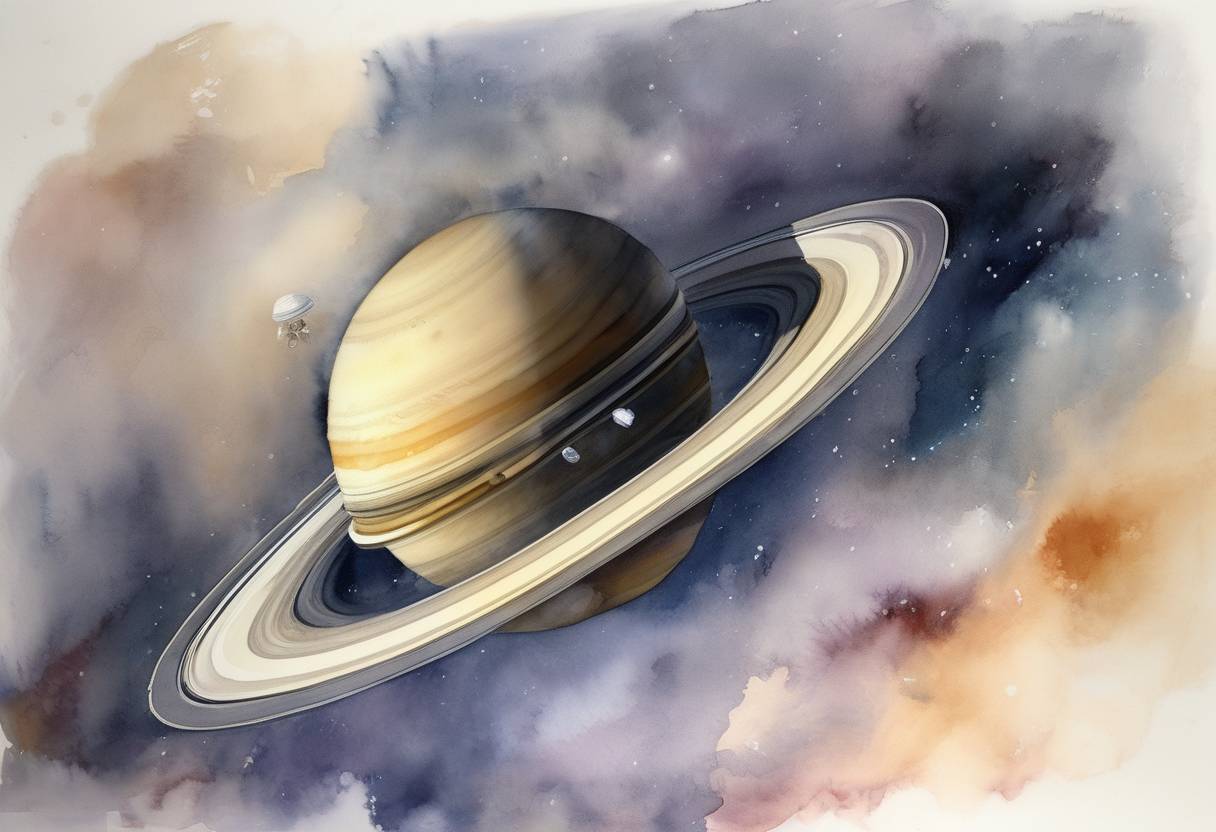
Cassini Spacecraft’s Grand Finale: September 14, 2017
On September 14, 2017, the Cassini spacecraft concluded its remarkable 20-year mission by diving into Saturn’s atmosphere, marking the end of one of NASA’s most successful and ambitious space explorations.
Background and Launch
The Cassini-Huygens mission was a collaborative project between NASA, the European Space Agency (ESA), and the Italian Space Agency (ASI). The spacecraft was launched on October 15, 1997, from Cape Canaveral, Florida. It was named after the Italian-French astronomer Giovanni Domenico Cassini, who discovered several of Saturn’s moons in the 17th century.
Mission Objectives
Cassini’s primary objectives were to study Saturn, its rings, and its moons. The mission aimed to provide a comprehensive understanding of the Saturnian system, including:
- The structure and behavior of Saturn’s rings.
- The composition and dynamics of Saturn’s atmosphere.
- The geological features and atmospheres of Saturn’s moons, particularly Titan and Enceladus.
- The magnetic environment around Saturn.
Key Discoveries
Throughout its mission, Cassini made numerous groundbreaking discoveries:
- Titan’s Surface: Cassini’s Huygens probe, which landed on Titan in January 2005, provided the first direct observations of the moon’s surface, revealing lakes and rivers of liquid methane and ethane.
- Enceladus’ Plumes: Cassini discovered geysers of water ice and organic molecules erupting from Enceladus, suggesting the presence of a subsurface ocean and the potential for microbial life.
- Saturn’s Rings: The spacecraft provided detailed images and data on the composition and dynamics of Saturn’s rings, enhancing our understanding of their structure and evolution.
The Grand Finale
As Cassini’s fuel supply dwindled, mission planners devised a dramatic end to the mission, known as the “Grand Finale.” This phase involved a series of daring orbits between Saturn and its innermost ring, providing unprecedented data on the planet’s gravity and magnetic fields.
On September 14, 2017, Cassini made its final plunge into Saturn’s atmosphere. This intentional descent ensured that the spacecraft would not contaminate any of Saturn’s moons, which might harbor conditions suitable for life. As it entered the atmosphere, Cassini transmitted its last data back to Earth before losing contact and disintegrating.
Legacy and Impact
Cassini’s mission significantly advanced our understanding of the Saturnian system and the broader dynamics of our solar system. Its findings have influenced future missions and sparked interest in the potential habitability of icy moons. The mission’s success demonstrated the value of international collaboration in space exploration and set a high standard for future planetary missions.
Cassini’s legacy continues to inspire scientists and the public alike, reminding us of the vastness of space and the potential for discovery beyond our planet.