The Consecration of the Hagia Sophia: December 27, 537
537 · Constantinople, Byzantine Empire
The Hagia Sophia in Constantinople is consecrated as a cathedral by Emperor Justinian I.
December 24, 0563
The Hagia Sophia in Constantinople was consecrated for the second time after being rebuilt by Emperor Justinian I following its destruction in the Nika riots.
Constantinople, Byzantine Empire | Byzantine Empire
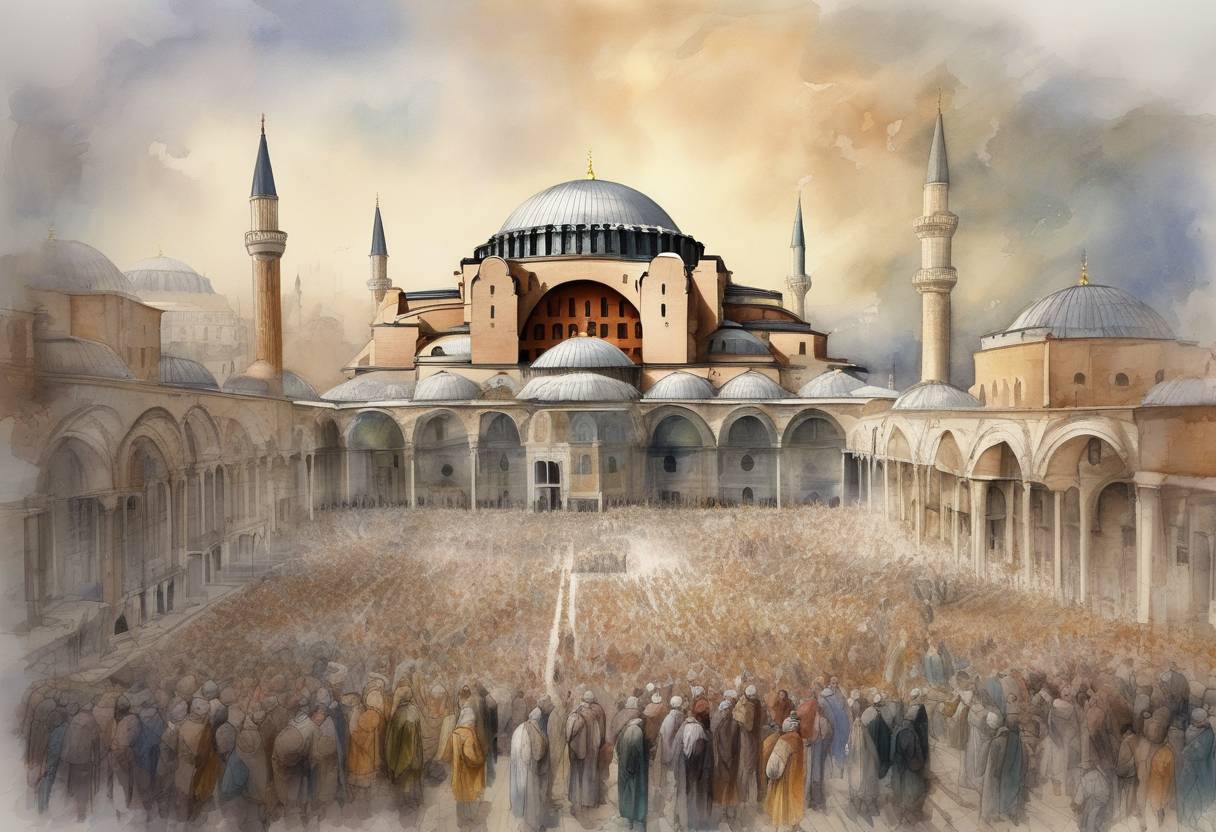
On December 24, 563, the Hagia Sophia in Constantinople was consecrated for the second time, marking a significant moment in Byzantine history. This event followed the reconstruction efforts led by Emperor Justinian I after the original structure was severely damaged during the Nika riots of 532.
The Nika riots were a devastating civil disturbance that erupted in Constantinople in January 532. The riots were initially sparked by tensions between rival chariot racing factions, the Blues and the Greens, but quickly escalated into a broader political rebellion against Emperor Justinian I. The violence resulted in the destruction of much of the city, including the original Hagia Sophia, which had been built by Emperor Constantius II in 360 and later rebuilt by Theodosius II.
In the aftermath of the riots, Justinian I embarked on an ambitious project to rebuild the Hagia Sophia, aiming to create a structure that would surpass its predecessor in grandeur and architectural innovation. He commissioned the renowned architects Isidore of Miletus and Anthemius of Tralles to design the new basilica. The reconstruction began in 532 and was completed in a remarkably short period, with the new Hagia Sophia being consecrated on December 27, 537.
The second consecration of the Hagia Sophia on December 24, 563, was necessitated by structural issues that arose after the initial completion. In 558, an earthquake caused the collapse of the main dome, a significant setback for the architectural marvel. Justinian ordered immediate repairs, which included reinforcing the dome and raising its height by approximately 20 feet to improve its stability. The reconstruction was overseen by Isidore the Younger, the nephew of Isidore of Miletus.
The Hagia Sophia, with its massive dome and innovative use of pendentives, became a masterpiece of Byzantine architecture. It served as the cathedral of Constantinople and the center of Eastern Orthodox Christianity for nearly a millennium. Its design influenced countless other structures and remains a testament to the architectural and engineering prowess of the Byzantine Empire.
The Hagia Sophia’s second consecration solidified its status as a symbol of Byzantine resilience and imperial power. It stood as the world’s largest cathedral for nearly a thousand years until the completion of the Seville Cathedral in 1520. The building’s rich history continued as it was converted into a mosque following the Ottoman conquest of Constantinople in 1453 and later into a museum in the 20th century. In 2020, it was reconverted into a mosque, reflecting its enduring significance in both religious and cultural contexts.
The Hagia Sophia remains an iconic monument, embodying the historical and cultural legacy of both the Byzantine and Ottoman empires.
Source: en.wikipedia.org