Theodore Roosevelt Awarded the Nobel Peace Prize - December 10, 1906
1906 · Oslo, Norway
President Theodore Roosevelt became the first American to be awarded the Nobel Peace Prize for his role in negotiating the end of the Russo-Japanese War.
September 5, 1905
The Treaty of Portsmouth was signed, ending the Russo-Japanese War. The treaty was mediated by U.S. President Theodore Roosevelt, who later won the Nobel Peace Prize for his efforts.
Portsmouth, United States | U.S. government
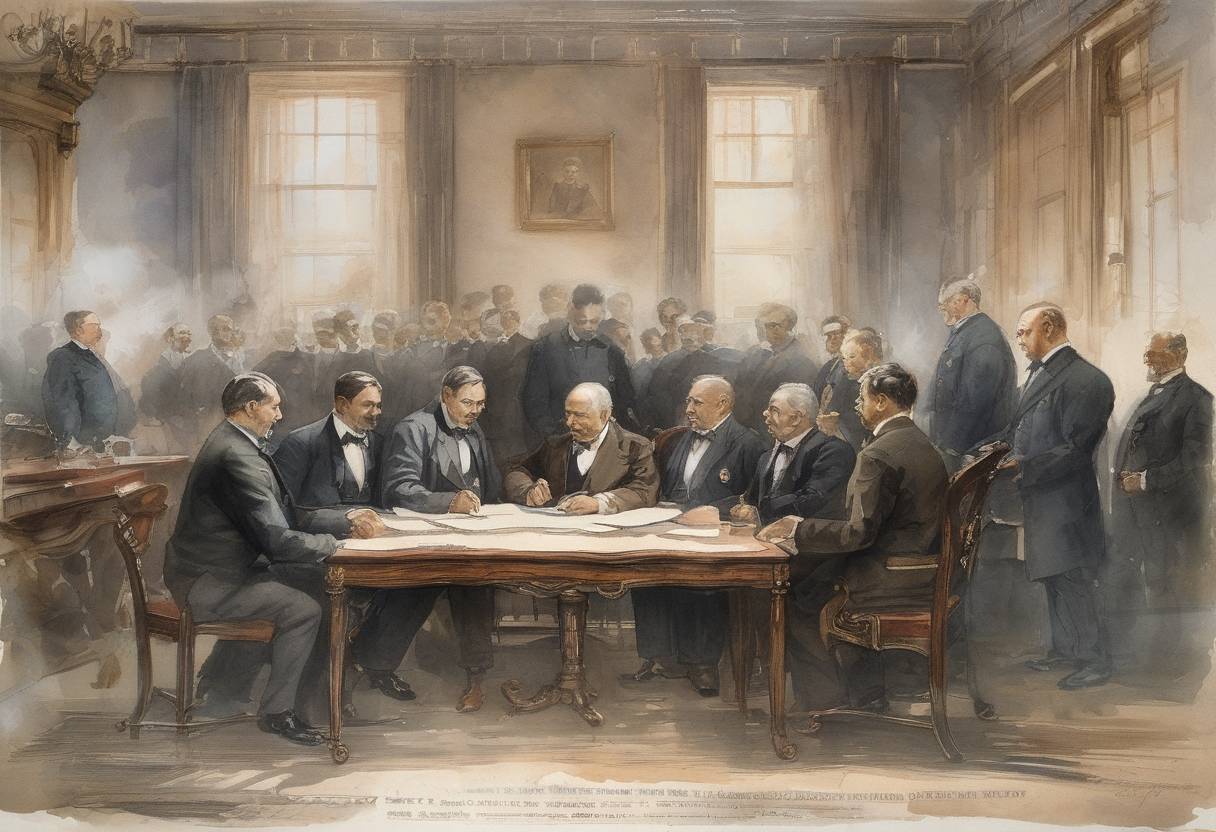
On September 5, 1905, the Treaty of Portsmouth was signed, bringing an end to the Russo-Japanese War. This significant event took place at the Portsmouth Naval Shipyard in Kittery, Maine, USA, and was mediated by U.S. President Theodore Roosevelt. His successful mediation efforts earned him the Nobel Peace Prize in 1906, marking the first time the award was given to an American.
The Russo-Japanese War, which lasted from 1904 to 1905, was primarily fought over imperial ambitions in Manchuria and Korea. Japan sought to expand its influence in East Asia, while Russia aimed to maintain and extend its control over the same regions. The conflict began with a surprise Japanese attack on the Russian naval base at Port Arthur in February 1904.
Japanese Victories: Japan achieved several significant victories, including the Battle of Tsushima, where the Japanese navy decisively defeated the Russian fleet. These victories underscored Japan’s growing military prowess and shifted the balance of power in East Asia.
Economic and Military Strain: Both nations faced considerable economic and military strain as the war dragged on. Russia, in particular, was dealing with internal unrest, which would later culminate in the Russian Revolution of 1905.
Diplomatic Intervention: Recognizing the potential for prolonged conflict and instability in the region, President Theodore Roosevelt offered to mediate peace talks. Both Japan and Russia, eager to end the costly war, accepted his offer.
The peace conference began in August 1905, with representatives from both nations meeting in Portsmouth. The negotiations were complex, with both sides having significant demands:
The Treaty of Portsmouth included several key provisions:
The Treaty of Portsmouth marked a turning point in international diplomacy and the balance of power in East Asia:
The Treaty of Portsmouth remains a significant example of early 20th-century diplomacy and the shifting dynamics of global power.
Source: www.britannica.com