Naval Battle off the Coast of Brittany - January 13, 1797
1797 · off the coast of Brittany, France
French Revolutionary Wars: A naval battle between French and British fleets occurs off the coast of Brittany.
March 15, 1744
The Battle of Toulon begins, a naval engagement during the War of the Austrian Succession between the French and combined British-Honé naval forces.
Toulon, France | French Navy
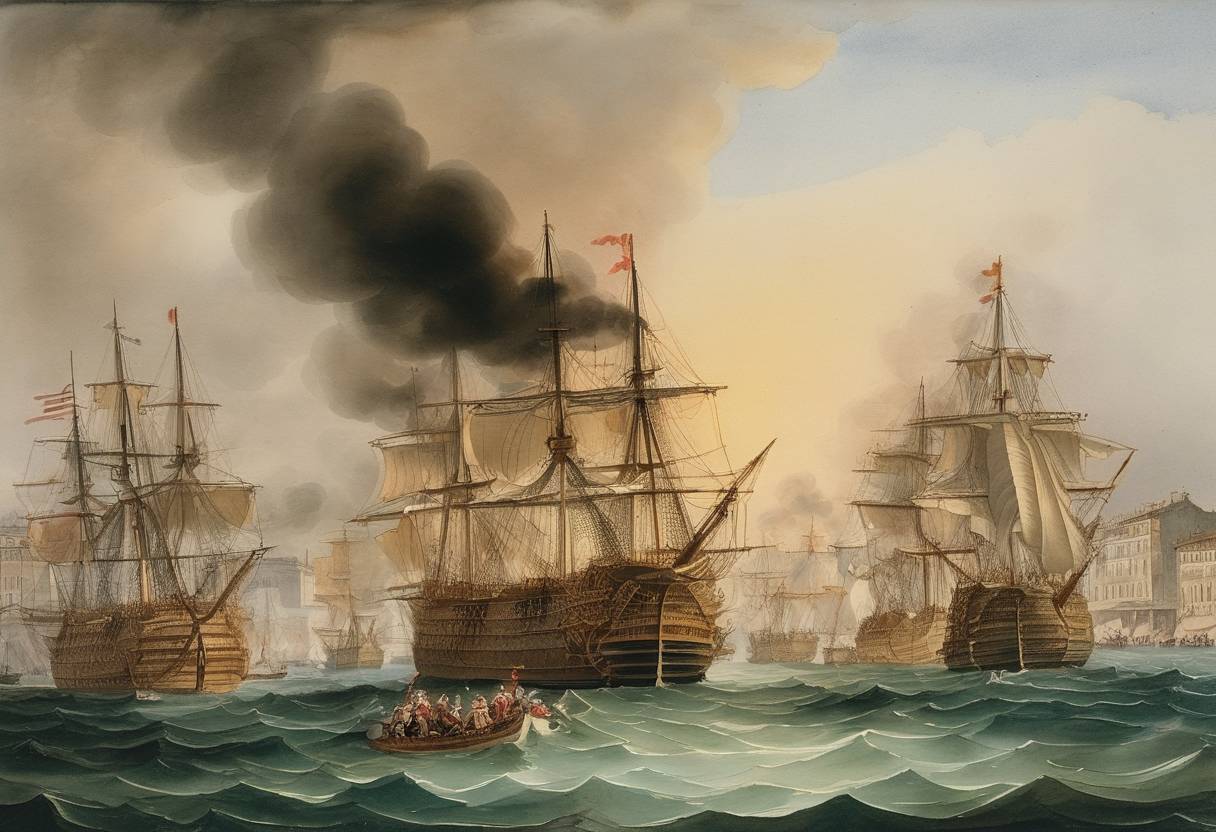
The Battle of Toulon was a key naval engagement during the War of the Austrian Succession, which was part of a larger series of conflicts concerning the balance of power in Europe. Emerging from the death of Charles VI, Holy Roman Emperor, in 1740, this war saw various European powers fighting over the succession rights to the Austrian throne.
Following Britain’s declaration of war on France in 1744, both powers quickly moved to strengthen their naval positions in the Mediterranean. Toulon was a critical strategic location as the primary base of the French Mediterranean fleet. The combined British and Dutch fleets, led by Admiral Thomas Mathews, sought to challenge French maritime influence and prevent French ships from interfering with British interests.
On March 15, 1744, the British and Dutch fleets engaged the French fleet near Toulon. The French fleet, commanded by Admiral Claude-Élisée de Court de La Bruyère, and the Spanish fleet, led by Don Juan José Navarro, collaborated due to the Bourbon family compacts aligning Spain and France. The French and Spanish forces were tasked with protecting a convoy meant to reinforce their Mediterranean presence.
The battle was characterized by chaotic exchanges and was known for the disorder in the British command structure, leading to a lack of concerted effort despite superior numbers. Both naval forces maintained their respective lines for much of the battle, exchanging artillery fire without significant gains.
The battle itself was tactically inconclusive, leading to strategic consequences. Despite not achieving a decisive victory or significant fleet damage, the engagement permitted the French and Spanish ships to continue their operations in the Mediterranean. The discord and lack of effective leadership within the British fleet would lead to the subsequent trial and court-martial of several senior officers, highlighting the need for better command coordination.
The Battle of Toulon underscored the complexity of naval warfare and illustrated the challenges of coalition operations, where diverse national interests and communication structures could significantly influence outcomes. While not decisive in the War of the Austrian Succession, it reflected the ongoing struggle for naval dominance and set the stage for future maritime engagements in the 18th century.
Source: www.britannica.com