Gustav I of Sweden Crowned King - January 12, 1528
1528 · Uppsala, Sweden
Gustav I of Sweden is crowned King of Sweden, marking the end of the Kalmar Union and the beginning of the modern Swedish state.
August 21, 0959
Eric the Victorious is proclaimed King of Sweden.
Uppsala, Sweden | Swedish monarchy
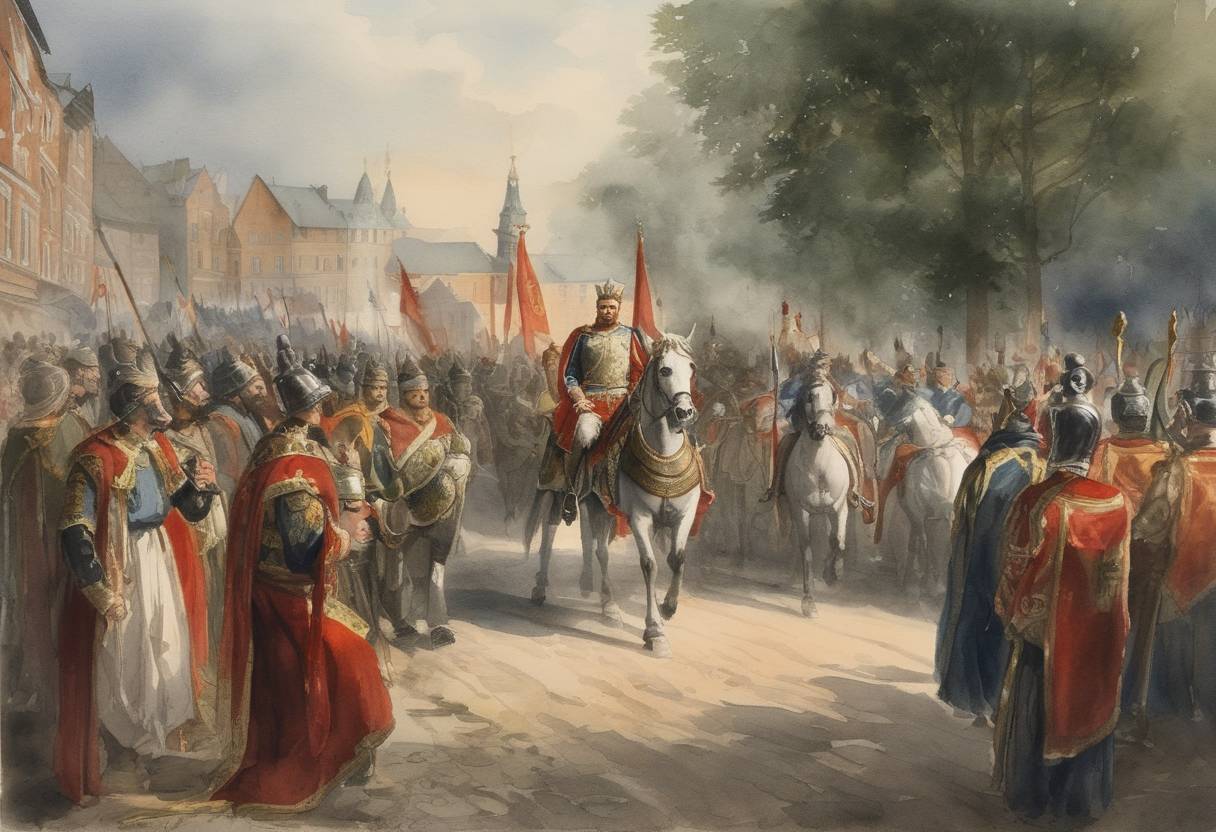
Eric the Victorious, known in Old Norse as Eiríkr inn sigrsæli, is traditionally recognized as the first King of Sweden. The specific date of his ascension, August 21, 959, is a matter of historical reconstruction as the exact records from this period are sparse. However, Eric’s reign marks a significant point in the formation of a unified Swedish kingdom, moving from a collection of small chiefdoms towards a centralized monarchy.
During the 10th century, the territories of what is now Sweden were fragmented among various regional lords and chiefs. The concept of a singular Swedish king began to emerge as these territories increasingly came under the control of more powerful leaders, capable of unifying the regions through both military prowess and strategic alliances.
Unification Efforts: Eric the Victorious was instrumental in uniting the various regions of Sweden. He hailed from a noble lineage, with connections that extended across Scandinavia. His ascension represented a consolidation of power, drawing together disparate groups under a singular leadership.
Military Achievements: Renowned for his military acumen, Eric’s victories against external threats and neighboring regions solidified his reputation as a formidable warrior. Though specific battles are not well-documented, his legacy as a conqueror hints at successful campaigns that expanded his influence.
Foundation of the Swedish Monarchy: Eric’s reign is often cited by historians as the starting point of a continuous line of Swedish monarchs, laying down the administrative and political groundwork for future rulers.
Cultural Impact: Eric the Victorious also had a lasting cultural impact. The stories of his reign, transmitted through Norse sagas and oral traditions, have contributed to the mythic heritage of Sweden, blending historical facts with legendary narratives.
External Relations: His rule is also marked by efforts to establish diplomatic ties with other leaders in Scandinavia, fostering trade and political alliances that would benefit Sweden’s positioning in Northern Europe.
Eric the Victorious’s legacy is enshrined in both legend and reality. While much of his life is subject to legendary embellishment, his role as a consolidator of power and an initiator of the Swedish monarchy is uncontested in historical studies. His era paved the way for subsequent Swedish rulers to develop a more centralized political entity, influencing the country’s trajectory through the medieval period and beyond.
Source: en.wikipedia.org