Thomas Edison's First Practical Electric Light Bulb Test
1879 · Menlo Park, United States
Using a carbon filament, Thomas Edison tests the first practical electric light bulb, which lasts 13.5 hours before burning out.
January 4, 1903
Topsy the elephant is electrocuted as part of a public demonstration by Thomas Edison to discredit alternating current (AC) and promote direct current (DC).
Luna Park, Coney Island, United States | Thomas Edison, Coney Island Circus
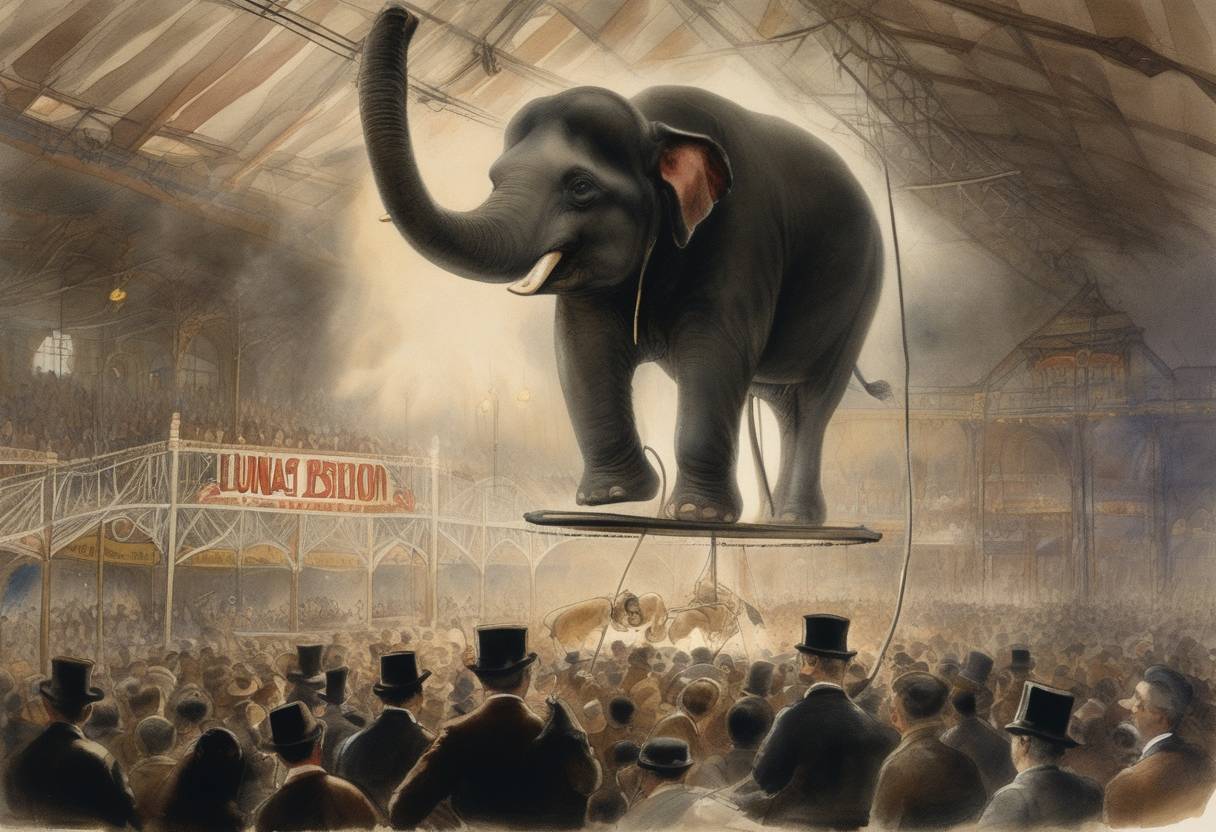
The electrocution of Topsy the Elephant was a tragic event that took place at the Luna Park Zoo on Coney Island in Brooklyn, New York, on January 4, 1903. Topsy, an Asian elephant, was put to death by electrocution amidst much public attention. Her killing marked a convergence of business interests, public spectacle, and the early 20th-century currents wars between alternating current (AC) and direct current (DC).
Topsy had been brought to the United States as a circus elephant and was later moved to Luna Park. Over time, she gained a reputation for belligerent behavior, reportedly killing three men over her lifetime. One of these incidents involved an intoxicated trainer who attempted to feed her a lit cigarette.
The electrocution of Topsy was orchestrated by Luna Park’s owners, who decided to euthanize her following her reputation and several public complaints. They initially planned to hang the elephant but this plan was deemed too horrific and impractical. Instead, they decided on electrocution, leveraging a method that had gained prominence during the “War of Currents,” a battle between Thomas Edison’s DC and the AC system advocated by Nikola Tesla and George Westinghouse.
While Thomas Edison did not personally conduct the electrocution, the use of electricity in this manner was heavily associated with his past efforts to demonstrate the dangers of AC power. Throughout the 1880s, Edison had campaigned against AC, conducting public demonstrations where animals were electrocuted to show its risks, a tactic that came to be known as “Westinghousing.” Despite Edison’s diminished role and previous efforts being largely behind him by 1903, the electrocution of Topsy resonated with those earlier anti-AC campaigns.
On the day of the execution, a large crowd and journalists gathered at Luna Park. Topsy was administered a combination of poisoned carrots and 6,600 volts of electricity supplied by the Edison Electric Illuminating Company of Brooklyn. The entire process was captured on film by the Edison Manufacturing Company, further entwining Edison’s name with the event.
The electrocution of Topsy was condemned by animal rights groups and marked a turning point in how animals were treated for entertainment and publicity. Although the event was initially used to sway public opinion about AC electricity, it largely failed to influence the outcomes of the currents war, as AC would eventually become the global standard for electrical power transmission.
The footage of Topsy’s death remains an unsettling reminder of early 20th-century spectacles and the intersection of scientific advocacy, entertainment, and ethics. The event contributed to ongoing discussions about animal rights and the ways technology is used and demonstrated to the public.
Source: en.wikipedia.org