Jacques Cartier's First Voyage to the New World
1534 · Saint-Malo, France
Jacques Cartier sets sail on his first voyage to the New World, commissioned by King Francis I of France to explore the northern lands, which would later become Canada.
July 24, 1534
French explorer Jacques Cartier lands in Canada, claiming it for France.
Gaspé, Canada | French Crown
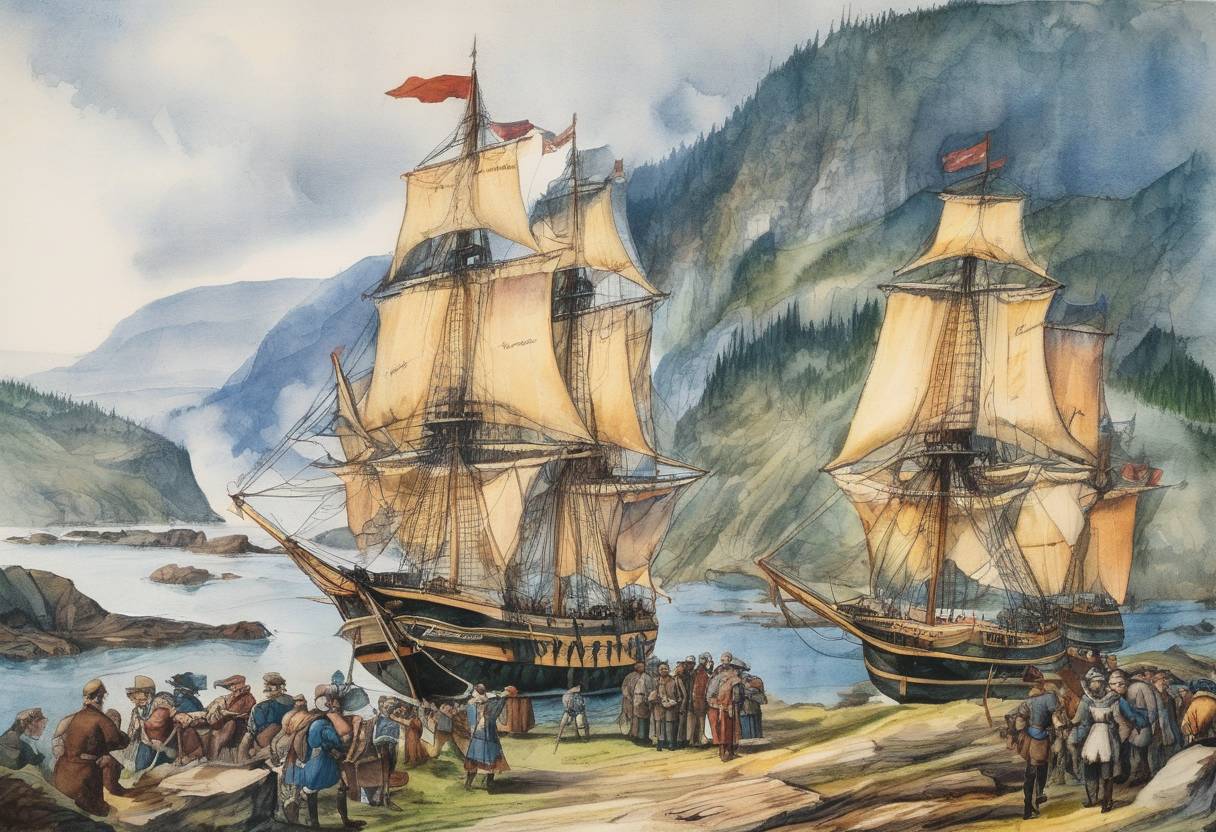
On July 24, 1534, the French explorer Jacques Cartier made a significant mark in the annals of history by landing on the shores of what is now Canada, claiming the territory for France. This event was a pivotal moment in the age of exploration and marked the beginning of French influence in North America.
Jacques Cartier: Born in 1491 in Saint-Malo, Brittany, Cartier was a skilled navigator and mariner. He was commissioned by King Francis I of France to explore the New World, seeking new lands and a possible passage to Asia.
The Mission: Cartier’s voyage was part of a broader European effort to explore and colonize the Americas. France, eager to expand its influence and compete with Spain and Portugal, sought new territories and resources.
Departure: Cartier set sail from Saint-Malo on April 20, 1534, with two ships and a crew of 61 men. His mission was to explore the Gulf of Saint Lawrence and find a northwest passage to Asia.
Exploration: During his journey, Cartier navigated the Gulf of Saint Lawrence, exploring parts of Newfoundland and the surrounding areas. He interacted with the indigenous peoples, including the St. Lawrence Iroquoians.
Gaspé Peninsula: On July 24, 1534, Cartier landed on the Gaspé Peninsula, located in present-day Quebec. Recognizing the strategic importance of the location, he erected a 30-foot wooden cross bearing the words “Vive le Roi de France” (“Long live the King of France”), symbolically claiming the land for France.
Interactions with Indigenous Peoples: Cartier’s arrival marked the beginning of complex interactions with the indigenous populations. He met with the local Iroquoian chief, Donnacona, and established initial relations, although these interactions would later become fraught with tension.
Subsequent Voyages: Cartier’s 1534 expedition was the first of three major voyages to the New World. He returned in 1535 and 1541, further exploring the Saint Lawrence River and laying the groundwork for future French colonization.
French Colonization: Cartier’s claim set the stage for the establishment of New France, a vast territory that would become a significant part of the French colonial empire in North America.
Legacy: Jacques Cartier is often credited with opening the interior of Canada to European exploration and establishing France’s enduring presence in the region. His voyages laid the foundation for the cultural and historical ties between France and Canada.
In summary, Jacques Cartier’s landing on July 24, 1534, was a landmark event in the history of exploration, marking the beginning of French territorial claims in North America and shaping the future of the continent.
Source: www.history.com