The Treaty of Fontainebleau: May 30, 1631
1631 · Fontainebleau, France
The Treaty of Fontainebleau was signed between Maximilian I, Elector of Bavaria, and King Louis XIII of France, marking a significant alliance during the Thirty Years' War.
January 17, 1601
The Treaty of Lyon is signed, ending the Franco-Savoyard War and resulting in territorial exchanges between France and the Duchy of Savoy.
Lyon, France | France and Duchy of Savoy
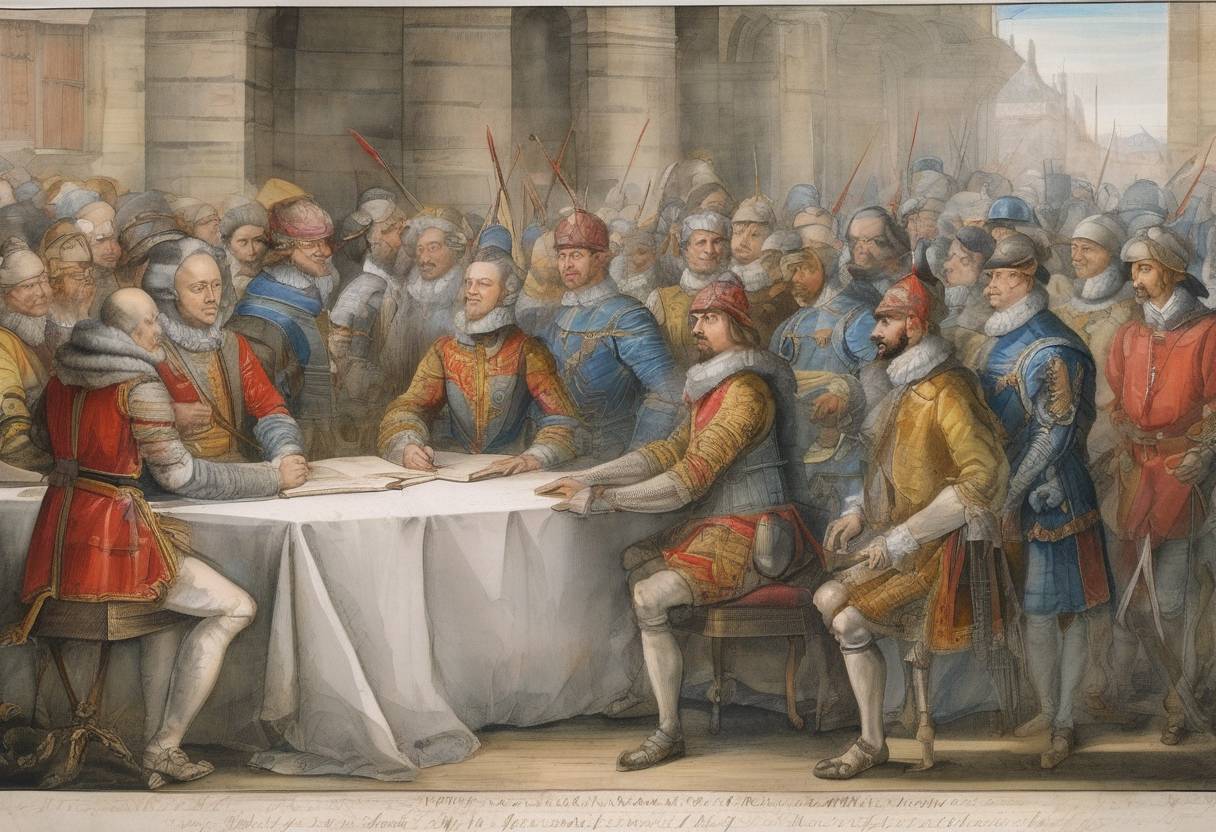
The Treaty of Lyon, signed on January 17, 1601, marked the conclusion of the Franco-Savoyard War, a conflict primarily between the Kingdom of France and the Duchy of Savoy. This treaty was a significant diplomatic agreement that resulted in territorial exchanges, reshaping the political landscape of the region.
The Franco-Savoyard War was part of the broader context of European power struggles in the late 16th and early 17th centuries. The Duchy of Savoy, strategically located in the Western Alps, was a key player in the region, often caught between the ambitions of France and the Habsburgs. The conflict arose from territorial disputes and the desire of both France and Savoy to expand their influence.
The Treaty of Lyon resulted in several important territorial exchanges:
France’s Gains: France acquired the regions of Bresse, Bugey, Valromey, and the Pays de Gex. These territories were strategically important as they provided France with greater control over the routes through the Alps and strengthened its eastern frontier.
Savoy’s Gains: In exchange, the Duchy of Savoy received the Marquisate of Saluzzo, a territory located in the Piedmont region. This acquisition was significant for Savoy as it consolidated its holdings in Italy and enhanced its influence in the region.
The Treaty of Lyon had several notable consequences:
Strengthening of France: By acquiring territories that improved its strategic position, France bolstered its defenses and expanded its influence in the region. This was part of King Henry IV’s broader strategy to stabilize and strengthen France after the Wars of Religion.
Savoy’s Italian Ambitions: The acquisition of Saluzzo allowed the Duchy of Savoy to focus more on its Italian ambitions, setting the stage for future conflicts and alliances in the Italian peninsula.
Diplomatic Precedent: The treaty demonstrated the effectiveness of diplomatic negotiations in resolving territorial disputes, setting a precedent for future treaties in Europe.
Regional Stability: The resolution of the conflict contributed to a period of relative stability in the region, allowing both France and Savoy to focus on internal consolidation and development.
In summary, the Treaty of Lyon was a pivotal moment in early 17th-century European diplomacy, reflecting the complex interplay of power, territory, and diplomacy that characterized the era. It not only ended a specific conflict but also influenced the geopolitical dynamics of Western Europe for years to come.
Source: en.wikipedia.org