The Duel Between Alexander Hamilton and Aaron Burr
1804 · Weehawken, United States
Alexander Hamilton was mortally wounded in a duel with Aaron Burr, the sitting Vice President of the United States, in Weehawken, New Jersey.
February 11, 1808
Anthracite coal is first burned as fuel, by Jesse Fell, in an experiment in Wilkes-Barre, Pennsylvania, demonstrating its potential as a heating source.
Wilkes-Barre, United States | none
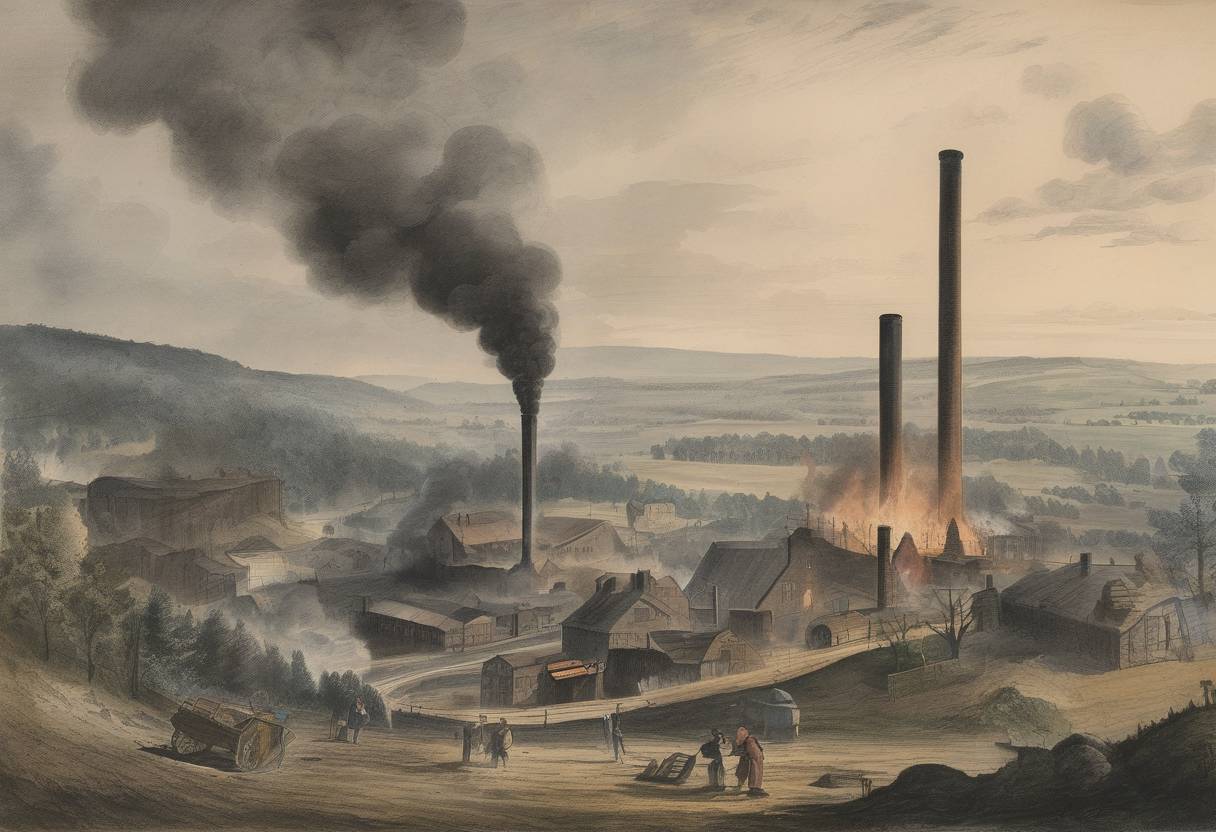
On February 11, 1808, Jesse Fell, a judge and entrepreneur in Wilkes-Barre, Pennsylvania, successfully burned anthracite coal in an open grate, demonstrating its potential as a viable heating source. This experiment marked a significant turning point in the use of coal as a fuel in the United States, particularly in the northeastern region.
Anthracite Coal: Known for its high carbon content and low impurities, anthracite is a hard, compact variety of coal that burns with little smoke. Despite its abundance in the northeastern United States, particularly in Pennsylvania, it was not widely used as a fuel source due to the difficulty in igniting it.
Early 19th Century Energy Needs: During this period, the primary sources of fuel for heating were wood and bituminous coal. However, as the population grew and industrialization began to take hold, there was an increasing demand for more efficient and abundant fuel sources.
The Experiment: Jesse Fell’s successful experiment involved burning anthracite coal on an open grate, which was a significant innovation. Prior attempts to use anthracite had failed due to its high ignition temperature and the lack of proper grates to facilitate its combustion.
Methodology: Fell’s method involved using a specially designed grate that allowed for better air circulation, which was crucial for maintaining the high temperatures needed to ignite and sustain the burning of anthracite coal.
Demonstration of Feasibility: Fell’s experiment proved that anthracite could be used effectively as a heating source, paving the way for its widespread adoption in homes and industries.
Economic and Industrial Impact: The successful use of anthracite coal contributed to the growth of the coal mining industry in Pennsylvania. It also played a crucial role in fueling the industrial revolution in the United States, providing a more efficient and cleaner-burning alternative to wood and bituminous coal.
Environmental Considerations: While anthracite burns cleaner than other types of coal, its increased use also marked the beginning of more intensive coal mining activities, which had significant environmental impacts over time.
Adoption and Expansion: Following Fell’s demonstration, anthracite coal became a popular heating source in the northeastern United States. Its use expanded rapidly, leading to the development of infrastructure such as railroads to transport coal from mines to urban centers.
Legacy: Jesse Fell’s innovation is remembered as a pivotal moment in the history of energy use in America. His experiment laid the groundwork for the coal industry, which would become a cornerstone of the American economy throughout the 19th and early 20th centuries.
In summary, Jesse Fell’s successful burning of anthracite coal on February 11, 1808, was a landmark event that demonstrated the fuel’s potential and set the stage for its widespread adoption, significantly impacting the economic and industrial landscape of the United States.
Source: en.wikipedia.org