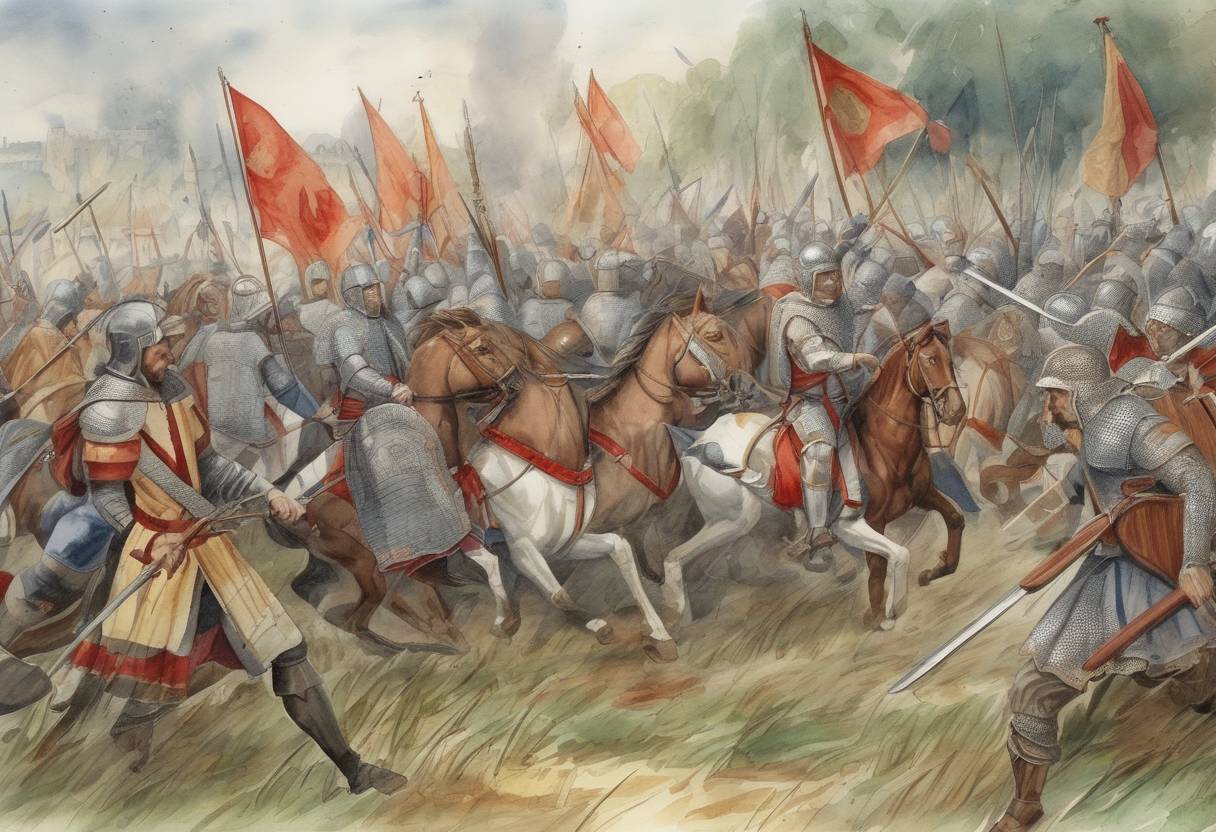
The Battle of Fontenay: A Key Conflict in the Carolingian Civil War
The Battle of Fontenay, fought on June 25, 841, was a pivotal engagement during the Carolingian Civil War, a conflict that arose from the power struggles within the Carolingian Empire following the death of Emperor Louis the Pious. This battle was instrumental in shaping the future political landscape of medieval Europe.
Context and Background
The Carolingian Civil War was primarily a succession dispute among the sons of Louis the Pious, the son of Charlemagne. Upon Louis’s death in 840, his empire was divided among his three surviving sons: Lothair I, Louis the German, and Charles the Bald. Lothair, the eldest, sought to assert his dominance over the entire empire, leading to tensions and eventual conflict with his brothers.
- Lothair I: Crowned as co-emperor by his father, he aimed to maintain the unity of the empire under his rule.
- Louis the German: Governed the eastern territories, known as East Francia.
- Charles the Bald: Controlled the western regions, known as West Francia.
The division of the empire and Lothair’s ambitions led to alliances forming between Louis the German and Charles the Bald against Lothair.
The Battle
The Battle of Fontenay took place near Fontenoy-en-Puisaye in present-day France. It was one of the largest and bloodiest battles of the era, involving tens of thousands of troops.
- Forces: The armies of Charles the Bald and Louis the German faced off against the forces of Lothair I and his nephew, Pepin II of Aquitaine.
- Outcome: The battle resulted in a tactical victory for Charles and Louis, although it was extremely costly in terms of lives lost. The victory prevented Lothair from consolidating control over the empire.
Aftermath and Significance
The Battle of Fontenay did not immediately resolve the conflict but was a decisive moment that weakened Lothair’s position. The continued struggle eventually led to the Treaty of Verdun in 843, which formally divided the Carolingian Empire into three distinct kingdoms:
- West Francia: Ruled by Charles the Bald, it laid the foundation for modern France.
- East Francia: Governed by Louis the German, it evolved into the Holy Roman Empire and later Germany.
- Middle Francia: Controlled by Lothair I, it included parts of modern-day Italy, the Low Countries, and Lorraine.
The Treaty of Verdun is often seen as a crucial moment in European history, marking the beginning of the formation of distinct European nations. The battle and subsequent treaty highlighted the challenges of maintaining a unified empire and set the stage for the political fragmentation of Europe in the Middle Ages.
In summary, the Battle of Fontenay was a significant conflict that underscored the complexities of succession and territorial control in the Carolingian Empire, ultimately leading to the division of one of the most powerful empires of the medieval period.