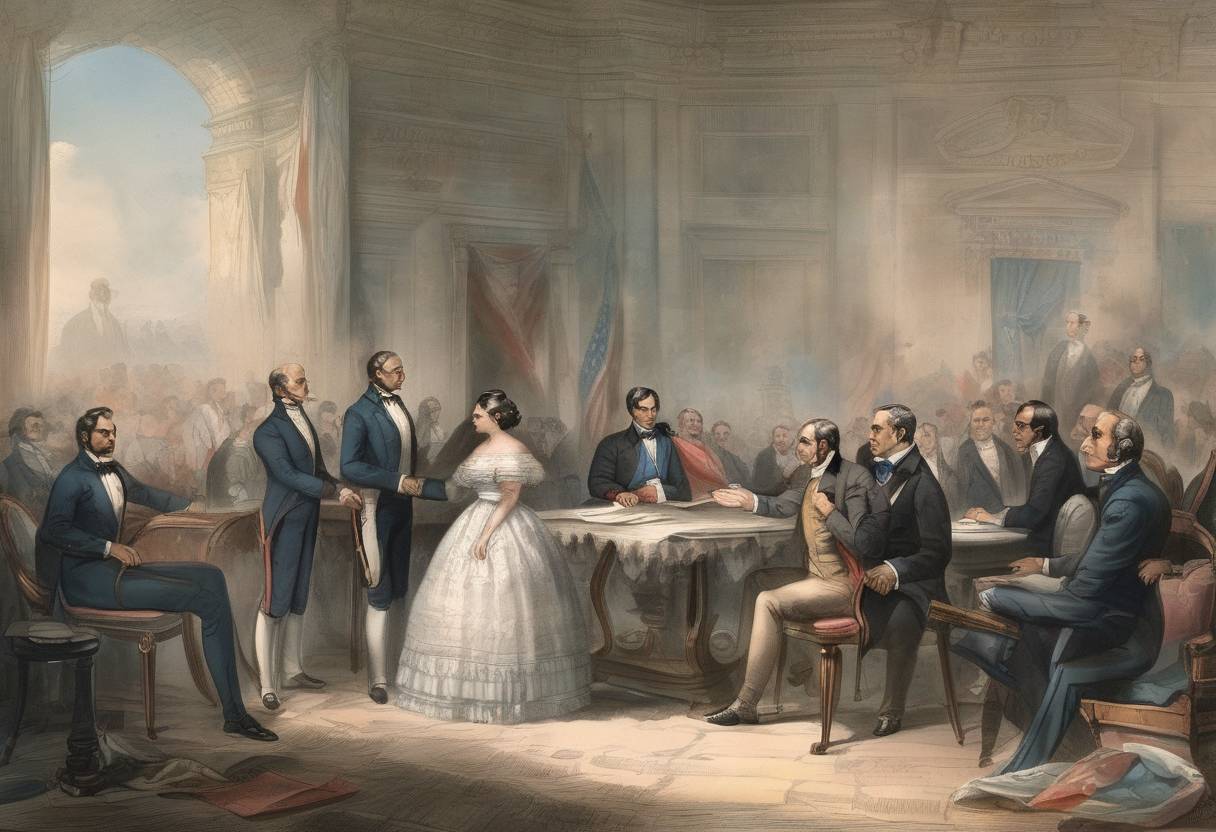
The Treaty of Guadalupe Hidalgo: Ratification by the U.S. Senate on March 10, 1848
On March 10, 1848, the United States Senate ratified the Treaty of Guadalupe Hidalgo, effectively bringing an end to the Mexican-American War. This treaty was a pivotal moment in North American history, as it not only concluded a significant conflict but also reshaped the territorial boundaries of the United States and Mexico.
Background
The Mexican-American War, which lasted from 1846 to 1848, was primarily driven by the United States’ expansionist policies under the doctrine of Manifest Destiny. The conflict began after the annexation of Texas by the United States in 1845, which Mexico still considered its territory despite the Texas Revolution of 1836. Tensions escalated when U.S. forces, under the command of General Zachary Taylor, moved into disputed territories between the Nueces River and the Rio Grande.
Key Provisions of the Treaty
The Treaty of Guadalupe Hidalgo was signed on February 2, 1848, in the Villa de Guadalupe Hidalgo, a neighborhood of Mexico City. The key provisions of the treaty included:
Territorial Cession: Mexico ceded approximately 55% of its pre-war territory to the United States. This included present-day California, Nevada, Utah, most of Arizona, and parts of New Mexico, Colorado, and Wyoming.
Financial Compensation: The United States agreed to pay Mexico \(15 million for the ceded territories and assumed \)3.25 million in debts owed by Mexico to American citizens.
Border Establishment: The Rio Grande was established as the southern border of Texas, resolving the territorial dispute that had partly led to the war.
Rights of Mexican Citizens: The treaty guaranteed that Mexican citizens residing in the newly acquired territories would have the right to remain and become U.S. citizens, with full civil rights.
Ratification and Aftermath
The U.S. Senate ratified the treaty on March 10, 1848, with a vote of 38 to 14. The ratification was not without controversy; some senators opposed the treaty, arguing either for more territorial gains or against the war’s expansionist motives.
The treaty’s ratification had significant consequences:
Territorial Expansion: It marked a major expansion of U.S. territory, fulfilling the Manifest Destiny ideology and setting the stage for future economic growth and settlement in the American West.
Impact on Mexico: The loss of territory was a severe blow to Mexico, contributing to political instability and economic challenges in the years that followed.
Native American and Mexican Populations: The treaty’s implementation often disregarded the rights of Native American tribes and Mexican citizens, leading to disputes and injustices that would persist for decades.
The Treaty of Guadalupe Hidalgo remains a critical document in understanding the complex history of U.S.-Mexico relations and the broader narrative of American expansionism in the 19th century.