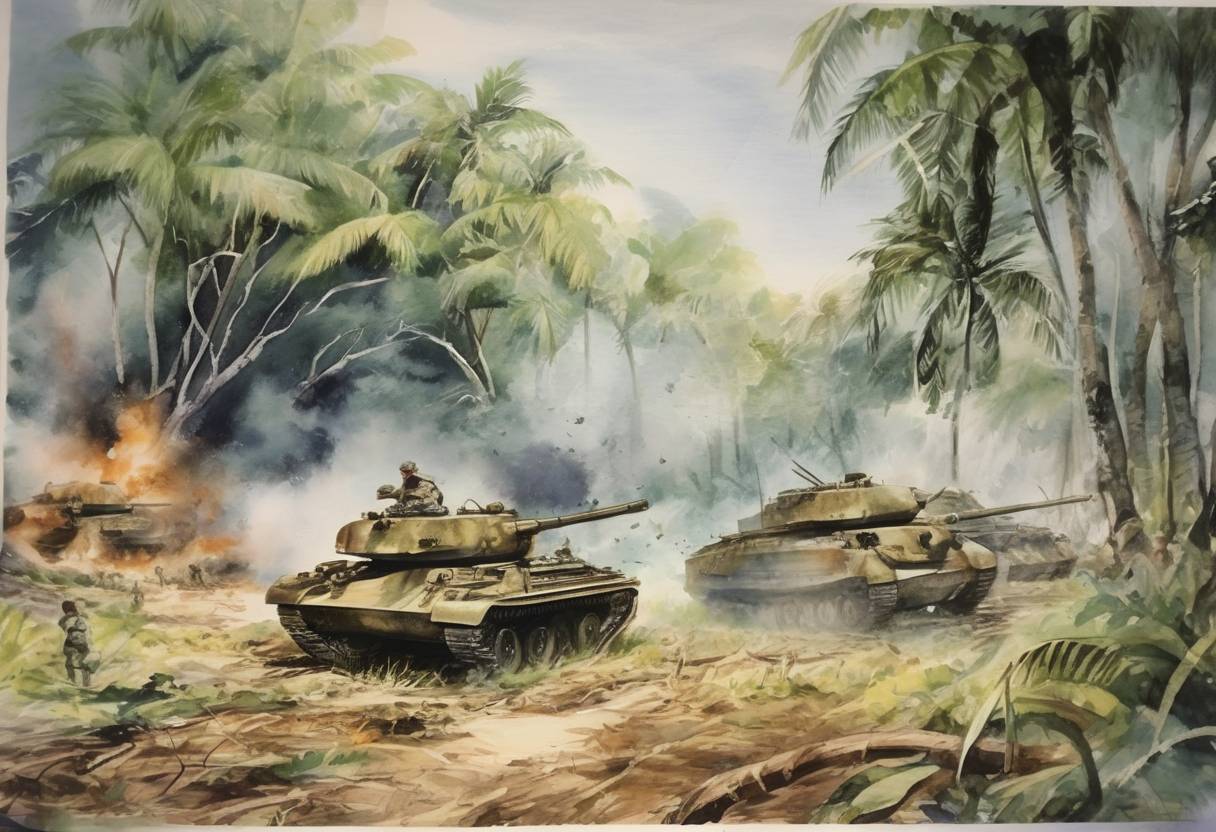
The Battle of Saipan: June 15, 1944
The Battle of Saipan, which commenced on June 15, 1944, was a pivotal engagement in the Pacific Theater of World War II. This battle marked a significant step in the United States’ island-hopping campaign aimed at recapturing territories occupied by Japan and moving closer to the Japanese mainland.
Context and Background
Strategic Importance: Saipan, part of the Mariana Islands, was strategically crucial due to its location. Capturing Saipan would allow the United States to establish airfields within striking distance of the Japanese home islands, facilitating bombing raids and cutting off Japanese supply lines.
Preparations: Prior to the invasion, American forces conducted extensive reconnaissance and planning. The operation was part of a larger campaign to secure the Marianas, which included the islands of Guam and Tinian.
The Invasion
Forces Involved: The invasion force consisted of the U.S. 2nd and 4th Marine Divisions, along with the U.S. Army’s 27th Infantry Division, totaling approximately 71,000 troops. They faced a well-entrenched Japanese garrison of about 31,000 soldiers.
Landing: On the morning of June 15, 1944, American forces launched an amphibious assault on Saipan’s western beaches. The landing was supported by naval bombardments and air strikes aimed at weakening Japanese defenses.
Initial Challenges: The American troops encountered fierce resistance from Japanese forces, who were deeply entrenched and utilized the island’s rugged terrain to their advantage. The battle quickly became a brutal and costly struggle.
Key Events and Tactics
Banzai Charges: Japanese forces, adhering to a strategy of no surrender, launched several banzai charges—frontal assaults intended to overwhelm American positions. These attacks, while courageous, resulted in heavy Japanese casualties.
American Advances: Despite initial setbacks, American forces gradually advanced inland, employing superior firepower and coordinated assaults to overcome Japanese defenses.
Civilians: The battle also involved tragic civilian casualties, as many of Saipan’s inhabitants were caught in the crossfire. Some civilians, influenced by Japanese propaganda, tragically chose suicide over capture.
Aftermath and Significance
Victory and Casualties: The battle concluded on July 9, 1944, with an American victory. The U.S. suffered approximately 3,426 killed and 13,099 wounded, while Japanese casualties were estimated at over 29,000, with only a few hundred taken prisoner.
Strategic Impact: The capture of Saipan had significant strategic implications. It provided the U.S. with a base for launching B-29 Superfortress bombers against Japan, marking a turning point in the Pacific War.
Psychological Effect: The loss of Saipan was a severe blow to Japanese morale and military strategy, demonstrating the vulnerability of the Japanese home islands to American air attacks.
The Battle of Saipan was a crucial step in the Allied campaign to defeat Japan, showcasing the determination and sacrifice of American forces in the Pacific and setting the stage for subsequent operations in the region.