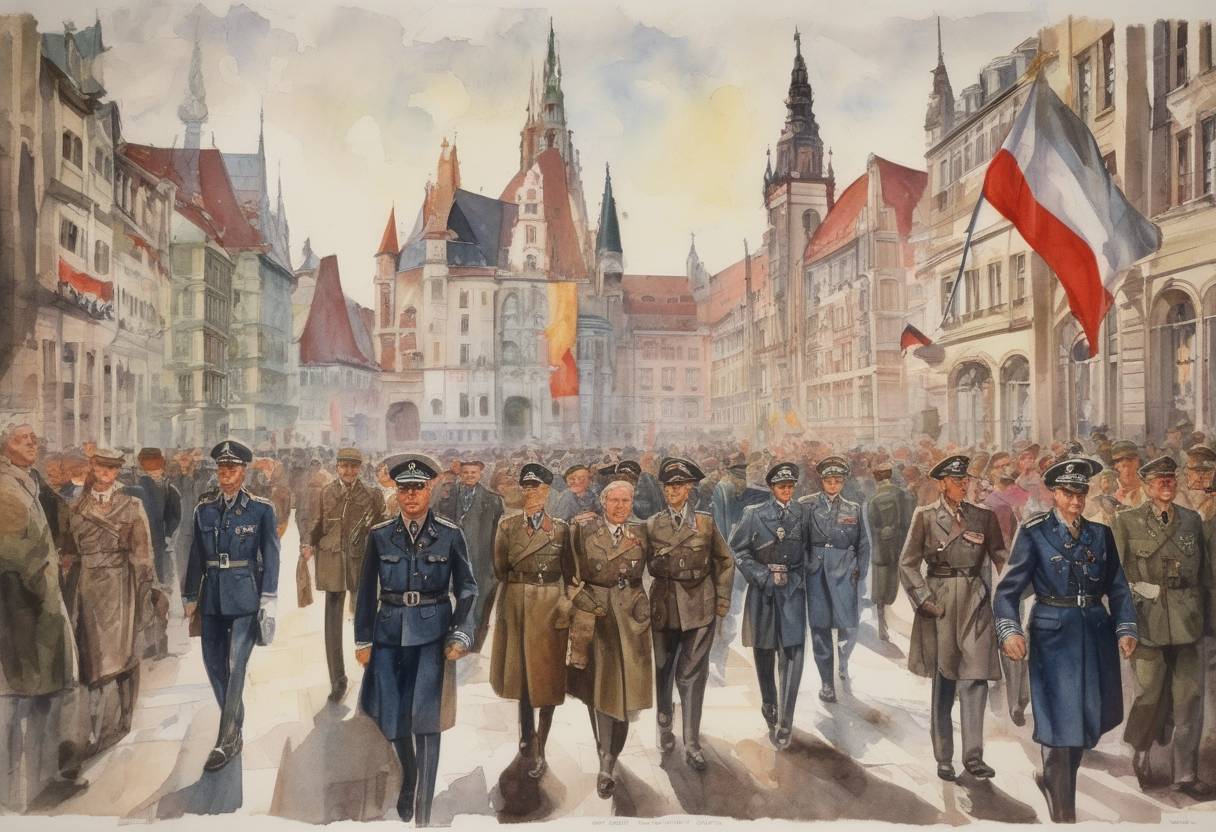
The Munich Agreement: September 29, 1938
On September 29, 1938, a pivotal moment in pre-World War II history occurred with the signing of the Munich Agreement. This accord was reached by Germany, the United Kingdom, France, and Italy, and it permitted Nazi Germany to annex the Sudetenland, a region of Czechoslovakia with a significant ethnic German population.
Context and Background
The Munich Agreement emerged from the complex geopolitical tensions in Europe during the late 1930s. Adolf Hitler, the Chancellor of Germany, had been aggressively pursuing expansionist policies, aiming to unite all German-speaking peoples under the Third Reich. The Sudetenland, with its substantial ethnic German community, became a focal point of Hitler’s ambitions.
Czechoslovakia, formed after World War I, was a multi-ethnic state with a significant German minority in the Sudetenland. The region was strategically important, both economically and militarily, as it contained vital industrial resources and defensive fortifications.
Key Events Leading to the Agreement
- March 1938: Germany annexed Austria in the Anschluss, emboldening Hitler’s expansionist agenda.
- Summer 1938: Tensions escalated as Hitler demanded the Sudetenland’s cession to Germany, citing self-determination for ethnic Germans.
- September 1938: European powers, eager to avoid another war, engaged in diplomatic efforts to resolve the crisis. British Prime Minister Neville Chamberlain and French Premier Édouard Daladier sought a peaceful solution.
The Munich Conference
The Munich Conference was convened on September 29, 1938, attended by Hitler, Chamberlain, Daladier, and Italian dictator Benito Mussolini. Notably, Czechoslovakia was not represented at the conference, nor was the Soviet Union, despite its alliance with Czechoslovakia.
Terms of the Agreement
- Germany was allowed to annex the Sudetenland, with the transfer of territory to occur by October 10, 1938.
- The agreement stipulated that the annexation would be overseen by an international commission.
- In exchange, Hitler provided assurances that he had no further territorial ambitions in Europe.
The Munich Agreement was initially hailed as a triumph of diplomacy, with Chamberlain famously declaring it brought “peace for our time.” However, the agreement is widely criticized for its policy of appeasement, as it effectively sacrificed Czechoslovakia’s sovereignty to placate Hitler.
- Czechoslovakia: The country was forced to cede the Sudetenland without a fight, severely weakening its defenses and economy.
- Europe: The agreement emboldened Hitler, who viewed the Western powers as unwilling to confront his aggression. This miscalculation contributed to the outbreak of World War II less than a year later, when Germany invaded Poland on September 1, 1939.
Historical Significance
The Munich Agreement is often cited as a classic example of the failures of appeasement. It demonstrated the dangers of compromising with aggressive totalitarian regimes and highlighted the need for a more resolute stance against expansionist policies. The agreement’s legacy influenced post-war policies and the formation of alliances aimed at preventing similar occurrences in the future.
In retrospect, the Munich Agreement is a stark reminder of the complexities and challenges of international diplomacy in the face of authoritarian aggression.