Discovery of Ancient Streambed on Mars by Curiosity Rover
2012 · Gale Crater, Mars
NASA's Mars rover Curiosity discovered evidence of ancient streambed on Mars, suggesting that water once flowed on the planet's surface.
August 1, 2012
The Mars Science Laboratory mission's rover, Curiosity, successfully landed on Mars, beginning its exploration of the Gale Crater to assess past and present habitability.
Gale Crater, Mars | NASA
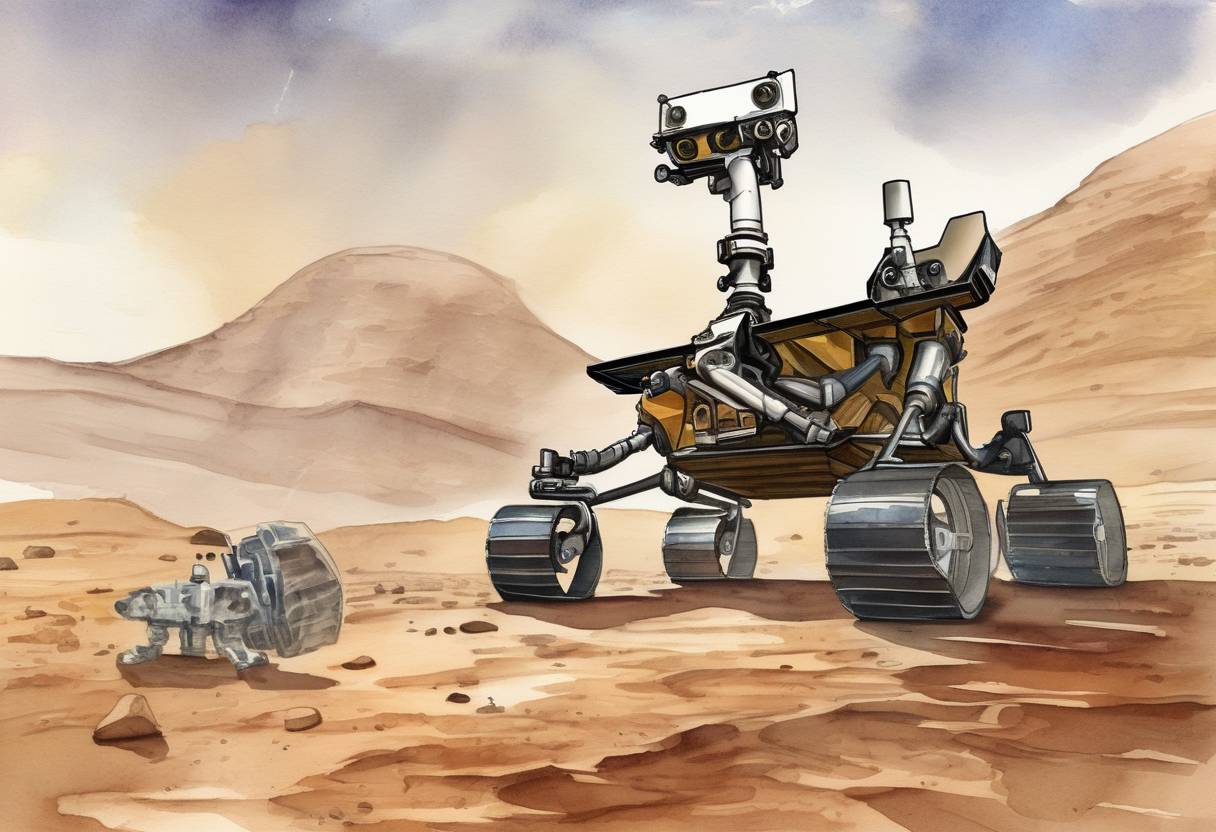
On August 1, 2012, the Mars Science Laboratory (MSL) mission’s rover, Curiosity, successfully landed on Mars, marking a significant milestone in space exploration. This event was a pivotal moment in NASA’s ongoing efforts to explore the Red Planet and assess its past and present habitability.
The Mars Science Laboratory mission was launched by NASA on November 26, 2011, from Cape Canaveral, Florida. The mission’s primary objective was to explore the Gale Crater on Mars, a site of great interest due to its diverse geology and potential to have once harbored conditions suitable for life.
Curiosity, a car-sized rover equipped with a suite of scientific instruments, was designed to carry out detailed analyses of the Martian surface. The rover’s mission included studying the planet’s climate and geology, assessing whether the selected field site inside Gale Crater ever offered environmental conditions favorable for microbial life, and investigating the role of water in the planet’s history.
Curiosity’s landing on Mars was a complex and highly anticipated event. The rover employed a novel landing technique known as the “sky crane” maneuver. This involved a controlled descent through the Martian atmosphere, followed by the deployment of a parachute to slow its descent. In the final stages, a rocket-powered sky crane lowered Curiosity gently onto the Martian surface.
The successful landing was confirmed at 10:32 PM PDT on August 5, 2012 (August 6, 2012, UTC), when signals from the rover were received by NASA’s Jet Propulsion Laboratory (JPL) in Pasadena, California. The landing site was named “Bradbury Landing” in honor of the late science fiction author Ray Bradbury.
Once on the surface, Curiosity began its exploration of Gale Crater. The rover’s scientific goals included:
Curiosity’s mission has significantly advanced our understanding of Mars. The rover’s findings have provided evidence that Gale Crater once had conditions suitable for microbial life, including the presence of ancient riverbeds and lakes. The data collected by Curiosity has also contributed to our knowledge of Mars’ climate evolution and its potential for future human exploration.
The success of the Curiosity mission has paved the way for subsequent Mars missions, including the Mars 2020 Perseverance rover, which continues to build on Curiosity’s legacy of exploration and discovery.
In summary, the successful landing of the Curiosity rover on August 1, 2012, was a landmark achievement in planetary exploration, offering invaluable insights into the habitability of Mars and setting the stage for future missions to the Red Planet.
Source: www.nasa.gov