Armenia Declares Independence from the Soviet Union
1990 · Yerevan, Armenia
Armenia declared its independence from the Soviet Union.
December 28, 1920
The Bolsheviks sign a treaty with the Armenian Republic in Yerevan, ending hostilities.
Yerevan, Armenia | Bolshevik government
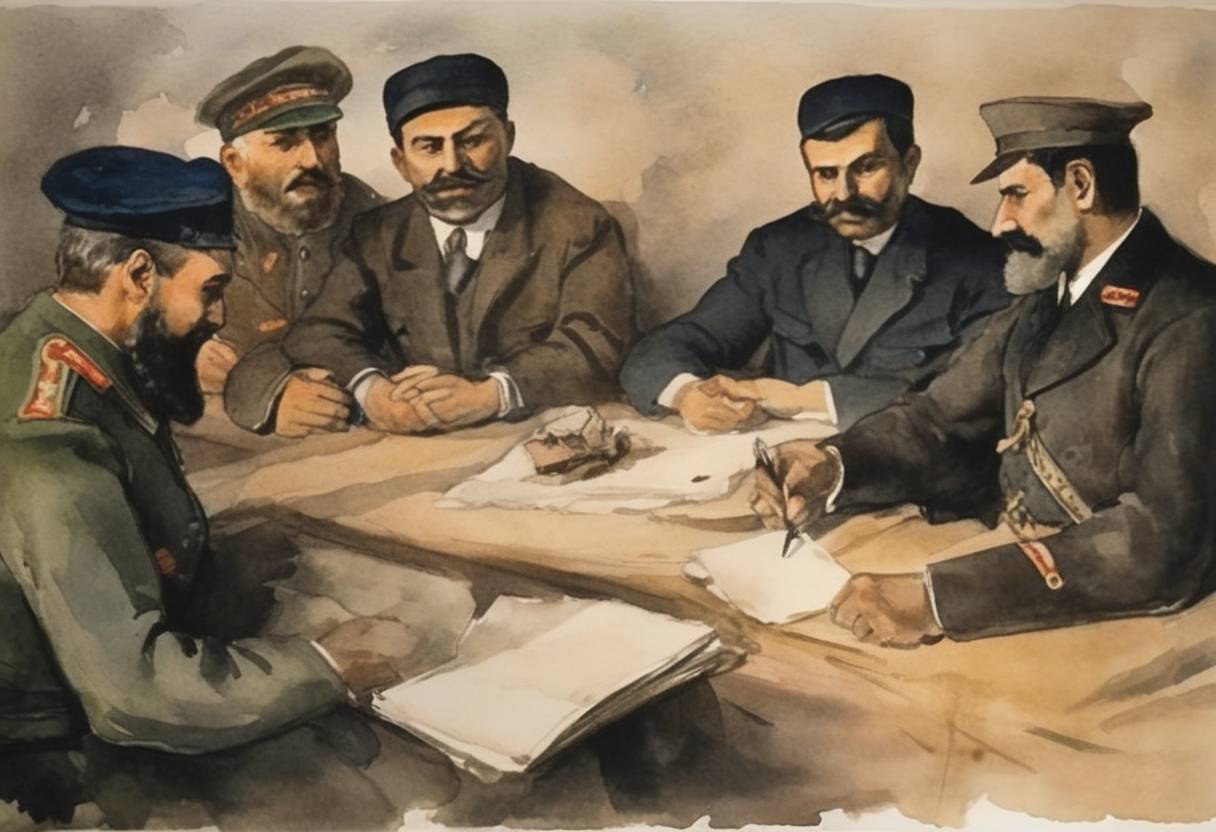
On December 28, 1920, the Bolshevik government’s representatives and delegates from the First Republic of Armenia signed a treaty in Yerevan, effectively ending hostilities between the Russian Soviet Federative Socialist Republic and Armenia. This event marked a pivotal moment in the Transcaucasian region’s history during a period of intense geopolitical transformation following the Russian Revolution and the collapse of the Ottoman Empire.
The establishment of the First Republic of Armenia in May 1918 followed the conclusion of World War I and the subsequent Treaty of Brest-Litovsk, which ceded parts of the Russian Empire to Ottoman Turkey. However, Armenia soon found itself embroiled in conflict with both Ottoman forces and neighboring states vying for territorial expansion, including Bolshevik Russia, which sought to reassert control over former imperial territories.
The Bolsheviks, engaged in a civil struggle to secure power across the former Russian Empire, had objectives in the Transcaucasus region to establish Soviet republics and spread socialism. The Armenian Republic, facing internal strife and external pressures, was unable to sustain prolonged military engagements, particularly against the larger Soviet forces.
Cessation of Hostilities: The primary aim of the treaty was to end ongoing military confrontations and to establish peace in the region, thereby providing a cessation of armed conflict between the Bolsheviks and Armenia.
Sovietization of Armenia: The agreement facilitated the Sovietization of Armenia, leading to the establishment of the Armenian Soviet Socialist Republic. Armenia agreed to adhere to a Soviet-style government, becoming a constituent part of the Transcaucasian Socialist Federative Soviet Republic.
Territorial Adjustments: The treaty also involved discussions over territorial holdings and mutual recognition of borders, though these issues would continue to evolve in subsequent years.
The treaty was part of a broader Bolshevik strategy to spread communist influence in the Caucasus, contributing to the eventual incorporation of Armenia, along with Georgia and Azerbaijan, into the Soviet Union. Soviet rule in Armenia brought significant political, social, and economic changes, aligning the country with Soviet ideologies and restructuring its political system.
The agreement also illustrated the complexities of early post-World War I treaties in Eastern Europe and the Caucasus, where newly formed nation-states struggled for independence amidst powerful regional forces and newly emerging ideologies. The Bolshevik victory solidified Soviet control in the Transcaucasian area, shaping the geopolitical landscape and affecting the region’s history throughout the 20th century.
The treaty of December 28, 1920, thus represents a critical juncture in Armenian history, reflecting the broader tumult and transformation that defined the post-imperial period in Eastern Europe and Central Asia.