Thomas Blood's Attempt to Steal the Crown Jewels - May 9, 1671
1671 · London, England
Thomas Blood, an Irish adventurer, attempted to steal the Crown Jewels from the Tower of London.
October 16, 1906
The Wilhelm Voigt impersonation caper occurred. Voigt, a German shoemaker, became famous when he impersonated a Prussian military officer and commandeered a squad of soldiers to help him rob a town hall in Köpenick.
Köpenick, Germany | none
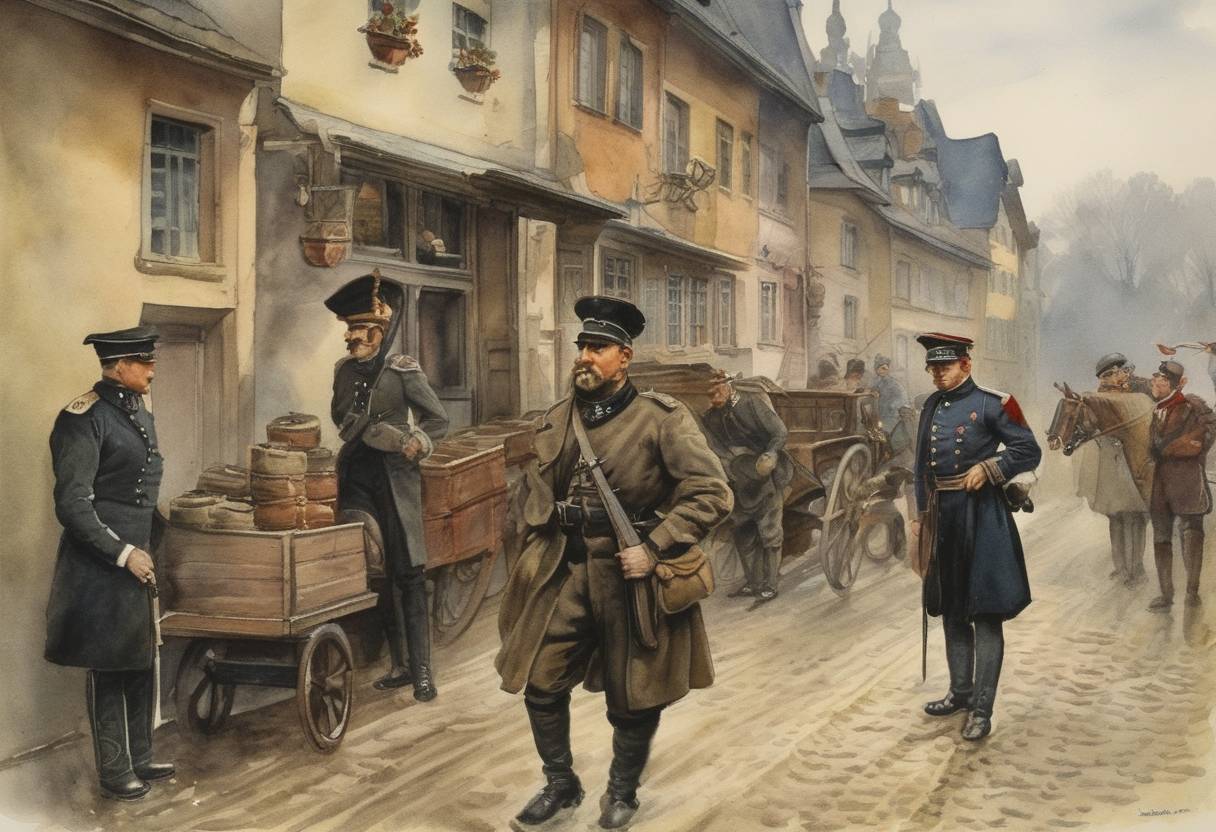
On October 16, 1906, Wilhelm Voigt, a German shoemaker who had previously served multiple prison sentences, executed one of the most audacious tricks in German history. Disguised as a Prussian military officer, Voigt commandeered a detachment of soldiers and seized the town hall of Köpenick, a suburb of Berlin.
Wilhelm Voigt was born on February 13, 1849, in Tilsit, East Prussia (now Sovetsk, Russia). Throughout his life, Voigt struggled to find steady work due to his criminal record and spent a total of 25 years in prison for various offenses, including theft and fraud. Upon his latest release in 1906, Voigt concocted a daring plan to solve his financial woes.
Using his knowledge of the Prussian military gained during his time in prison, Voigt acquired a used captain’s uniform piece by piece from several second-hand shops. On the morning of October 16, he donned this uniform and confidently approached a group of soldiers on leave in Berlin.
Voigt’s authoritative demeanor and plausible military bearing convinced the soldiers to follow him as if he were a real officer. He led them to the town hall of Köpenick and asserted that he had orders to take control of the building due to alleged discrepancies in the town’s accounts.
Once inside, Voigt detained the mayor and other officials, citing bureaucratic irregularities as the reason for their temporary arrest. Voigt then instructed the soldiers to guard these town hall officials and confiscated 4,002 marks and 37 pfennigs from the municipal treasury.
Having secured the money, Voigt excused himself, claiming he needed to take the funds to Berlin for audit evaluation purposes. Once outside, he vanished into the bustling city, leaving the soldiers and town officials bewildered.
The audacity and success of the caper captured public imagination and entertained people across Germany and beyond, largely due to its brazen challenge to the discipline of the Prussian military system. Voigt’s ruse held strong until he was apprehended on October 26, 1906.
In 1907, Voigt was convicted and sentenced to four years in prison. However, his daring act had made him something of a folk hero. Public sentiment, combined with his relatively non-violent crime, led Kaiser Wilhelm II to pardon Voigt on August 16, 1908.
After his release, Voigt capitalized on his newfound fame, appearing in vaudeville performances and publishing his autobiography. He died in Luxemburg in 1922, but his story lived on, immortalizing the date October 16, 1906, as a remarkable instance of audacious impersonation in history.
Source: en.wikipedia.org