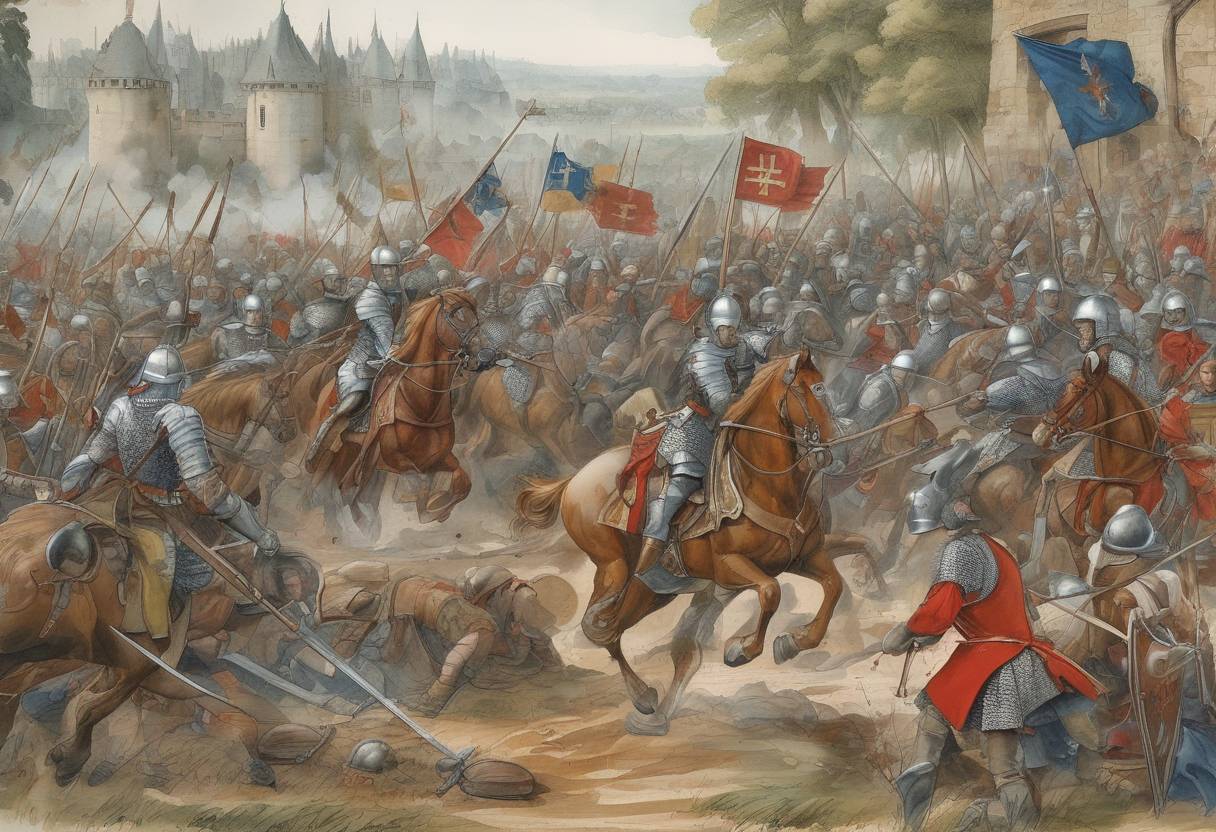
The Battle of the Spurs: August 16, 1513
The Battle of the Spurs, also known as the Battle of Guinegate, took place on August 16, 1513, during the War of the League of Cambrai, a part of the larger Italian Wars. This conflict saw English forces, led by King Henry VIII, achieve a significant victory over the French near the town of Guinegate in northern France.
Context and Prelude
- The War of the League of Cambrai: This was a complex series of conflicts involving major European powers, including France, the Holy Roman Empire, Spain, and England. Initially, the League of Cambrai was formed against Venice, but alliances shifted over time, leading to broader conflicts.
- Henry VIII’s Ambitions: Eager to assert his influence on the European stage and reclaim English territories in France, Henry VIII allied with the Holy Roman Emperor Maximilian I and Pope Julius II against France.
- The Campaign: In 1513, Henry VIII launched a campaign in northern France, aiming to capture key territories. The English forces were well-equipped and supported by the Emperor’s troops.
The Battle
- Location: The battle occurred near Guinegate, close to the town of Thérouanne, which was under siege by the English.
- Forces Involved: The English army, bolstered by Imperial forces, faced a French cavalry force led by French nobles, including the Duke of Longueville.
- The Engagement: The battle was characterized by a swift cavalry skirmish rather than a prolonged engagement. The French, upon encountering the English forces, quickly retreated in disarray. The speed of their retreat led to the battle being dubbed the “Battle of the Spurs,” as the French cavalry was said to have used their spurs more than their swords.
Aftermath and Significance
- English Victory: The English forces captured several French nobles, including the Duke of Longueville, which was a significant morale boost for Henry VIII’s campaign.
- Capture of Thérouanne and Tournai: Following the battle, the English successfully captured the towns of Thérouanne and Tournai, consolidating their position in northern France.
- Diplomatic Impact: The victory enhanced Henry VIII’s reputation and influence in European politics, although the territorial gains were not long-lasting.
- Legacy: The Battle of the Spurs is remembered for its demonstration of English military prowess and the effective use of cavalry tactics. It also highlighted the shifting alliances and complex nature of European politics during the early 16th century.
In summary, the Battle of the Spurs was a notable event in the early reign of Henry VIII, showcasing his military ambitions and the intricate web of alliances that characterized the Italian Wars.