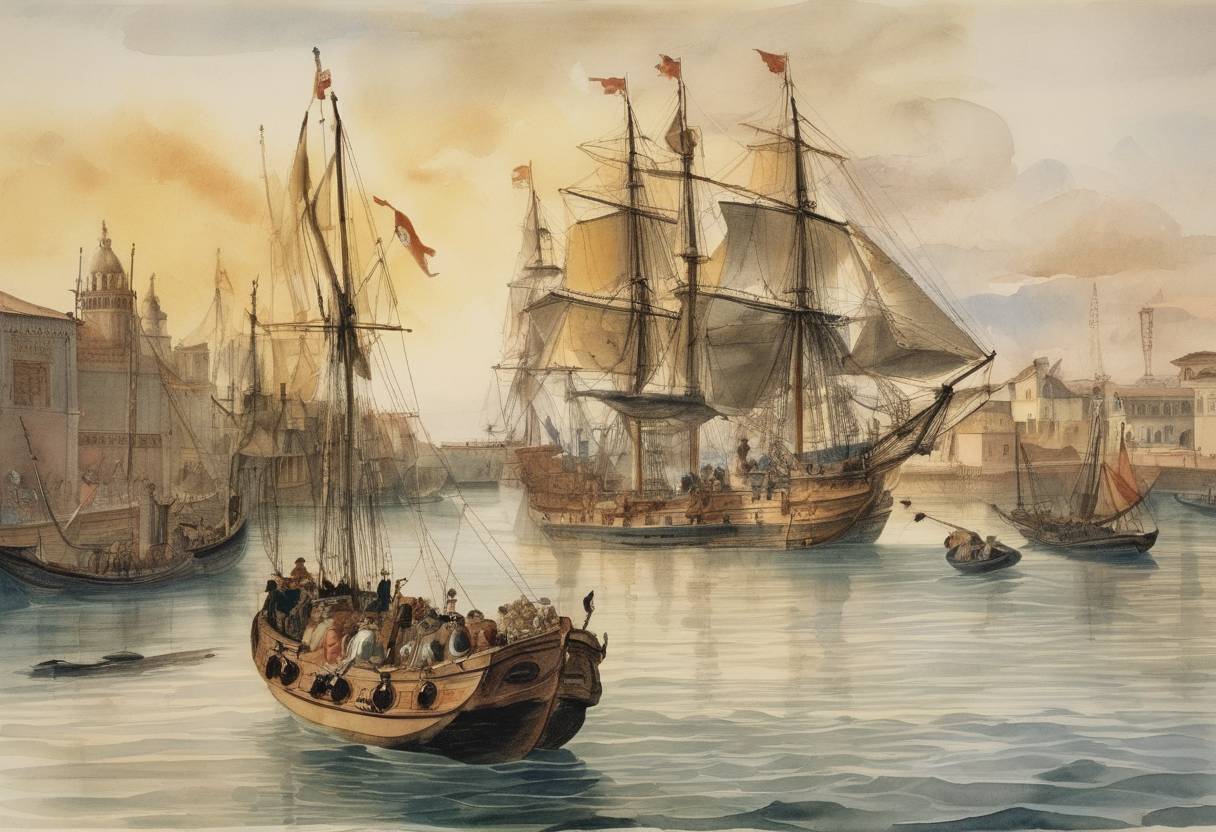
March 22, 1508: Amerigo Vespucci Appointed Chief Navigator of Spain
On March 22, 1508, King Ferdinand II of Aragon appointed the Italian explorer Amerigo Vespucci as the chief navigator of Spain. This pivotal appointment enabled Vespucci to establish a standardized system for determining nautical distances and positions, which significantly advanced the field of navigation and exploration during the Age of Discovery.
Historical Context
During the late 15th and early 16th centuries, European nations were driven by the quest for new trade routes and territories. This period, known as the Age of Discovery, saw significant advancements in maritime exploration. Spain, eager to assert its dominance in the New World following Columbus’s historic voyages, required a systematic approach to navigation for its expanding empire.
Amerigo Vespucci’s Role
Amerigo Vespucci was an Italian explorer and cartographer renowned for recognizing that the lands discovered by Columbus were part of a new continent, later named “America” in his honor. His voyages to the New World, primarily between 1499 and 1502, contributed to a clearer understanding of the geography of the Americas.
In his position as the chief navigator, Vespucci was tasked with devising a system that would allow Spanish explorers to accurately chart their courses across the oceans. His work facilitated better planning and implementation of maritime voyages, which was crucial for the expansion of Spanish influence overseas.
Significance of the Appointment
Vespucci’s appointment signaled increased professionalism and reliance on scientific knowledge in navigation. Prior to this, navigation relied heavily on experience and rudimentary tools. Vespucci’s contributions laid foundational work for advancements in navigation technology, which would ultimately lead to more precise global exploration.
Contributions
- Standardization: Vespucci helped standardize nautical maps, charts, and instrumentation, fostering consistency in navigation practices.
- Training and Education: He played a role in educating navigators, thus spreading his standardized methods across Spain’s naval fleets.
- Mapping Techniques: His improvements to cartography were instrumental in producing more accurate global maps, incorporating longitude and latitude concepts more reliably.
Aftermath and Historical Impact
Vespucci’s contributions to navigation continued to influence explorers after his tenure. The systems and training programs he established under the Spanish crown laid groundwork for future explorations, including those by Ferdinand Magellan and others who expanded Europe’s geographic understanding.
The recognition of Vespucci’s work is evident not only in the continent named after him but also in the lasting legacy of modern navigation practices rooted in his innovative approaches. His appointment as chief navigator was a crucial turning point in the history of exploration, fostering an era of greater precision and understanding of world geography.