Evacuation Day: November 25, 1783
1783 · New York City, United States
The last British troops leave New York City, marking the end of British occupation in the United States after the American Revolutionary War.
April 15, 1783
Preliminary articles of peace ending the American Revolutionary War were ratified by the Congress of the Confederation in the United States.
Philadelphia, United States | Congress of the Confederation
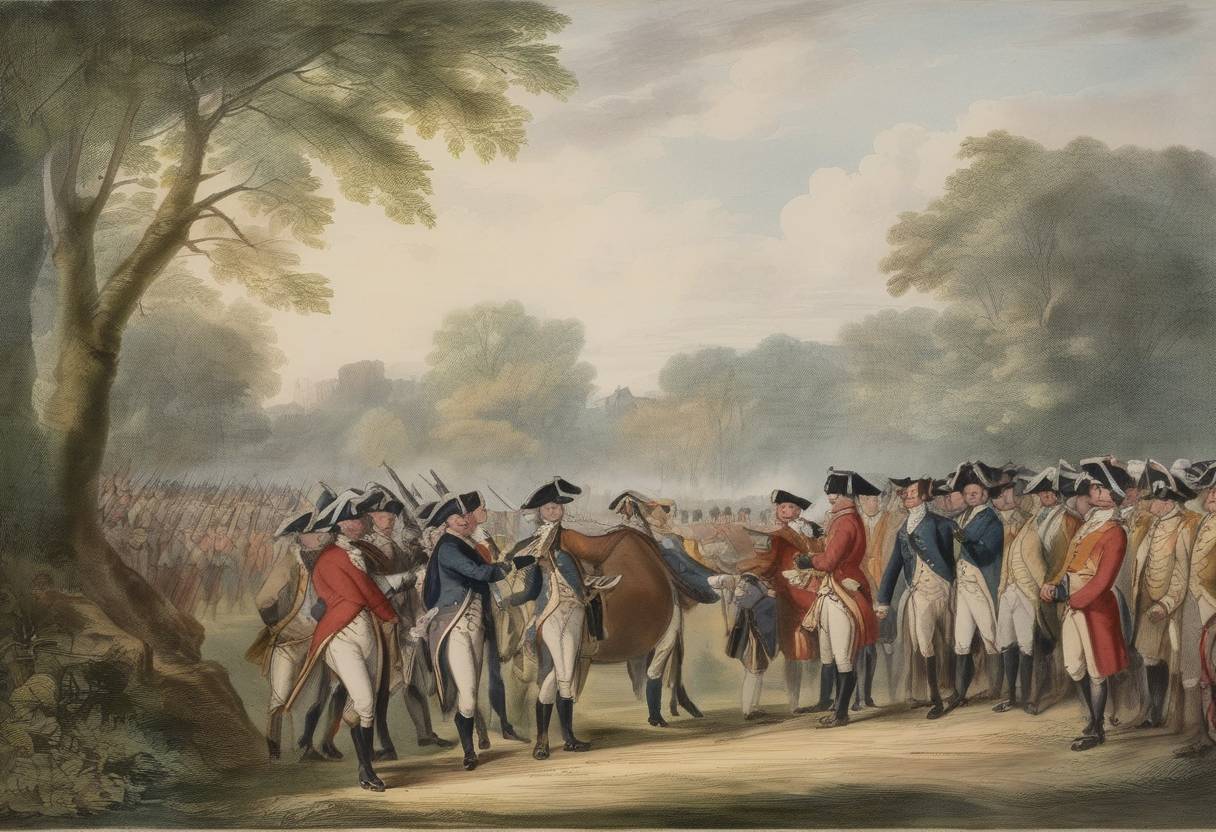
On April 15, 1783, the Congress of the Confederation ratified the Preliminary Articles of Peace, marking a significant step towards the official end of the American Revolutionary War. This vote represented a commitment by the United States to the terms agreed upon in Paris, setting the stage for the final Treaty of Paris that would formally conclude the conflict.
The American Revolutionary War (1775–1783) was fought between Great Britain and thirteen of its North American colonies, which declared independence as the United States of America. After several years of warfare and a turning point with the American victory at Yorktown in 1781, the impetus for peace gained strength.
Negotiations for peace began in 1782 in Paris, involving American negotiators such as John Adams, Benjamin Franklin, John Jay, and Henry Laurens, and British representatives under the administration of Prime Minister Lord Shelburne.
The Preliminary Articles of Peace, agreed upon in November 1782, set forth several crucial provisions:
The ratification by Congress was a formal acceptance of these preliminary agreements, demonstrating the colonies’ unanimous commitment to peace. This action underscored the shift from wartime footing to a focus on creating a stable, independent nation.
Following the ratification, preparations were made for the definitive Treaty of Paris, which was signed on September 3, 1783, and formally ended the war. With the treaty’s implementation, the United States secured international recognition of its sovereignty and boundaries, paving the way for westward expansion and the political and economic development of the young nation.
The ratification of the Preliminary Articles signified a pivotal moment in American history, transitioning from a period of conflict and struggle for independence to one of peace and nation-building.
Source: en.wikipedia.org