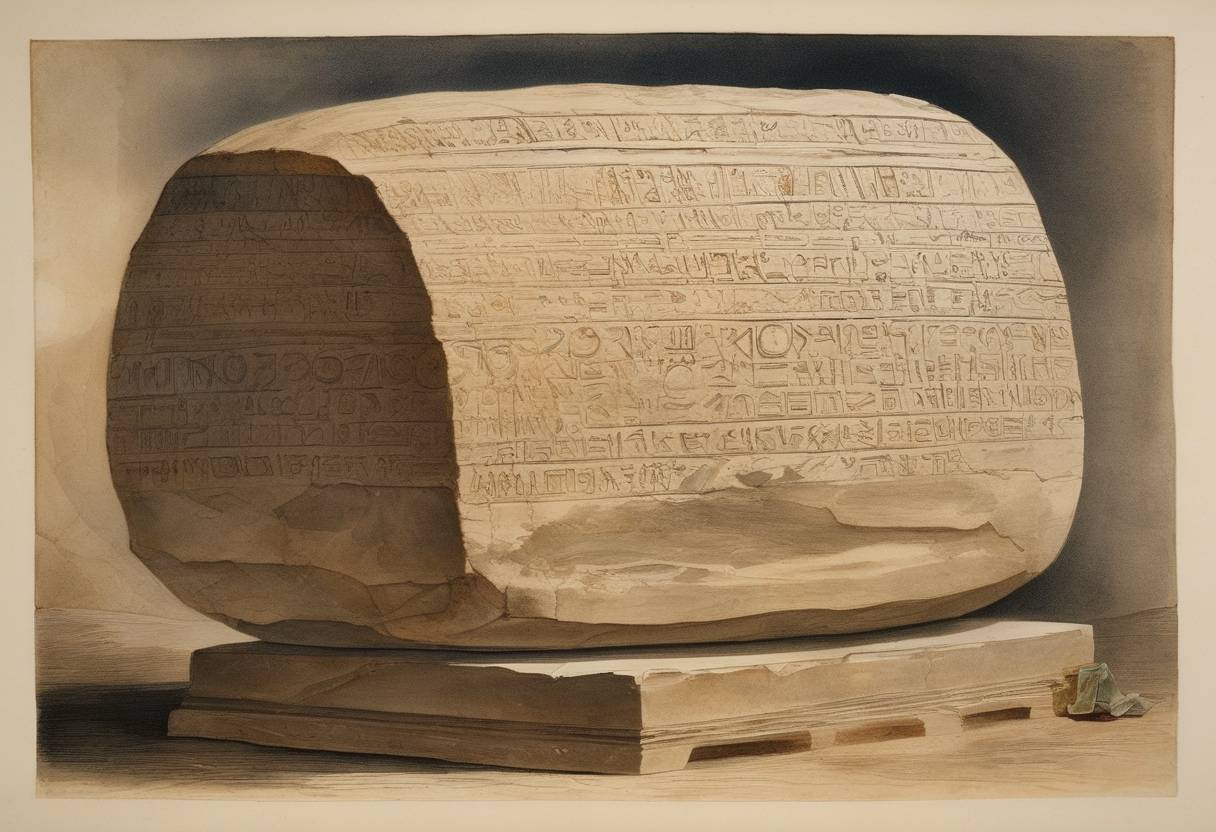
Champollion’s Decipherment of the Rosetta Stone: October 28, 1822
On October 28, 1822, Jean-François Champollion, a French scholar and linguist, presented his groundbreaking findings on the Rosetta Stone to the Académie des Inscriptions et Belles-Lettres in Paris. This marked a pivotal moment in the history of Egyptology as Champollion announced his decipherment of ancient Egyptian hieroglyphs.
Background
- The Rosetta Stone, discovered in 1799 near the town of Rashid (Rosetta) by French soldiers during Napoleon’s campaign in Egypt, played a crucial role in this breakthrough.
- The stone is inscribed with the same text in three scripts: Greek, Demotic, and hieroglyphic. The Greek text was understood and provided a basis for translation efforts.
Key Events Leading to the Decipherment
- Champollion, who began his study of languages at an early age, had an extensive background in Coptic, believed to be the linguistic descendant of ancient Egyptian. This knowledge proved instrumental in his studies.
- Prior to Champollion, other scholars such as Thomas Young had made significant progress, particularly in identifying the cartouches (encircled hieroglyphs) as royal names.
- Champollion distinguished himself by correctly identifying that hieroglyphs could function as a phonetic script, not just symbolic or ideographic.
The Announcement
- On October 28, 1822, Champollion delivered his letter titled “Lettre à M. Dacier”, detailing how he unlocked the phonetic components of hieroglyphs.
- Champollion demonstrated that hieroglyphs were a complex writing system featuring both phonetic and ideographic elements.
- His presentation provided the first comprehensive understanding, allowing for the translation of vast amounts of Egyptian inscriptions for the first time in millennia.
Aftermath and Impact
- Champollion’s success opened the field of Egyptology, leading to greater historical and cultural understanding of ancient Egypt.
- His work enabled subsequent scholars to translate a multitude of inscriptions and documents, fundamentally altering the study of ancient Egyptian civilization.
- The ability to read hieroglyphs allowed historians to reconstruct Egyptian history, religion, and administrative functions with unprecedented accuracy.
Legacy
- Champollion is hailed as the “Father of Egyptology” due to his pivotal role in the creation of the field.
- The methods and principles he established remain foundational in the study of ancient scripts and decipherment.
- Commemorations of his work can still be seen in modern Egyptology, illustrating the lasting impact of his achievements.
Champollion’s decipherment of the Rosetta Stone remains one of the most remarkable scholarly achievements of the 19th century, revolutionizing the understanding of ancient Egyptian civilization.