Battle of Talana Hill: October 13, 1899
1899 · Dundee, South Africa
In South Africa, the Battle of Talana Hill marked one of the opening battles of the Second Boer War.
January 4, 1781
The British defeat the Americans in the Battle of Jersey during the American Revolutionary War.
St. Helier, United Kingdom | British Army
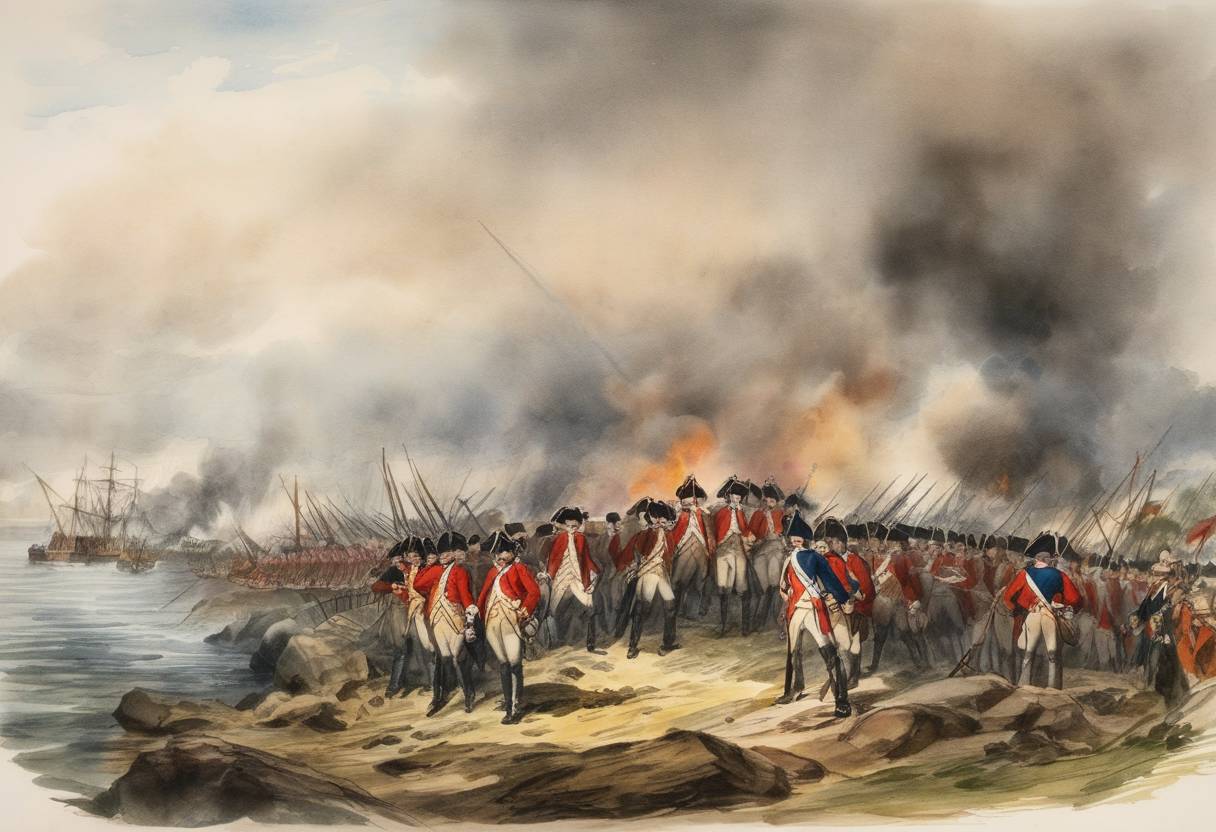
On January 4, 1781, during the broader context of the American Revolutionary War, the Battle of Jersey took place, not on mainland America, but on the island of Jersey in the English Channel. This engagement was a part of the ongoing conflict between Britain and France, the latter having entered the war as an ally of the American revolutionaries.
The American Revolutionary War, ignited in 1775, had by this time transformed into a global conflict, involving several European powers. France, having joined the war effort against Britain in 1778, aimed to weaken British influence and assist the American colonies in achieving independence. The island of Jersey, under British rule, was strategically important due to its location near the French coast.
In late 1780, the French sought to capture Jersey in order to disrupt British naval power and possibly use the island as a base for further operations. Commanded by Baron Philippe de Rullecourt, a force of approximately 1,200 French soldiers embarked on a surprise nighttime crossing, landing on the southeastern coast of Jersey near the town of St. Helier.
Upon their landing early on January 4, the French troops quickly advanced into St. Helier. Rullecourt managed to capture the Governor of Jersey, Major Peirson, and sought to compel a rapid surrender. However, Peirson, refusing capitulation, organized resistance with the local militia and a small contingent of British regulars stationed on the island.
The ensuing battle unfolded in the streets of St. Helier. Peirson swiftly organized a counterattack that engaged the French forces. The local militia played a vital role, and the British troops mounted a fierce defense, battling through the town’s narrow lanes.
The battle, though brief, was intense and resulted in a decisive British victory. During the fighting, both Rullecourt and Peirson were killed. Peirson’s leadership, even until his death, was later celebrated in popular British accounts of the battle.
The failure of the French forces to secure Jersey demonstrated both the resilience of British defenses and the challenges faced by the French in their efforts against Britain away from the continental theater. While not directly influencing the American Revolutionary War’s outcome, the defense of Jersey was a symbolic victory for the British, helping to maintain their morale and control over important territories.
Overall, the Battle of Jersey is a reminder of the wide-reaching impact of the American Revolutionary War, illustrating how it intersected with broader European conflicts of the era.
Source: en.wikipedia.org