Coronation of Philip V of France
1322 · Reims, France
Philip V of France, also known as Philip the Tall, was crowned King of France at Reims Cathedral.
May 1, 1308
The coronation of King Philip V as the king of Navarre takes place. Philip was the first husband of Queen Joan II of Navarre and became king after her father, Louis X of France, passed away.
Pamplona, Navarre | Kingdom of Navarre
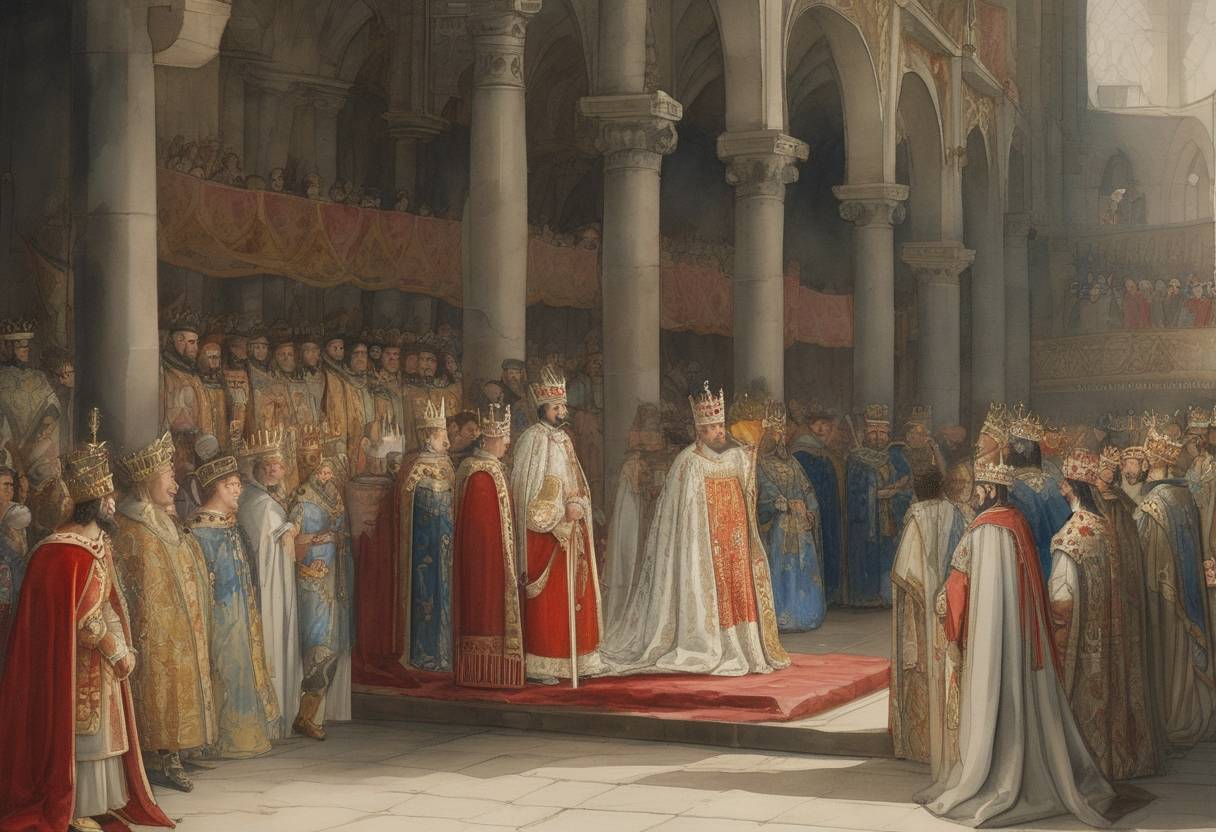
On May 1, 1308, Philip V was not actually coronated as the King of Navarre. The misunderstanding might stem from a mix-up of timelines, as Philip V, also known as Philip the Tall, was not crowned on this date. It was Philip V of France who became King of France and Navarre later on, due to his marriage to Joan II of Navarre. Philip the Tall was married to Joan II of Navarre in 1307, setting the stage for the complex sequence of dynastic events leading to his eventual rule.
Philip V was born into a period dominated by the Capetian dynasty, which controlled both France and Navarre through strategic marriages and political maneuvers. He was the second son of Philip IV of France and Joan I of Navarre. His eventual rise to power followed the death of his elder brother, Louis X, and amidst questions of legitimacy and succession.
Marriage to Joan II of Navarre (1307): Philip’s marriage to Joan II initially tied him closely to the fortunes of the Navarre kingdom. This bond was strengthened through Joan’s lineage as the daughter of Louis X, further entrenching Philip’s claims to the throne.
Ascension as King of France and Navarre (1316): Philip became the regent for his nephew, John I of France, and then claimed the titles for himself in 1316 following John I’s short-lived reign. His coronation took place on January 9, 1317.
Rule Over Navarre: He assumed control over the territories associated with the Kings of Navarre as part of his broader dominion of France, despite no distinct separate coronation taking place for Navarre itself in 1308.
Philip V’s ascent marked a period where the kingdoms of France and Navarre were intertwined, affecting Navarre’s relative autonomy. The integration under a single monarch tied the smaller kingdom’s fate closely with the immensely powerful French apparatus, dovetailing with broader medieval European dynastic politics.
Philip’s reign was characterized by efforts to stabilize the kingdom and enact reforms. However, his death in 1322 without a male heir led to the reign of his younger brother, Charles IV, continuing the intricate Capetian legacy. The eventual separation of the crowns of France and Navarre occurred after Charles IV’s death, with Navarre’s throne reverting to Joan II in 1328, re-establishing Navarre’s distinct royal line.
In summary, while no coronation of Philip V as King of Navarre happened on May 1, 1308, his marriage to Joan II and subsequent political maneuvers left an indelible impact on the history of Navarre and France.
Source: www.britannica.com