The First Launch of Space Shuttle Columbia: April 12, 1981
1981 · Cape Canaveral, United States
The first launch of a Space Shuttle, Columbia, occurred, marking the beginning of the Space Shuttle program by NASA.
February 18, 1977
NASA's first Space Shuttle, Enterprise, made its first test flight on top of a Boeing 747 Shuttle Carrier Aircraft. This marked a key step in shuttle testing leading towards human spaceflight.
Edwards Air Force Base, United States | NASA
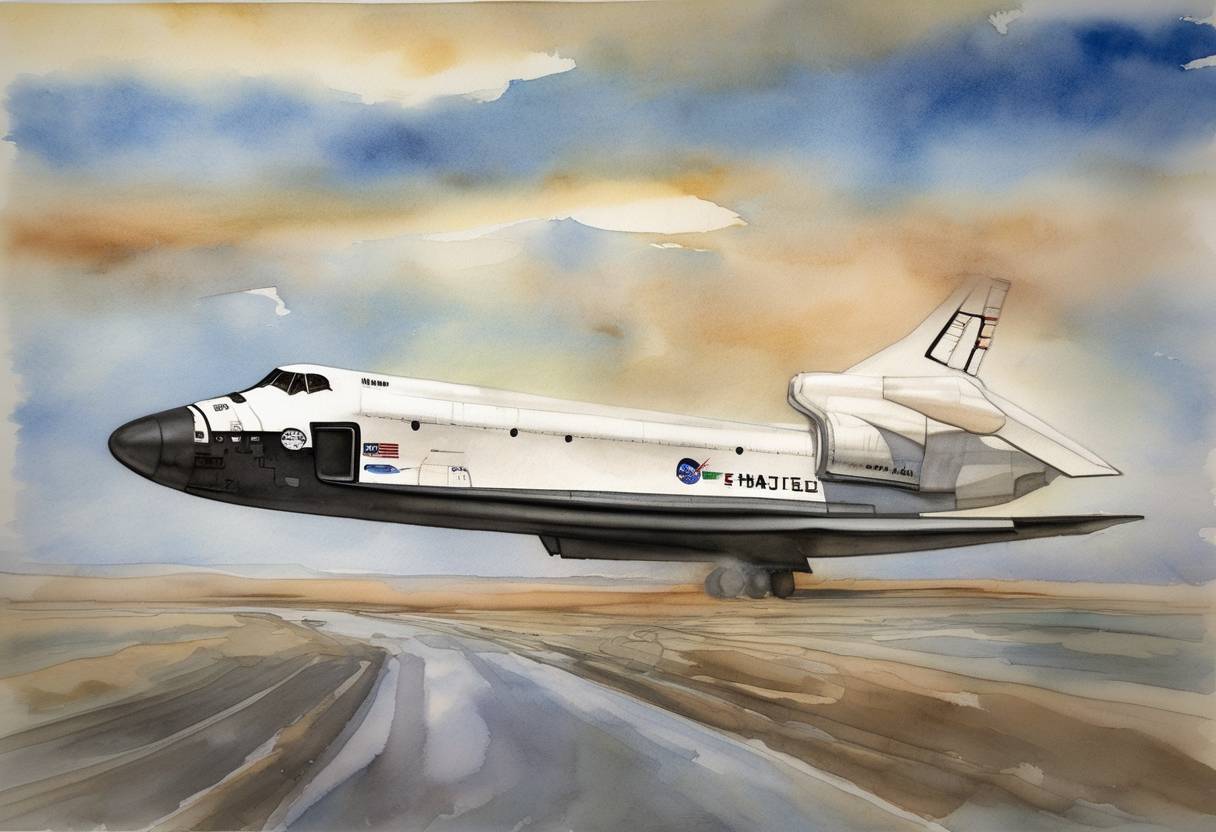
On February 18, 1977, NASA marked a significant milestone in the development of its Space Shuttle program with the first test flight of the Space Shuttle Enterprise. This event was crucial in testing the capabilities and handling of the shuttle when attached to its Shuttle Carrier Aircraft (SCA), a Boeing 747 specifically modified to carry the shuttle.
The Space Shuttle Enterprise, named after the famed starship from the television series Star Trek, was constructed not for spaceflight but as a crucial part of the testing and validation process for shuttle design. The program aimed to develop a reusable spaceship to reduce costs and improve accessibility to space.
The test conducted on this day was part of the Approach and Landing Tests (ALT), which sought to prove the aerodynamics of the shuttle during the glide and landing phases of flight. During this initial “captive-inactive” flight, Enterprise remained mated to the SCA, allowing engineers to assess wind flow and stress factors without detaching the shuttle. This was the first in a series of tests designed to ensure the shuttle’s safety and operability.
The test flight was pivotal as it provided critical data on both vehicle performance and aerodynamics, directly influencing future modifications and improvements to the orbiter design. It also paved the way for subsequent phases of test flights, which would include full free-flight tests where the shuttle would separate from the aircraft and glide to a landing on its own.
While Enterprise itself never went to space, the successful outcome of its testing period contributed significantly to the development of later shuttle orbiters like Columbia, Challenger, Discovery, and others, eventually culminating in the first spaceflight of the shuttle Columbia in April 1981. This program was instrumental in shaping human spaceflight, enabling numerous scientific missions and the construction of the International Space Station.
Source: www.nasa.gov