The Signing of the Tripartite Pact: September 27, 1940
1940 · Berlin, Germany
The Tripartite Pact is signed in Berlin by Germany, Italy, and Japan, establishing the Axis Powers during World War II.
May 22, 1939
Germany and Italy sign the Pact of Steel, formally known as the Pact of Friendship and Alliance between Germany and Italy, solidifying their military and political alliance.
Berlin, Germany | Nazi Germany, Kingdom of Italy
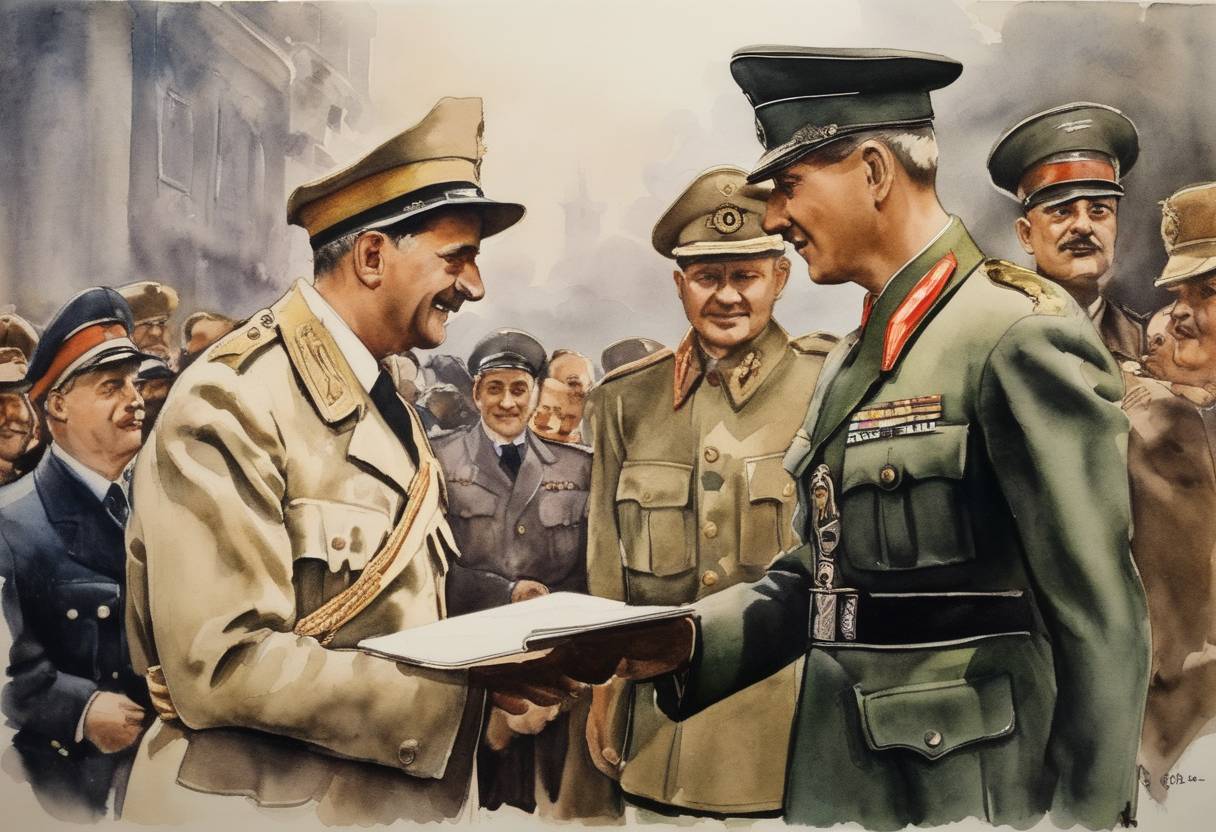
On May 22, 1939, a significant event in the prelude to World War II took place with the signing of the Pact of Steel, formally known as the Pact of Friendship and Alliance between Germany and Italy. This agreement marked a crucial consolidation of the alliance between the two Axis powers.
Throughout the 1930s, Europe witnessed increasing militarization and aggressive expansion by several nations. Germany, under Adolf Hitler’s leadership, pursued policies of rearmament and territorial expansion in contravention of the Treaty of Versailles. Meanwhile, Benito Mussolini in Italy sought to establish a new Roman Empire, evidenced by invasions such as the takeover of Ethiopia in 1935.
Both nations found common ground in their totalitarian regimes’ philosophies and political objectives. Mussolini, initially wary of Hitler’s ambitions, became more aligned with German policies following Italy’s global isolation after Ethiopian conquests and the subsequent sanctions imposed by the League of Nations.
The Pact of Steel was a direct result of consultations spearheaded by Italian Foreign Minister Galeazzo Ciano and his German counterpart, Joachim von Ribbentrop. The treaty was signed in Berlin and consisted of two main sections:
Political and Military Alliance: It bound both nations in a military and political alliance, committing them to support each other in case of a conflict that required military intervention. This included consultations on military strategies and the fostering of stronger ties in political, economic, and military cooperation.
Ideological Unity: The preamble of the Pact emphasized the deep-seated mutual recognition of shared ideologies and the countries’ combined vision of a new order in Europe.
The signing of the Pact of Steel was a clear signal of the Axis powers’ intentions, solidifying their cooperative stance ahead of the widespread conflict that would engulf the world with the onset of World War II. It assured Germany of Italian support, albeit complicated by Italy’s lack of readiness for warfare when the conflict broke out later in 1939.
In practice, the alliance proved to be asymmetrical. Italy was not fully prepared for long-term warfare, leading to strained and occasionally contentious relations between the two nations during the subsequent global conflict. The Pact of Steel, while ensuring military cooperation, also exposed differences in strategic priorities. Historically, the Pact illustrated the volatile nature of mid-20th-century European politics and underscored the rise of totalitarian regimes focused on militaristic expansion.
Thus, the Pact of Steel was not merely a military agreement; it was emblematic of the broader geopolitical realignments that defined the late 1930s and paved the way for World War II.
Source: www.britannica.com