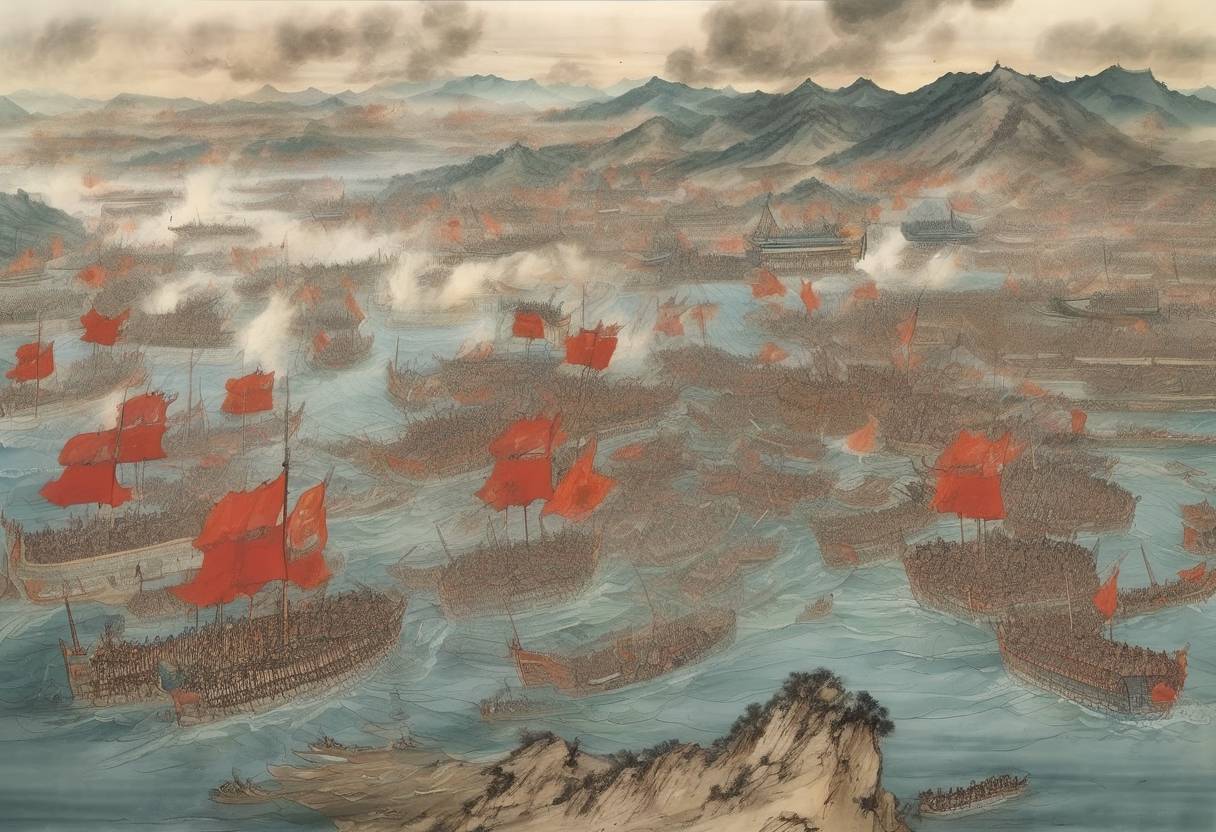
The Battle of Lake Poyang: August 30, 1363
The Battle of Lake Poyang, which commenced on August 30, 1363, stands as one of the largest and most significant naval battles in history. This pivotal conflict was fought between the forces of the emerging Ming dynasty, led by Zhu Yuanzhang, and the Han forces commanded by Chen Youliang. The battle played a crucial role in the eventual establishment of the Ming dynasty in China.
Historical Context
- The Yuan Dynasty’s Decline: By the mid-14th century, the Yuan dynasty, established by the Mongols, was in decline. This period of instability led to widespread rebellion across China.
- Emergence of Rebel Factions: Among the various rebel factions, two prominent groups emerged: the Red Turbans, which included Zhu Yuanzhang, and the Han forces under Chen Youliang.
- Strategic Importance of Lake Poyang: Lake Poyang, located in Jiangxi Province, was strategically significant due to its size and location, serving as a vital waterway for controlling the surrounding regions.
The Battle
- Initial Engagement: The battle began on August 30, 1363, when Chen Youliang’s forces, numbering approximately 650,000 men and 1,000 ships, laid siege to the city of Nanchang, held by Zhu Yuanzhang’s forces.
- Ming’s Naval Strategy: Zhu Yuanzhang, commanding a smaller fleet of about 200,000 men and 200 ships, employed innovative tactics, including the use of fire ships to disrupt and damage the larger Han fleet.
- Tactical Maneuvers: Over several weeks, the battle saw intense naval engagements, with both sides employing various strategies to gain the upper hand. Zhu’s forces capitalized on their superior maneuverability and knowledge of the local geography.
Outcome and Aftermath
- Decisive Victory for the Ming: The battle concluded with a decisive victory for Zhu Yuanzhang’s forces. Chen Youliang was killed during the battle, leading to the collapse of the Han faction.
- Consolidation of Power: This victory significantly bolstered Zhu Yuanzhang’s position, allowing him to consolidate power and eventually proclaim himself the first emperor of the Ming dynasty in 1368.
- Long-term Impact: The establishment of the Ming dynasty marked the end of Mongol rule in China and initiated a period of economic and cultural resurgence.
Historical Significance
The Battle of Lake Poyang is not only notable for its scale but also for its impact on the course of Chinese history. It exemplifies the strategic and tactical innovations that characterized the period and underscores the importance of naval power in medieval Chinese warfare. The victory at Lake Poyang was instrumental in the rise of the Ming dynasty, which would go on to rule China for nearly three centuries.