Volodymyr Zelensky's Landslide Victory in the 2019 Ukrainian Presidential Election
2019 · Kyiv, Ukraine
Volodymyr Zelensky, a former comedian with no prior political experience, won the Ukrainian presidential election in a landslide victory.
February 21, 2014
Ukrainian President Viktor Yanukovych and opposition leaders sign a deal to end the crisis in Ukraine, which includes a return to the 2004 constitution and early elections.
Kyiv, Ukraine | Ukrainian Government
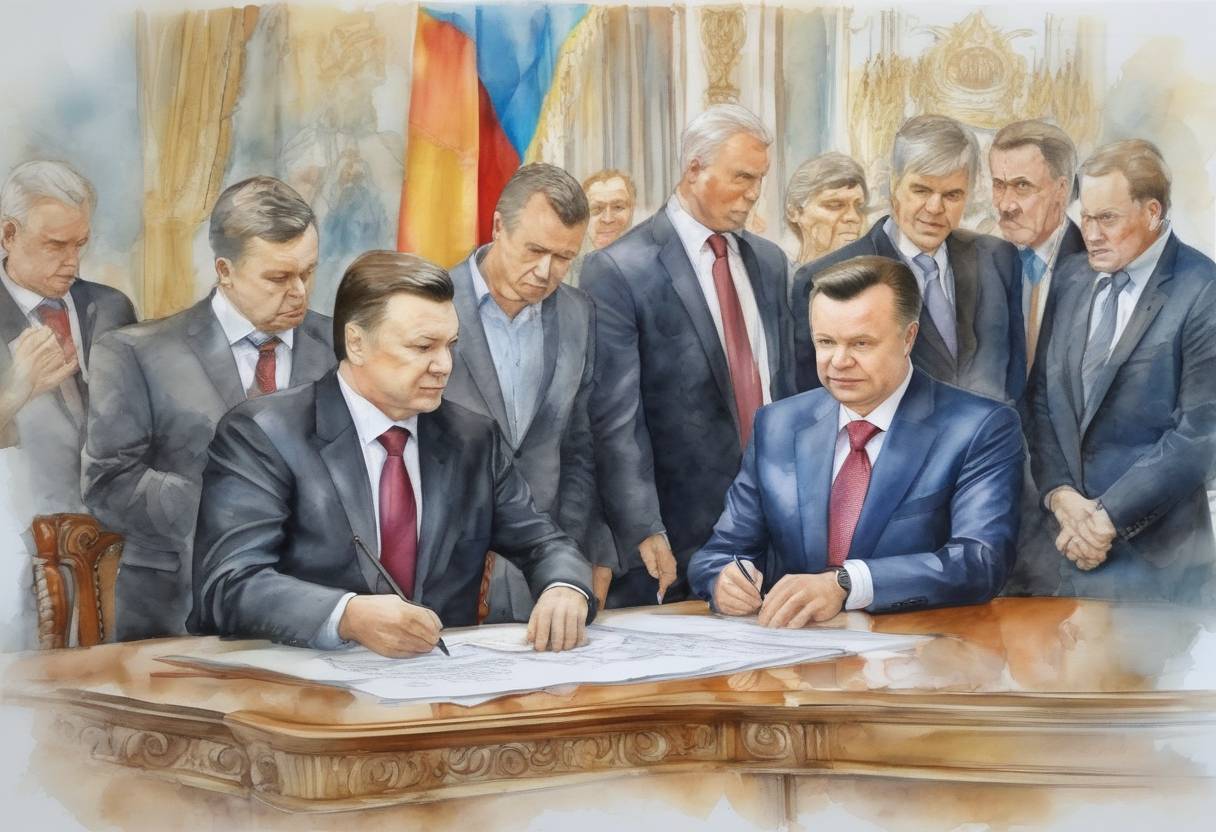
On February 21, 2014, a significant political agreement was reached in Ukraine aimed at resolving the escalating crisis that had gripped the nation. This agreement was signed by Ukrainian President Viktor Yanukovych and leaders of the opposition, under the mediation of European Union representatives. The deal was a critical attempt to address the widespread unrest and violence that had erupted in Ukraine, particularly in the capital, Kyiv.
The crisis in Ukraine began in November 2013 when President Yanukovych suspended preparations for the implementation of an association agreement with the European Union, opting instead to strengthen ties with Russia. This decision sparked massive protests, known as the Euromaidan movement, as many Ukrainians favored closer integration with Europe. The protests grew in size and intensity, leading to violent clashes between demonstrators and security forces.
The agreement signed on February 21, 2014, included several crucial elements aimed at de-escalating the situation:
Return to the 2004 Constitution: The deal stipulated a return to the 2004 Ukrainian Constitution, which would limit presidential powers and strengthen the role of parliament. This move was intended to address concerns about Yanukovych’s consolidation of power.
Formation of a National Unity Government: The agreement called for the establishment of a national unity government, which would include representatives from both the ruling party and the opposition.
Early Presidential Elections: It was agreed that early presidential elections would be held by December 2014, providing a democratic avenue for resolving the leadership crisis.
Investigation into Violence: The deal included a commitment to investigate the violence that had occurred during the protests, ensuring accountability for the deaths and injuries sustained.
Amnesty for Protesters: An amnesty was promised for protesters involved in the demonstrations, except those accused of serious crimes.
Despite the agreement, the situation in Ukraine remained volatile. The deal failed to satisfy many protesters, and tensions continued to simmer. Just a day after the agreement, President Yanukovych fled Kyiv, and the Ukrainian parliament voted to remove him from office. This led to the establishment of an interim government and further political changes.
The crisis in Ukraine also had significant international ramifications. It heightened tensions between Western countries and Russia, eventually leading to Russia’s annexation of Crimea in March 2014 and the ongoing conflict in Eastern Ukraine.
The February 21 agreement was a pivotal moment in Ukraine’s modern history, marking both an attempt at peaceful resolution and a prelude to further geopolitical upheaval.
Source: www.bbc.com