Charlemagne's Arrival in Rome on December 1, 800
800 · Rome, Papal States
Charlemagne, King of the Franks, arrives in Rome at the request of Pope Leo III to restore order and prepare for his coronation as Emperor of the Romans.
October 9, 0768
Charlemagne and his brother Carloman I are crowned Kings of the Franks following the death of their father, Pepin the Short.
Noyon, France | Frankish Kingdom
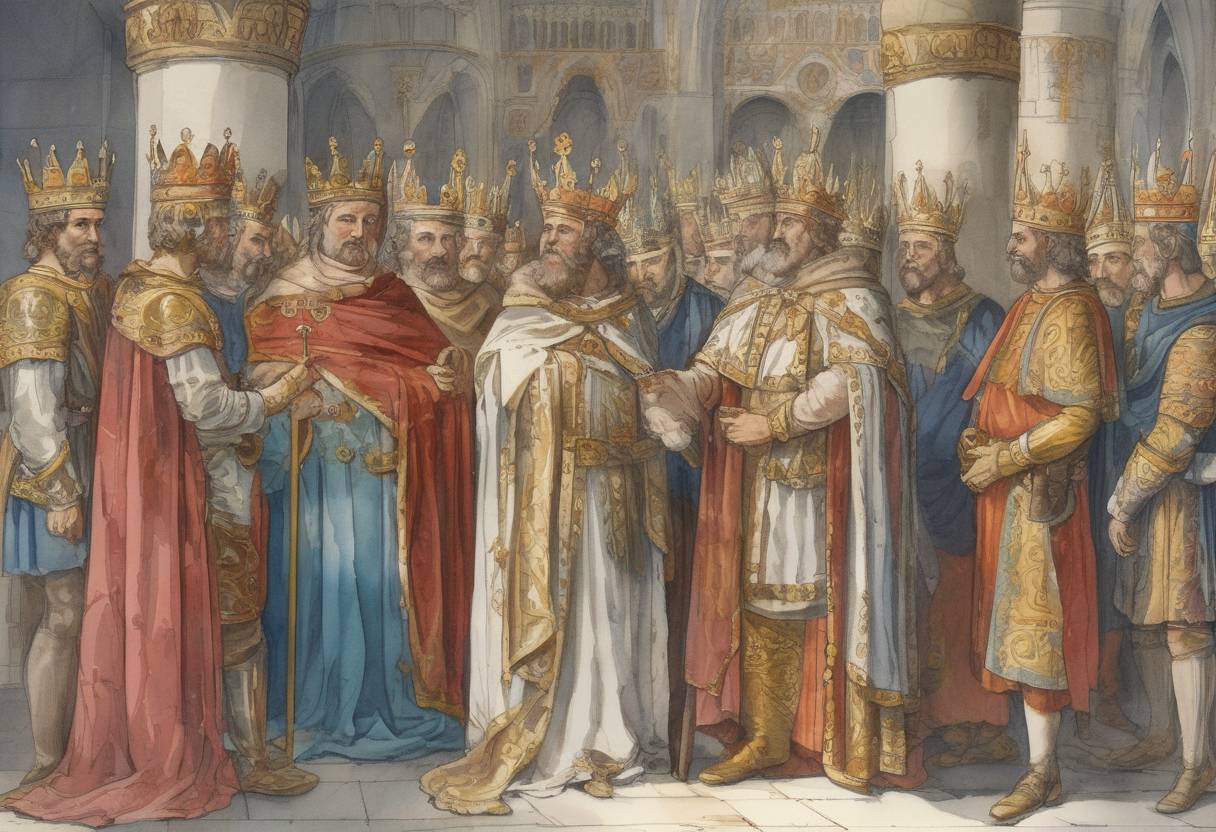
On October 9, 768, Charlemagne and his brother Carloman I were crowned as Kings of the Franks following the death of their father, Pepin the Short. This event marked a significant moment in the history of the Frankish Kingdom and laid the groundwork for the Carolingian Empire.
Pepin the Short: Pepin the Short, the father of Charlemagne and Carloman I, was the first Carolingian king of the Franks. He ascended to the throne in 751, after deposing the last Merovingian king, Childeric III, with the support of the Pope. Pepin’s reign was marked by his efforts to strengthen the Frankish state and his close alliance with the Papacy.
Division of the Kingdom: Before his death, Pepin the Short divided the Frankish kingdom between his two sons, Charlemagne and Carloman I, in accordance with Frankish custom. This division was intended to ensure a smooth succession and prevent disputes over the throne.
Date and Location: The coronation took place on October 9, 768. The exact location is not definitively recorded, but it is believed to have occurred in the Frankish heartland, possibly in the city of Noyon or Soissons.
Division of Territories: Charlemagne received the western part of the kingdom, which included Neustria and parts of Aquitaine, while Carloman I was given the eastern territories, including Austrasia and parts of Burgundy. This division reflected the traditional Frankish practice of partitioning the realm among heirs.
Dual Kingship: The dual kingship of Charlemagne and Carloman I was a continuation of the Frankish tradition of dividing power among heirs. However, it also set the stage for potential conflict, as the brothers had differing personalities and political ambitions.
Charlemagne’s Rise: Although initially sharing power with his brother, Charlemagne would eventually become the sole ruler after Carloman’s death in 771. This paved the way for Charlemagne’s expansion of the Frankish Empire and his eventual coronation as Emperor of the Romans in 800.
Carloman’s Death: Carloman I died unexpectedly in 771, just three years after their joint coronation. His death allowed Charlemagne to consolidate power and become the sole ruler of the Frankish kingdom.
Expansion and Legacy: Charlemagne’s reign marked a period of significant expansion and consolidation of the Frankish territories. His efforts in unifying much of Western Europe under his rule and his support for the Carolingian Renaissance had a lasting impact on European history.
In summary, the coronation of Charlemagne and Carloman I as Kings of the Franks was a pivotal event that not only shaped the future of the Frankish kingdom but also set the stage for the rise of one of history’s most influential rulers, Charlemagne.
Source: en.wikipedia.org