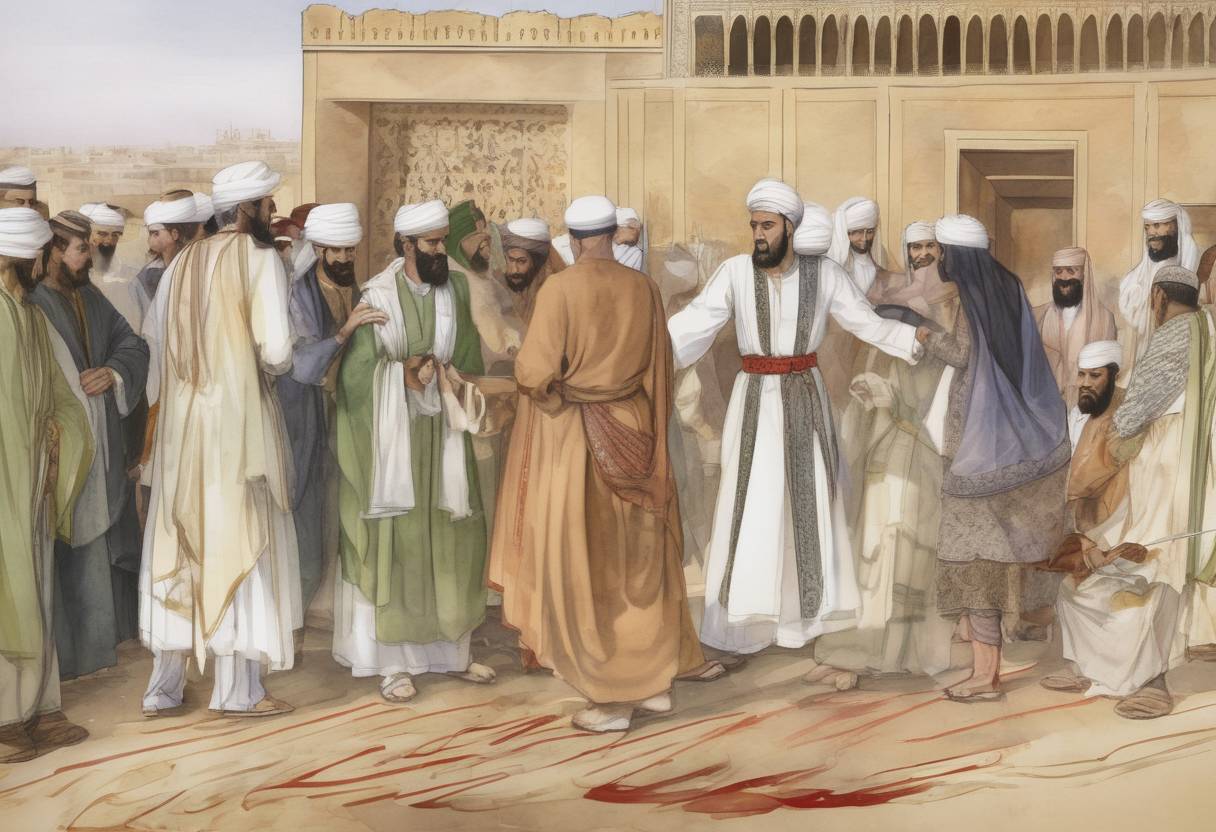
The Assassination of Umar ibn al-Khattab and the Succession of Uthman ibn Affan
On November 3, 644, Umar ibn al-Khattab, the second caliph of the Rashidun Caliphate, succumbed to wounds inflicted by a Persian slave named Abu Lu’lu’a Firuz. This event marked a significant transition in the early Islamic state, leading to the appointment of Uthman ibn Affan as the third caliph.
Background
Umar ibn al-Khattab, one of the closest companions of the Prophet Muhammad, became the caliph in 634 following the death of Abu Bakr, the first caliph. Umar’s decade-long rule was characterized by significant territorial expansion and administrative reforms. Under his leadership, the Islamic empire expanded rapidly, encompassing regions such as the Levant, Egypt, and parts of the Persian Empire.
The Assassination
The assassination occurred during the Fajr (dawn) prayer in the mosque of Medina. Abu Lu’lu’a Firuz, a Persian slave who harbored grievances against Umar, attacked him with a dagger. Umar was critically wounded and succumbed to his injuries three days later. The motives behind the assassination are debated, with some attributing it to personal grievances and others to broader political tensions.
Succession and Uthman ibn Affan
Before his death, Umar established a council of six companions to choose his successor, ensuring a smooth transition of power. This council included prominent figures such as Uthman ibn Affan, Ali ibn Abi Talib, and others. After deliberations, Uthman ibn Affan was selected as the third caliph.
Uthman’s caliphate, which lasted from 644 to 656, was marked by further expansion of the Islamic empire and the compilation of the Quran into a single, standardized text. However, his rule also faced internal dissent and challenges, culminating in his assassination in 656.
Historical Significance
The assassination of Umar ibn al-Khattab was a pivotal moment in Islamic history. It highlighted the vulnerabilities of the nascent Islamic state and set the stage for future political and sectarian conflicts. Umar’s leadership had established a strong administrative framework and expanded the empire’s reach, but his death underscored the challenges of maintaining unity and stability in a rapidly growing empire.
The succession of Uthman ibn Affan continued the expansion and consolidation of the Islamic state, but it also sowed the seeds of discord that would later lead to significant internal strife, including the First Fitna (Islamic civil war).
In summary, the events of November 3, 644, were crucial in shaping the early Islamic caliphate’s trajectory, influencing both its immediate political landscape and its long-term historical development.