Discovery of Titania and Oberon
1787 · Slough, England
William Herschel discovered Titania and Oberon, two moons of Uranus.
October 24, 1851
William Lassell discovered Ariel and Umbriel, two moons of Uranus.
Liverpool, United Kingdom | Astronomical Society of Liverpool
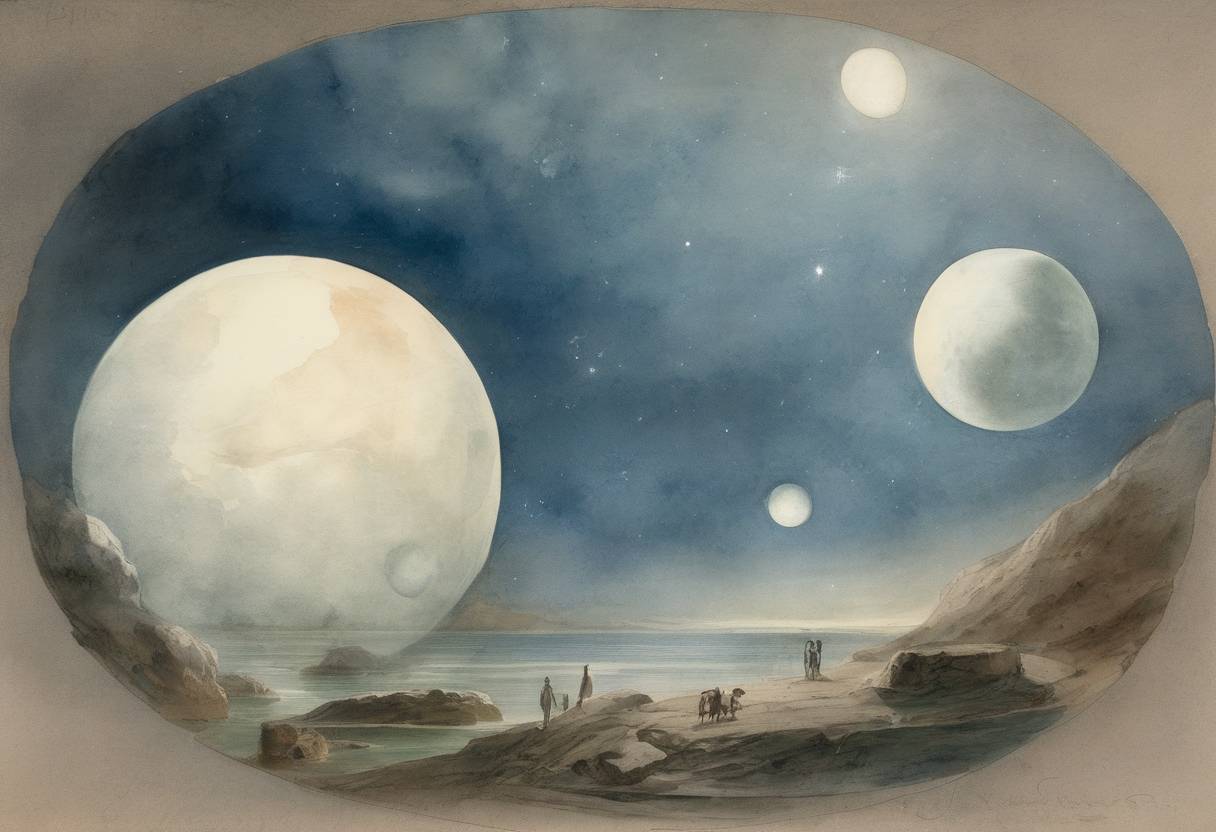
On October 24, 1851, the English astronomer William Lassell made a significant contribution to the field of astronomy by discovering two new moons of Uranus, named Ariel and Umbriel. These discoveries expanded our understanding of the Uranian system and highlighted the advancements in astronomical observation techniques during the 19th century.
William Lassell was an accomplished astronomer known for his work with telescopes. He constructed his own observatory in Liverpool, England, and was renowned for his use of a 24-inch reflector telescope, which was one of the largest and most advanced telescopes of the time. Lassell’s dedication to improving observational instruments played a crucial role in his ability to discover celestial bodies.
Lassell’s discovery of Ariel and Umbriel came after the earlier identification of Uranus’s first two moons, Titania and Oberon, by William Herschel in 1787. Using his powerful telescope, Lassell was able to detect these additional moons, which were not visible with the less advanced telescopes available in Herschel’s time.
Ariel: Named after a character in Alexander Pope’s poem “The Rape of the Lock” and Shakespeare’s “The Tempest,” Ariel is the fourth-largest moon of Uranus. It is known for its bright surface and complex geological features, including canyons and ridges.
Umbriel: Named after a character in Pope’s “The Rape of the Lock,” Umbriel is the third-largest moon of Uranus. It is characterized by its dark surface, which is less reflective than Ariel’s, and is believed to be composed mainly of water ice and rock.
The discovery of Ariel and Umbriel was significant for several reasons:
Advancement in Astronomy: Lassell’s work demonstrated the capabilities of improved telescopic technology and observational techniques, paving the way for future discoveries in the solar system.
Understanding Uranus: The identification of additional moons provided greater insight into the Uranian system, helping astronomers study the planet’s gravitational influence and the dynamics of its satellites.
Cultural Impact: The naming of the moons after literary characters reflects the tradition of linking astronomical discoveries with cultural and literary references, enriching the intersection between science and the humanities.
Lassell’s discoveries were widely recognized and celebrated in the scientific community. His work contributed to the broader efforts of 19th-century astronomers to map and understand the solar system. The study of Ariel and Umbriel, along with other Uranian moons, continues to be a subject of interest in planetary science, particularly with the advent of space missions and advanced observational technologies.
In summary, William Lassell’s discovery of Ariel and Umbriel on October 24, 1851, marked a pivotal moment in the exploration of our solar system, showcasing the importance of technological innovation and the enduring curiosity that drives astronomical research.
Source: en.wikipedia.org