The Battle of Marathon: September 12, 490 BCE
490 · Marathon, Greece
The Battle of Marathon took place, where the Athenians and their Plataean allies defeated the first Persian invasion of Greece.
September 29, 0480
The Battle of Salamis took place, where the Greek fleet, under the command of Themistocles, defeated the Persian navy led by Xerxes I. This naval battle was a turning point in the Greco-Persian Wars, significantly weakening Persian naval power and contributing to the eventual Greek victory.
Salamis, Greece | Greek City-States
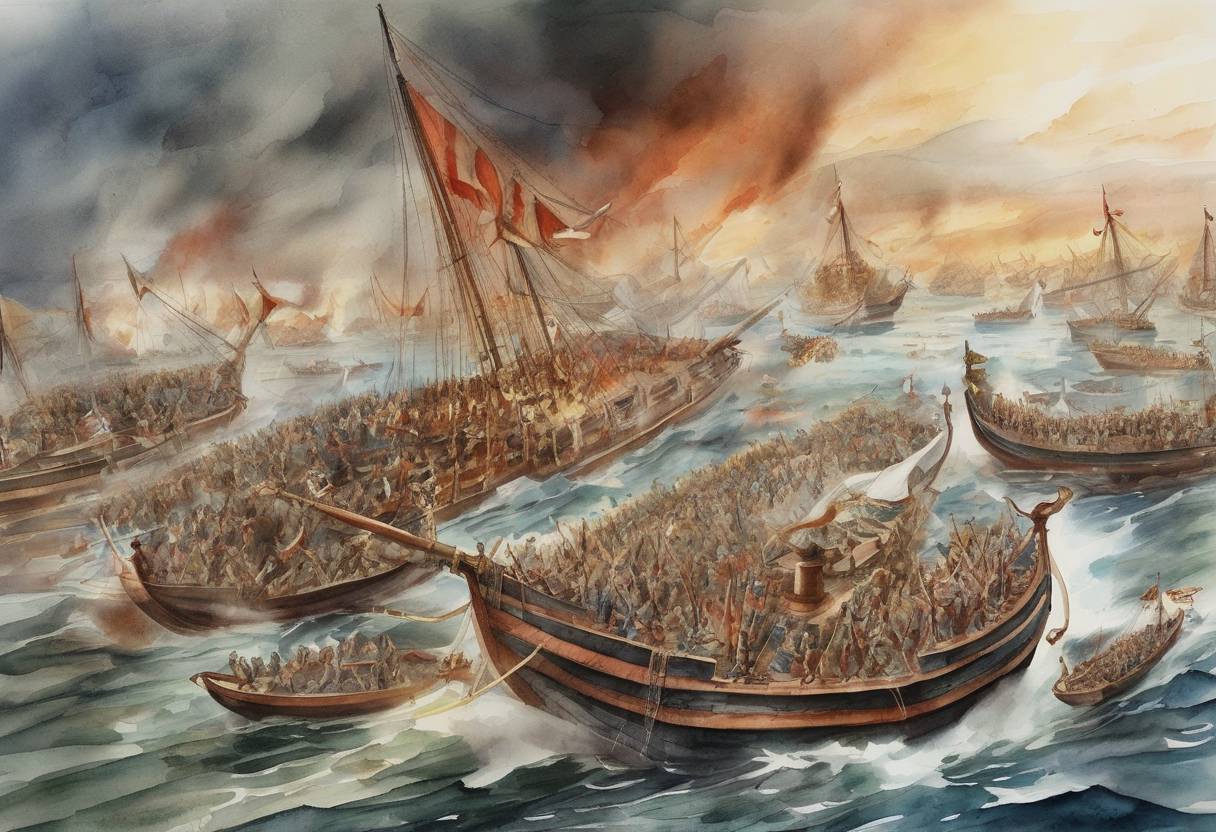
The Battle of Salamis was a pivotal naval engagement during the Greco-Persian Wars, occurring on September 29, 480 BCE. This battle marked a significant turning point in the conflict between the Greek city-states and the Persian Empire, led by King Xerxes I.
The Greco-Persian Wars were a series of conflicts that began in 499 BCE, primarily as a result of Persian expansion into the Greek world. By 480 BCE, Xerxes I had launched a massive invasion of Greece, aiming to subjugate the Greek city-states and expand his empire. After the Persian victory at the Battle of Thermopylae, Xerxes advanced towards Athens, which was evacuated by its inhabitants.
Themistocles, an Athenian politician and general, played a crucial role in the Greek strategy. He advocated for a naval confrontation, believing that the Greek fleet could exploit its superior maneuverability in the narrow straits of Salamis, near Athens.
The Greek fleet, composed of approximately 370 triremes, was significantly outnumbered by the Persian armada, which boasted over 1,200 ships. However, Themistocles’ strategic acumen turned the tide in favor of the Greeks. He lured the Persian fleet into the narrow straits, where their numbers became a disadvantage.
The confined waters prevented the Persians from effectively utilizing their numerical superiority. The Greek triremes, more agile and familiar with the local geography, executed a series of coordinated attacks. The Persian fleet, unable to maneuver, suffered heavy losses.
The Battle of Salamis was a decisive Greek victory. It significantly weakened the Persian navy, curtailing Xerxes’ ability to supply his army and maintain his campaign in Greece. The defeat forced Xerxes to retreat with the bulk of his forces, leaving a smaller contingent to continue the war.
This victory bolstered Greek morale and unity, setting the stage for further successes, such as the Battle of Plataea in 479 BCE, which effectively ended the Persian invasion. The Battle of Salamis is celebrated as a testament to strategic ingenuity and the resilience of the Greek city-states against a formidable empire.
The triumph at Salamis had lasting implications for the Greek world. It preserved the independence of the Greek city-states and allowed for the flourishing of Greek culture and democracy, particularly in Athens. The battle also demonstrated the importance of naval power and strategic planning in warfare, influencing military tactics in subsequent conflicts.
In summary, the Battle of Salamis was not only a critical military victory but also a defining moment in the preservation of Greek civilization and the shaping of Western history.
Source: en.wikipedia.org