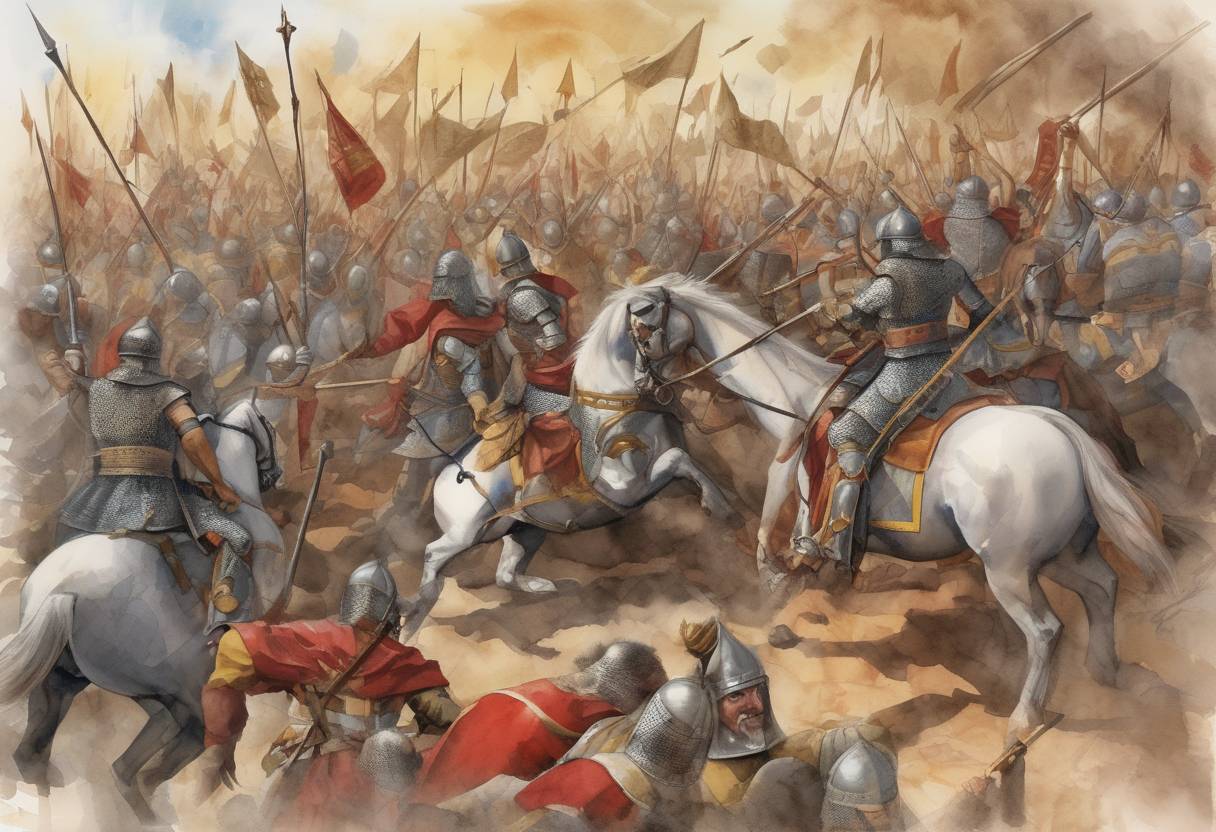
The Battle of Sagrajas: October 23, 1086
The Battle of Sagrajas, also known as the Battle of Zalaca, was a significant military engagement that took place on October 23, 1086. This battle saw the forces of the Almoravid dynasty decisively defeat the army of Alfonso VI of León and Castile, marking a pivotal moment in the history of the Iberian Peninsula during the Reconquista.
Context and Prelude
Alfonso VI of León and Castile: By the late 11th century, Alfonso VI had established himself as a powerful Christian monarch in the Iberian Peninsula. His ambitions included expanding his territories at the expense of the fragmented Muslim taifas (small independent Muslim principalities) that had emerged following the decline of the Umayyad Caliphate of Córdoba.
The Almoravids: Originating from North Africa, the Almoravids were a Berber Muslim dynasty known for their strict adherence to Islamic principles. They were invited to the Iberian Peninsula by the taifa kings, who sought assistance against the encroaching Christian forces led by Alfonso VI.
The Call for Help: The Muslim rulers of Al-Andalus, particularly Al-Mu’tamid, the ruler of Seville, appealed to the Almoravid leader Yusuf ibn Tashfin for military aid. Concerned about the Christian advances, Yusuf crossed into the Iberian Peninsula with a formidable army.
The Battle
Location: The battle took place near Sagrajas, close to Badajoz in present-day Spain. The site was strategically chosen by the Almoravids to confront the advancing forces of Alfonso VI.
Forces and Strategy: The Almoravid army, composed of Berber warriors and Andalusian allies, was well-organized and disciplined. In contrast, Alfonso VI’s forces were a mix of Castilian, Leonese, and other Christian troops, including knights from various parts of Europe.
The Engagement: The battle commenced with the Almoravids employing tactical maneuvers that took advantage of their cavalry and archers. Despite initial successes by the Christian forces, the Almoravids’ superior numbers and strategic acumen led to a decisive victory.
Aftermath and Significance
Impact on Alfonso VI: The defeat at Sagrajas was a severe setback for Alfonso VI, halting his expansionist ambitions and forcing him to retreat. It underscored the vulnerability of the Christian kingdoms to coordinated Muslim resistance.
Almoravid Influence: The victory solidified the Almoravid presence in the Iberian Peninsula, allowing them to exert significant influence over the Muslim taifas. This intervention temporarily stemmed the tide of the Reconquista, delaying Christian advances for several decades.
Long-term Consequences: The battle highlighted the importance of unity among the Muslim states in the face of external threats. It also set the stage for future conflicts between the Almoravids and the Christian kingdoms, shaping the geopolitical landscape of medieval Spain.
In summary, the Battle of Sagrajas was a crucial event in the history of the Iberian Peninsula, demonstrating the complex interplay of power, religion, and politics during the era of the Reconquista.